

17 Steglich and Boden–Keck Variants in the Synthesis
of Macrocyclic Lactones
17.1 Background
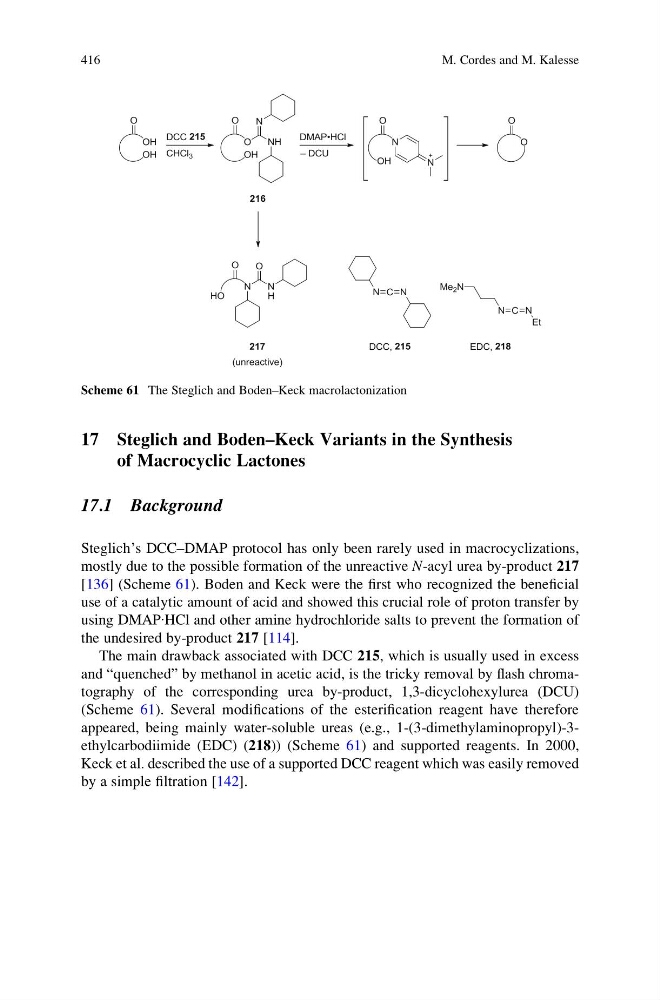
Steglich’s DCC–DMAP protocol has only been rarely used in macrocyclizations,
mostly due to the possible formation of the unreactive N-acyl urea by-product 217
[136] (Scheme 61). Boden and Keck were the first who recognized the beneficial
use of a catalytic amount of acid and showed this crucial role of proton transfer by
using DMAP∙HCl and other amine hydrochloride salts to prevent the formation of
the undesired by-product 217 [114].
The main drawback associated with DCC 215, which is usually used in excess
and “quenched” by methanol in acetic acid, is the tricky removal by flash chromatography of the corresponding urea by-product, 1,3-dicyclohexylurea (DCU)
(Scheme 61). Several modifications of the esterification reagent have therefore
appeared, being mainly water-soluble ureas (e.g., 1-(3-dimethylaminopropyl)-3ethylcarbodiimide (EDC) (218)) (Scheme 61) and supported reagents. In 2000,
Keck et al. described the use of a supported DCC reagent which was easily removed
by a simple filtration [142].
Scheme 61 The Steglich and Boden–Keck macrolactonization
416
M. Cordes and M. Kalesse
of Macrocyclic Lactones
17.1 Background
Steglich’s DCC–DMAP protocol has only been rarely used in macrocyclizations,
mostly due to the possible formation of the unreactive N-acyl urea by-product 217
[136] (Scheme 61). Boden and Keck were the first who recognized the beneficial
use of a catalytic amount of acid and showed this crucial role of proton transfer by
using DMAP∙HCl and other amine hydrochloride salts to prevent the formation of
the undesired by-product 217 [114].
The main drawback associated with DCC 215, which is usually used in excess
and “quenched” by methanol in acetic acid, is the tricky removal by flash chromatography of the corresponding urea by-product, 1,3-dicyclohexylurea (DCU)
(Scheme 61). Several modifications of the esterification reagent have therefore
appeared, being mainly water-soluble ureas (e.g., 1-(3-dimethylaminopropyl)-3ethylcarbodiimide (EDC) (218)) (Scheme 61) and supported reagents. In 2000,
Keck et al. described the use of a supported DCC reagent which was easily removed
by a simple filtration [142].
Scheme 61 The Steglich and Boden–Keck macrolactonization
416
M. Cordes and M. Kalesse