

2.1 Green Methods for Synthesizing Nano-TiO 2
2.1.1 From Trigella Foenum-Graecum
(Fenugreek) Plant Leaves
Green methods of synthesis are favoured for various reasons,
with the chief among them being minimum pollution of the
environment; for example, one of them involves the use of
an extract of leaves (Subhapriya and Gomathipriya 2018) of
a plant, namely Trigella foenum-graecum. Leaves from
Trigella foenum-graecum were washed with deionized
water, ground in a mortar and pestle. The resulting powder
was added to water and stirred to yield an extract. The pH of
the extract was adjusted to 8 with 1 M NaOH followed by
the addition of titanium oxysulphate with stirring to give a
precipitate of n-TiO 2 . The latter require calcination at 700 °
C for 3 h to give the final product. Extracts of sorgum roots
have also been used to synthesize nano-TiO 2 (Dutta and
Fulakar 2017). The phenol like compounds in these extracts
was reported to function via reducing properties to produce
nano-TiO 2 . The nano-TiO 2 particles produced by this
method were utilized to degrade methyl orange dye in
wastewater samples.
2.1.2 From Moringa Leaves
A green technique for the synthesis of nanotitanium dioxide
involves the leaves of Moringa which have been used for
medicinal purposes over a very long period (Sivaranjani and
Philominathan 2016). Moringa oleifera is a low-cost source
of a precursor for the green synthesis of titanium dioxide
nanoparticles which are being used for many interactions
with plants.
2.1.3 From Peels of Fruit
A cheap, environment-friendly and eminently green method,
to prepare titanium dioxide nanoparticles involved the
exploitation of agricultural waste in the form of peels of
fruits, namely plum, kiwi and peach (Naqvi et al. 2021).
These cylindrical nanoparticles were found to have
antibacterial activity. Extract of fruit peels was also used by
Roopan et al. (2012) for photosynthesis of nanotitanium
dioxide with rutile morphology. The resulting nanoparticles
had spherical shapes and were in the size range from 23 to
25 nm.
2.2 Physical Methods for Synthesis
of Nano-TiO 2
2.2.1 Ball Mill Method
i. Method-1
Physical methods for generating nanotitanium dioxide
can also be classified as being eco-friendly; in that there
is no need to remove solvent from the reaction for
disposal elsewhere. A physical method was used to
produce nanotitanium dioxide (Pavlovic et al. 2002).
High purity titanium (IV) oxide powder was subjected
to 10 mm zirconium (IV) oxide balls in a planetary ball
mill for varying times. Distilled water as added to
resulting powder and the mixture was put under ultrasonic radiation for 10 min. The solid was separated and
dried at 100 °C for a day. The final powdery material
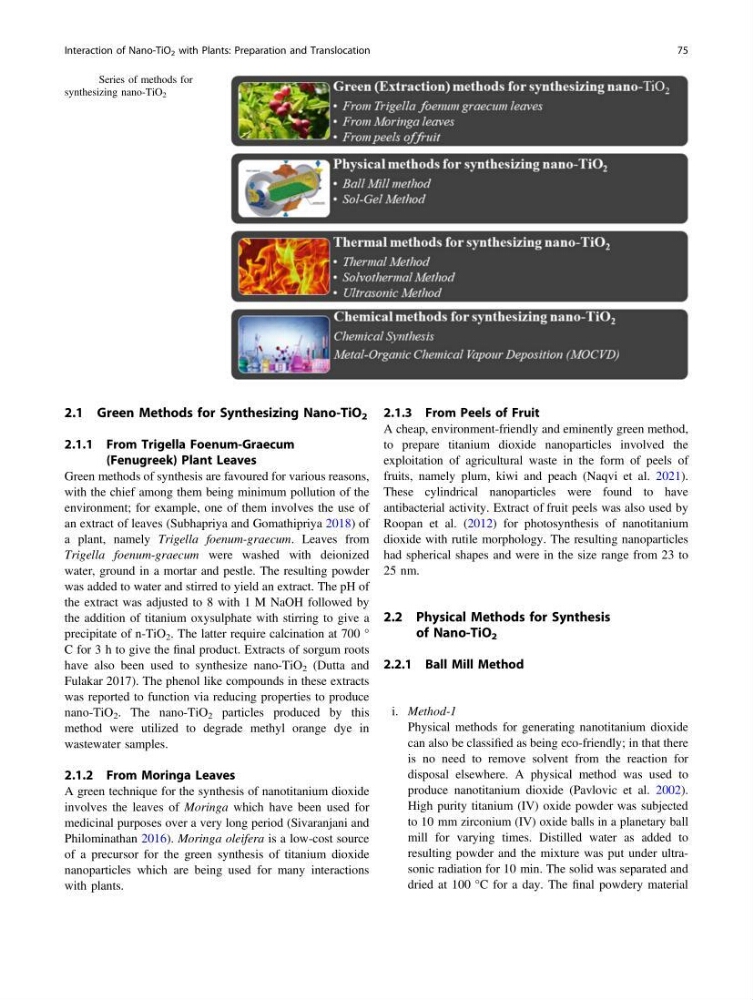
Fig. 1 Series of methods for
synthesizing nano-TiO 2
Interaction of Nano-TiO 2 with Plants: Preparation and Translocation
75
2.1.1 From Trigella Foenum-Graecum
(Fenugreek) Plant Leaves
Green methods of synthesis are favoured for various reasons,
with the chief among them being minimum pollution of the
environment; for example, one of them involves the use of
an extract of leaves (Subhapriya and Gomathipriya 2018) of
a plant, namely Trigella foenum-graecum. Leaves from
Trigella foenum-graecum were washed with deionized
water, ground in a mortar and pestle. The resulting powder
was added to water and stirred to yield an extract. The pH of
the extract was adjusted to 8 with 1 M NaOH followed by
the addition of titanium oxysulphate with stirring to give a
precipitate of n-TiO 2 . The latter require calcination at 700 °
C for 3 h to give the final product. Extracts of sorgum roots
have also been used to synthesize nano-TiO 2 (Dutta and
Fulakar 2017). The phenol like compounds in these extracts
was reported to function via reducing properties to produce
nano-TiO 2 . The nano-TiO 2 particles produced by this
method were utilized to degrade methyl orange dye in
wastewater samples.
2.1.2 From Moringa Leaves
A green technique for the synthesis of nanotitanium dioxide
involves the leaves of Moringa which have been used for
medicinal purposes over a very long period (Sivaranjani and
Philominathan 2016). Moringa oleifera is a low-cost source
of a precursor for the green synthesis of titanium dioxide
nanoparticles which are being used for many interactions
with plants.
2.1.3 From Peels of Fruit
A cheap, environment-friendly and eminently green method,
to prepare titanium dioxide nanoparticles involved the
exploitation of agricultural waste in the form of peels of
fruits, namely plum, kiwi and peach (Naqvi et al. 2021).
These cylindrical nanoparticles were found to have
antibacterial activity. Extract of fruit peels was also used by
Roopan et al. (2012) for photosynthesis of nanotitanium
dioxide with rutile morphology. The resulting nanoparticles
had spherical shapes and were in the size range from 23 to
25 nm.
2.2 Physical Methods for Synthesis
of Nano-TiO 2
2.2.1 Ball Mill Method
i. Method-1
Physical methods for generating nanotitanium dioxide
can also be classified as being eco-friendly; in that there
is no need to remove solvent from the reaction for
disposal elsewhere. A physical method was used to
produce nanotitanium dioxide (Pavlovic et al. 2002).
High purity titanium (IV) oxide powder was subjected
to 10 mm zirconium (IV) oxide balls in a planetary ball
mill for varying times. Distilled water as added to
resulting powder and the mixture was put under ultrasonic radiation for 10 min. The solid was separated and
dried at 100 °C for a day. The final powdery material
Fig. 1 Series of methods for
synthesizing nano-TiO 2
Interaction of Nano-TiO 2 with Plants: Preparation and Translocation
75