

vulgare. Enhanced plant growth, yield and quality (in terms
of gluten and starch content) under foliar application of
TiO 2 -NPs solution in Triticum aestivum under water-deficit
stress conditions were observed by Jaberzadeh et al. (2013).
Results from spinach with TiO 2 -NPs treatment also showed
increased biomass, nutritional quality and improved yield
(Zheng et al. 2005; Yang et al. 2007).
From the above discussion, it can be concluded that the
impacts posed by TiO 2 -NPs exhibit a dual characteristic, as
it could be either toxic or beneficial which is determined by
various factors such as experimental conditions, features of
targeted plants and also the nature of NPs used (Zheng et al.
2005; Andersen et al. 2016; Cox et al. 2016; Chaudhary and
Singh 2020). However, the results showed promising contribution to support TiO 2 -NPs applications, but still subtle
methodology and conditions are accountable factors.
3.3 Detoxification Mechanism vs TiO 2
Nanoparticles Phytotoxicity
It is clear from above discussion that the plants have a defense
system that protects them when they are exposed to adverse
conditions. At toxic concentration, NPs interact with the cellular moiety and accelerate the production of ROS (Rico et al.
2015; Tripathi et al. 2017). Yin et al. (2012) demonstrated that
the excess ROS led to cytotoxicity in a cell in response to
TiO 2 -NPs. These ROS in low concentration act as signaling
molecules and thus activate plant antioxidant defense system
to alleviate the toxicity caused by different free radicals.
Antioxidant defense system of plants has both enzymatic
(SOD, CAT, POD, GPX, APX) and non-enzymatic antioxidants including such as ascorbic acid, glutathione, non-protein
thiols, polyphenols, carotenoids, etc. (Singh et al. 2016; Rico
et al. 2015). SOD detoxifies the superoxide anions by dismutating it into H 2 O 2 , while CAT and GPX significantly
scavenge the both ROS and peroxy radicals (Rico et al. 2015).
In addition to this, enzymes like APX, DHAR and GR that are
chief components of ascorbate–glutathione cycle (AA-GSH
cycle) help in maintaining ROS concentration and redox status
of plant cell (Rico et al. 2015). A large number of research
information revealed the direct influence of NPs on the
activities of various antioxidant enzymes (Mohammadi et al.
2014; Rico et al. 2015), but there is still lack of information
that could associate the activation of antioxidant with the
chemical properties of NPs. Indeed, the information is unreliable and irregular that show variations. Lei et al. (2008) and
Song et al. (2012) observed that TiO 2 -NPs enhanced the
enzymatic activities of several enzymes such as SOD, CAT,
APX and GPX in Spinacia oleracea and Lemna minor,
respectively. On contrary to this, Foltête et al. (2011) reported
that TiO 2 -NPs treatment decreased GR and APX enzymes
activities in Vicia faba. Besides enzymatic defense system,
plants have some cellular defense mechanisms also in which
they protect themselves from the toxic effects of TiO 2 -NPs by
increasing the number of oil bodies and lytic vacuoles (Santos
Filho et al. 2019). Furthermore, transformation of TiO 2 -NPs
from anatase form (25 nm) to another brookite form
(orthorhomboid; 450 nm) may also be a protective mechanism
to mitigate the toxic effects of TiO 2 -NPs in Allium cepa
(Santose Filho et al. 2019).
4 Scope of TiO 2 Nanoparticles in Agriculture
Various anthropogenic activities have led to increased pollution of soil all over the world which ultimately affects the
crop yield and productivity. Further, a rapid growth in
world’s population may eventually end with increasing
demand for food supply globally. Thus, there is an urgent
need to adapt some innovative technologies in the field of
agriculture to ensure food security. Nanotechnology has
enormous potential in the field of agriculture. Because of
their markedly different physiochemical properties than their
bulk counterparts, NPs are of special interest to combat real
life agricultural issues and provide better foods globally.
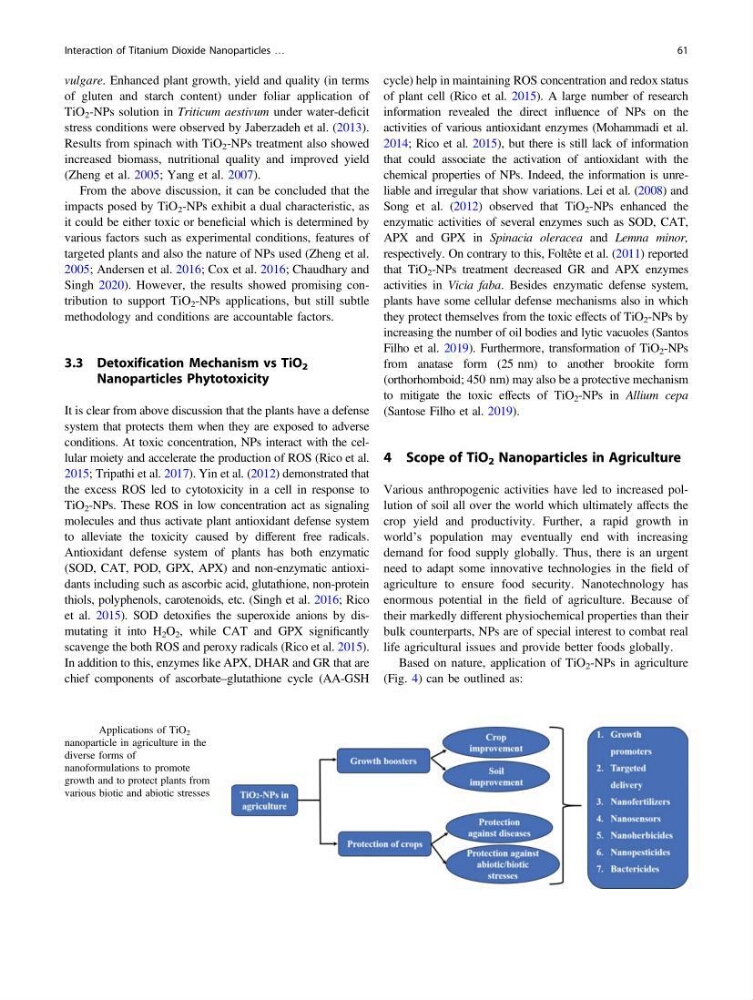
Based on nature, application of TiO 2 -NPs in agriculture
(Fig. 4) can be outlined as:
Fig. 4 Applications of TiO 2
nanoparticle in agriculture in the
diverse forms of
nanoformulations to promote
growth and to protect plants from
various biotic and abiotic stresses
Interaction of Titanium Dioxide Nanoparticles …
61
of gluten and starch content) under foliar application of
TiO 2 -NPs solution in Triticum aestivum under water-deficit
stress conditions were observed by Jaberzadeh et al. (2013).
Results from spinach with TiO 2 -NPs treatment also showed
increased biomass, nutritional quality and improved yield
(Zheng et al. 2005; Yang et al. 2007).
From the above discussion, it can be concluded that the
impacts posed by TiO 2 -NPs exhibit a dual characteristic, as
it could be either toxic or beneficial which is determined by
various factors such as experimental conditions, features of
targeted plants and also the nature of NPs used (Zheng et al.
2005; Andersen et al. 2016; Cox et al. 2016; Chaudhary and
Singh 2020). However, the results showed promising contribution to support TiO 2 -NPs applications, but still subtle
methodology and conditions are accountable factors.
3.3 Detoxification Mechanism vs TiO 2
Nanoparticles Phytotoxicity
It is clear from above discussion that the plants have a defense
system that protects them when they are exposed to adverse
conditions. At toxic concentration, NPs interact with the cellular moiety and accelerate the production of ROS (Rico et al.
2015; Tripathi et al. 2017). Yin et al. (2012) demonstrated that
the excess ROS led to cytotoxicity in a cell in response to
TiO 2 -NPs. These ROS in low concentration act as signaling
molecules and thus activate plant antioxidant defense system
to alleviate the toxicity caused by different free radicals.
Antioxidant defense system of plants has both enzymatic
(SOD, CAT, POD, GPX, APX) and non-enzymatic antioxidants including such as ascorbic acid, glutathione, non-protein
thiols, polyphenols, carotenoids, etc. (Singh et al. 2016; Rico
et al. 2015). SOD detoxifies the superoxide anions by dismutating it into H 2 O 2 , while CAT and GPX significantly
scavenge the both ROS and peroxy radicals (Rico et al. 2015).
In addition to this, enzymes like APX, DHAR and GR that are
chief components of ascorbate–glutathione cycle (AA-GSH
cycle) help in maintaining ROS concentration and redox status
of plant cell (Rico et al. 2015). A large number of research
information revealed the direct influence of NPs on the
activities of various antioxidant enzymes (Mohammadi et al.
2014; Rico et al. 2015), but there is still lack of information
that could associate the activation of antioxidant with the
chemical properties of NPs. Indeed, the information is unreliable and irregular that show variations. Lei et al. (2008) and
Song et al. (2012) observed that TiO 2 -NPs enhanced the
enzymatic activities of several enzymes such as SOD, CAT,
APX and GPX in Spinacia oleracea and Lemna minor,
respectively. On contrary to this, Foltête et al. (2011) reported
that TiO 2 -NPs treatment decreased GR and APX enzymes
activities in Vicia faba. Besides enzymatic defense system,
plants have some cellular defense mechanisms also in which
they protect themselves from the toxic effects of TiO 2 -NPs by
increasing the number of oil bodies and lytic vacuoles (Santos
Filho et al. 2019). Furthermore, transformation of TiO 2 -NPs
from anatase form (25 nm) to another brookite form
(orthorhomboid; 450 nm) may also be a protective mechanism
to mitigate the toxic effects of TiO 2 -NPs in Allium cepa
(Santose Filho et al. 2019).
4 Scope of TiO 2 Nanoparticles in Agriculture
Various anthropogenic activities have led to increased pollution of soil all over the world which ultimately affects the
crop yield and productivity. Further, a rapid growth in
world’s population may eventually end with increasing
demand for food supply globally. Thus, there is an urgent
need to adapt some innovative technologies in the field of
agriculture to ensure food security. Nanotechnology has
enormous potential in the field of agriculture. Because of
their markedly different physiochemical properties than their
bulk counterparts, NPs are of special interest to combat real
life agricultural issues and provide better foods globally.
Based on nature, application of TiO 2 -NPs in agriculture
(Fig. 4) can be outlined as:
Fig. 4 Applications of TiO 2
nanoparticle in agriculture in the
diverse forms of
nanoformulations to promote
growth and to protect plants from
various biotic and abiotic stresses
Interaction of Titanium Dioxide Nanoparticles …
61