

the electron transport, reducing the reactive oxygen species
formation in chloroplasts and consequently boosting photosynthesis in the crops (Giraldo et al. 2014). Multi-walled
CNTs regulate hormones, like auxin, in the plants, aiding in
altering the plants growth (McLamore et al. 2010). A wireless NS was developed to identify the insect attack by differentiating volatiles released by the plant–insect interaction
(Afsharinejad et al. 2016). Nano-gold has been used in NSs
to identify karnal bunt disease in Triticum aestivum (Singh
et al. 2010). Potassium niobate-based NSs have been stated
to possess moisture detection capability, thereby could assist
productivity enhancement (Ganeshkumar et al. 2016).
Moreover, NSs could help quantify pollution levels in the
soils (Shang et al. 2019).
5.3 Nano-robots
Nano-robots could be used in combination with wireless
communication systems to scan plants under consideration.
The capillaries present inside the plants could be explored
thoroughly for the identification of deficient water and
nutrient levels. Additionally, the agricultural soils could be
monitored by the nano-robots for the determination of
nutritional status and prevalent moisture contents (Pandey
2018). Further, the quality of irrigational water provisioned
to the soils could be monitored using the nano-robots
(Cavalcanti et al. 2003). The details generated by the
nano-robots could be furnished through communicational
channels to remote computer centres for further analysis.
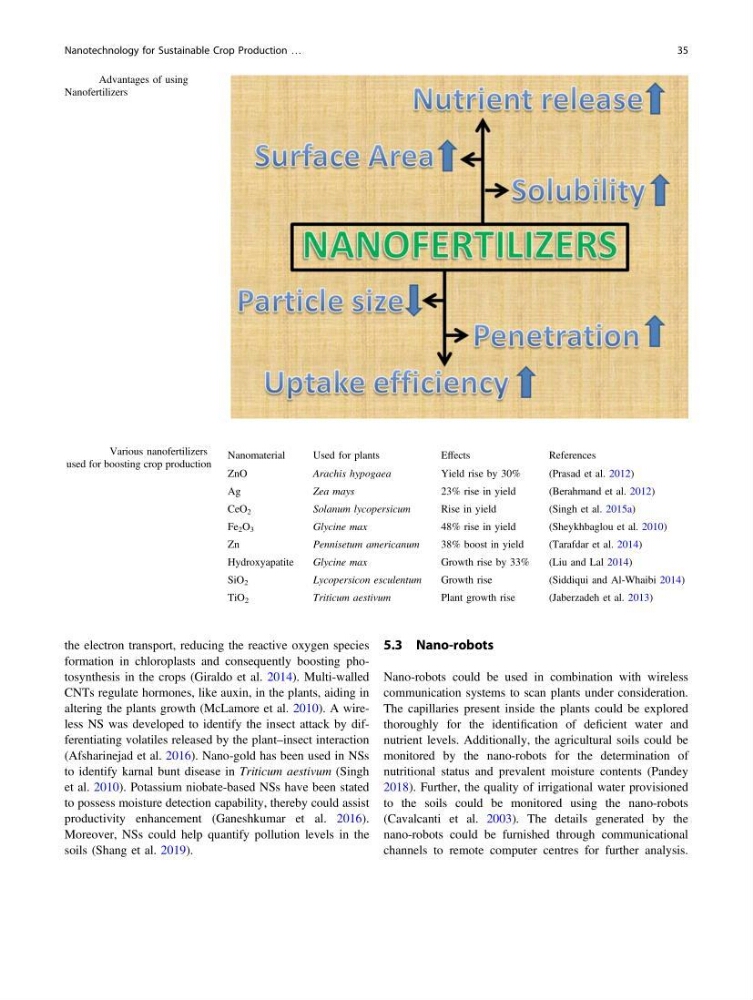
Fig. 1 Advantages of using
Nanofertilizers
Table 1 Various nanofertilizers
used for boosting crop production
Nanomaterial
Used for plants
Effects
References
ZnO
Arachis hypogaea
Yield rise by 30%
(Prasad et al. 2012)
Ag
Zea mays
23% rise in yield
(Berahmand et al. 2012)
CeO 2
Solanum lycopersicum
Rise in yield
(Singh et al. 2015a)
Fe 2 O 3
Glycine max
48% rise in yield
(Sheykhbaglou et al. 2010)
Zn
Pennisetum americanum
38% boost in yield
(Tarafdar et al. 2014)
Hydroxyapatite
Glycine max
Growth rise by 33%
(Liu and Lal 2014)
SiO 2
Lycopersicon esculentum
Growth rise
(Siddiqui and Al-Whaibi 2014)
TiO 2
Triticum aestivum
Plant growth rise
(Jaberzadeh et al. 2013)
Nanotechnology for Sustainable Crop Production …
35
formation in chloroplasts and consequently boosting photosynthesis in the crops (Giraldo et al. 2014). Multi-walled
CNTs regulate hormones, like auxin, in the plants, aiding in
altering the plants growth (McLamore et al. 2010). A wireless NS was developed to identify the insect attack by differentiating volatiles released by the plant–insect interaction
(Afsharinejad et al. 2016). Nano-gold has been used in NSs
to identify karnal bunt disease in Triticum aestivum (Singh
et al. 2010). Potassium niobate-based NSs have been stated
to possess moisture detection capability, thereby could assist
productivity enhancement (Ganeshkumar et al. 2016).
Moreover, NSs could help quantify pollution levels in the
soils (Shang et al. 2019).
5.3 Nano-robots
Nano-robots could be used in combination with wireless
communication systems to scan plants under consideration.
The capillaries present inside the plants could be explored
thoroughly for the identification of deficient water and
nutrient levels. Additionally, the agricultural soils could be
monitored by the nano-robots for the determination of
nutritional status and prevalent moisture contents (Pandey
2018). Further, the quality of irrigational water provisioned
to the soils could be monitored using the nano-robots
(Cavalcanti et al. 2003). The details generated by the
nano-robots could be furnished through communicational
channels to remote computer centres for further analysis.
Fig. 1 Advantages of using
Nanofertilizers
Table 1 Various nanofertilizers
used for boosting crop production
Nanomaterial
Used for plants
Effects
References
ZnO
Arachis hypogaea
Yield rise by 30%
(Prasad et al. 2012)
Ag
Zea mays
23% rise in yield
(Berahmand et al. 2012)
CeO 2
Solanum lycopersicum
Rise in yield
(Singh et al. 2015a)
Fe 2 O 3
Glycine max
48% rise in yield
(Sheykhbaglou et al. 2010)
Zn
Pennisetum americanum
38% boost in yield
(Tarafdar et al. 2014)
Hydroxyapatite
Glycine max
Growth rise by 33%
(Liu and Lal 2014)
SiO 2
Lycopersicon esculentum
Growth rise
(Siddiqui and Al-Whaibi 2014)
TiO 2
Triticum aestivum
Plant growth rise
(Jaberzadeh et al. 2013)
Nanotechnology for Sustainable Crop Production …
35