

nutrition regulation and soil fertility improvement (Janvier
et al. 2007; Suresh et al. 2013).
The presence of ENPs in soil has raised notable concern
regarding its impact on soil biodiversity (Bondarenko et al.
2013). Various properties of soil such as texture, pH, organic
matter, and structure alter the capability of ENPs that have
toxic effects on microorganisms (bioavailability) (Fierer and
Jackson 2006; Simonin and Richaume 2015). Soil microbes
are key indicator of change as they play an important role in
biogeochemical cycling (Kandeler et al. 1996; Holden et al.
2014; Kumar and Verma 2018). ENPs mobility in soil is
lower (Darlington et al. 2009) as the soil porosity and
transport are governed by mucilage, voids, and exudates
from hyphae, roots, and bacteria (Oades 1993; Zhao et al.
2012). Therefore, subtle changes in the microbial community induced by ENPs exposure could alter the uptake of
nutrients, disease suppression, and development of plants as
well as the fate of nanoparticles (NPs). ENPs affect plants at
different levels such as physiological, biochemical, and
molecular. Unlike animals, plants are sessile and roots
absorb NPs along with water and nutrient from the contaminated environment. These ENPs are accumulated in
plant products and reach human and animals. Additionally,
they also induce toxicity to plant such as inhibition of seed
germination, nutrient acquisition, plant growth, and transport
(Xiong et al. 2017; Zhao et al. 2017). Thus, the toxicity of
NPs considers numerous perspectives from deoxyribonucleic acid (DNA) to physiological level and ecosystem
functioning. The quality of soil, water, and the environment
is an extremely important issue. Maintaining the ecosystem quality, particularly soil is necessary for proper functioning (Kumar et al. 2021). Therefore, intensive
development of nanotechnology, enormous use of ENPs,
and their release in the environment are a challenge for the
future. Although nanotechnology is relatively a young field
in science, its contribution is developing dramatically due to
its wider application. Besides, it is expected that the production scale of ENPs will be much higher in a few years. In
this chapter, we have briefly discussed about the different
types of engineered NPs, their sources, and its impact on
microbial community, soil health, and plant responses.
2 Sources of Engineered Nanoparticles
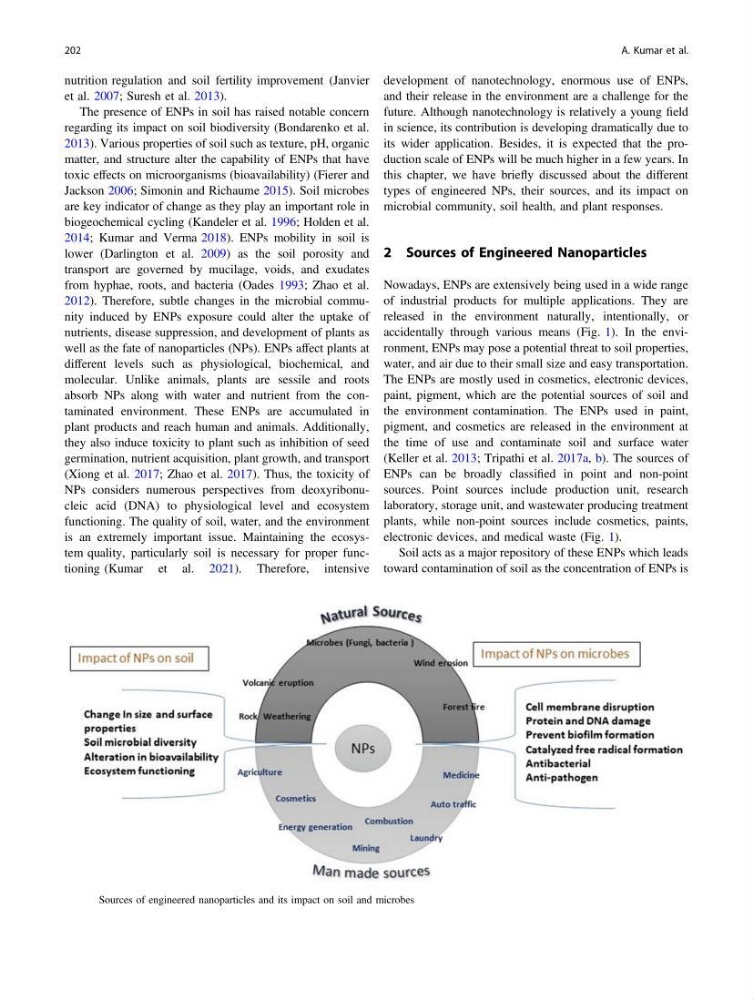
Nowadays, ENPs are extensively being used in a wide range
of industrial products for multiple applications. They are
released in the environment naturally, intentionally, or
accidentally through various means (Fig. 1). In the environment, ENPs may pose a potential threat to soil properties,
water, and air due to their small size and easy transportation.
The ENPs are mostly used in cosmetics, electronic devices,
paint, pigment, which are the potential sources of soil and
the environment contamination. The ENPs used in paint,
pigment, and cosmetics are released in the environment at
the time of use and contaminate soil and surface water
(Keller et al. 2013; Tripathi et al. 2017a, b). The sources of
ENPs can be broadly classified in point and non-point
sources. Point sources include production unit, research
laboratory, storage unit, and wastewater producing treatment
plants, while non-point sources include cosmetics, paints,
electronic devices, and medical waste (Fig. 1).
Soil acts as a major repository of these ENPs which leads
toward contamination of soil as the concentration of ENPs is
Fig. 1 Sources of engineered nanoparticles and its impact on soil and microbes
202
A. Kumar et al.
et al. 2007; Suresh et al. 2013).
The presence of ENPs in soil has raised notable concern
regarding its impact on soil biodiversity (Bondarenko et al.
2013). Various properties of soil such as texture, pH, organic
matter, and structure alter the capability of ENPs that have
toxic effects on microorganisms (bioavailability) (Fierer and
Jackson 2006; Simonin and Richaume 2015). Soil microbes
are key indicator of change as they play an important role in
biogeochemical cycling (Kandeler et al. 1996; Holden et al.
2014; Kumar and Verma 2018). ENPs mobility in soil is
lower (Darlington et al. 2009) as the soil porosity and
transport are governed by mucilage, voids, and exudates
from hyphae, roots, and bacteria (Oades 1993; Zhao et al.
2012). Therefore, subtle changes in the microbial community induced by ENPs exposure could alter the uptake of
nutrients, disease suppression, and development of plants as
well as the fate of nanoparticles (NPs). ENPs affect plants at
different levels such as physiological, biochemical, and
molecular. Unlike animals, plants are sessile and roots
absorb NPs along with water and nutrient from the contaminated environment. These ENPs are accumulated in
plant products and reach human and animals. Additionally,
they also induce toxicity to plant such as inhibition of seed
germination, nutrient acquisition, plant growth, and transport
(Xiong et al. 2017; Zhao et al. 2017). Thus, the toxicity of
NPs considers numerous perspectives from deoxyribonucleic acid (DNA) to physiological level and ecosystem
functioning. The quality of soil, water, and the environment
is an extremely important issue. Maintaining the ecosystem quality, particularly soil is necessary for proper functioning (Kumar et al. 2021). Therefore, intensive
development of nanotechnology, enormous use of ENPs,
and their release in the environment are a challenge for the
future. Although nanotechnology is relatively a young field
in science, its contribution is developing dramatically due to
its wider application. Besides, it is expected that the production scale of ENPs will be much higher in a few years. In
this chapter, we have briefly discussed about the different
types of engineered NPs, their sources, and its impact on
microbial community, soil health, and plant responses.
2 Sources of Engineered Nanoparticles
Nowadays, ENPs are extensively being used in a wide range
of industrial products for multiple applications. They are
released in the environment naturally, intentionally, or
accidentally through various means (Fig. 1). In the environment, ENPs may pose a potential threat to soil properties,
water, and air due to their small size and easy transportation.
The ENPs are mostly used in cosmetics, electronic devices,
paint, pigment, which are the potential sources of soil and
the environment contamination. The ENPs used in paint,
pigment, and cosmetics are released in the environment at
the time of use and contaminate soil and surface water
(Keller et al. 2013; Tripathi et al. 2017a, b). The sources of
ENPs can be broadly classified in point and non-point
sources. Point sources include production unit, research
laboratory, storage unit, and wastewater producing treatment
plants, while non-point sources include cosmetics, paints,
electronic devices, and medical waste (Fig. 1).
Soil acts as a major repository of these ENPs which leads
toward contamination of soil as the concentration of ENPs is
Fig. 1 Sources of engineered nanoparticles and its impact on soil and microbes
202
A. Kumar et al.