

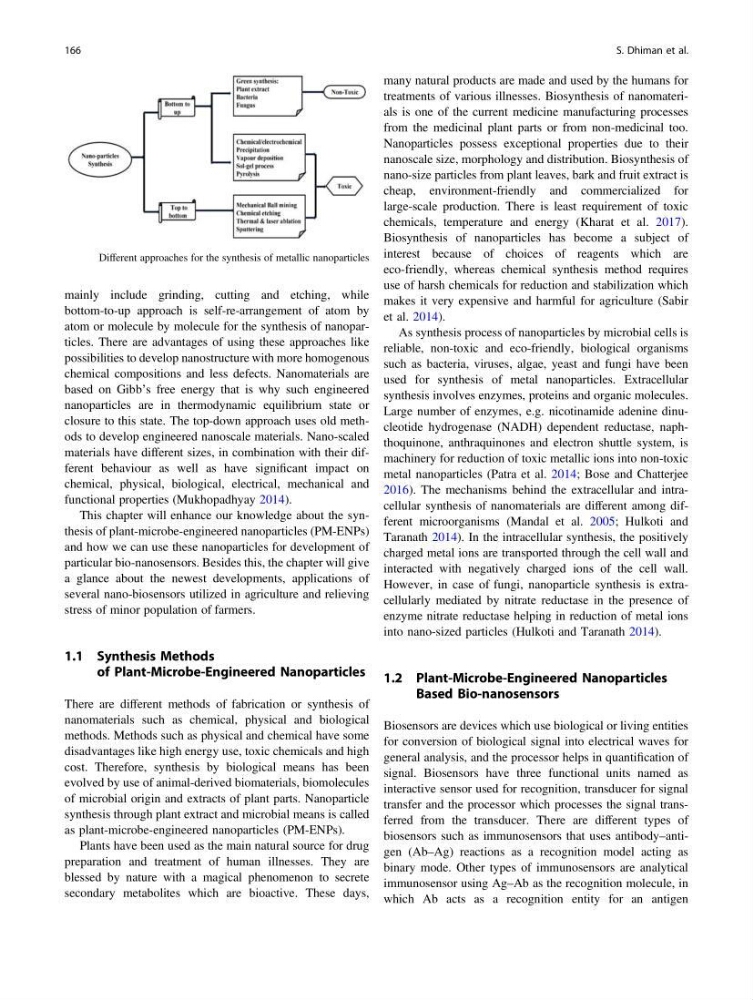
mainly include grinding, cutting and etching, while
bottom-to-up approach is self-re-arrangement of atom by
atom or molecule by molecule for the synthesis of nanoparticles. There are advantages of using these approaches like
possibilities to develop nanostructure with more homogenous
chemical compositions and less defects. Nanomaterials are
based on Gibb’s free energy that is why such engineered
nanoparticles are in thermodynamic equilibrium state or
closure to this state. The top-down approach uses old methods to develop engineered nanoscale materials. Nano-scaled
materials have different sizes, in combination with their different behaviour as well as have significant impact on
chemical, physical, biological, electrical, mechanical and
functional properties (Mukhopadhyay 2014).
This chapter will enhance our knowledge about the synthesis of plant-microbe-engineered nanoparticles (PM-ENPs)
and how we can use these nanoparticles for development of
particular bio-nanosensors. Besides this, the chapter will give
a glance about the newest developments, applications of
several nano-biosensors utilized in agriculture and relieving
stress of minor population of farmers.
1.1 Synthesis Methods
of Plant-Microbe-Engineered Nanoparticles
There are different methods of fabrication or synthesis of
nanomaterials such as chemical, physical and biological
methods. Methods such as physical and chemical have some
disadvantages like high energy use, toxic chemicals and high
cost. Therefore, synthesis by biological means has been
evolved by use of animal-derived biomaterials, biomolecules
of microbial origin and extracts of plant parts. Nanoparticle
synthesis through plant extract and microbial means is called
as plant-microbe-engineered nanoparticles (PM-ENPs).
Plants have been used as the main natural source for drug
preparation and treatment of human illnesses. They are
blessed by nature with a magical phenomenon to secrete
secondary metabolites which are bioactive. These days,
many natural products are made and used by the humans for
treatments of various illnesses. Biosynthesis of nanomaterials is one of the current medicine manufacturing processes
from the medicinal plant parts or from non-medicinal too.
Nanoparticles possess exceptional properties due to their
nanoscale size, morphology and distribution. Biosynthesis of
nano-size particles from plant leaves, bark and fruit extract is
cheap, environment-friendly and commercialized for
large-scale production. There is least requirement of toxic
chemicals, temperature and energy (Kharat et al. 2017).
Biosynthesis of nanoparticles has become a subject of
interest because of choices of reagents which are
eco-friendly, whereas chemical synthesis method requires
use of harsh chemicals for reduction and stabilization which
makes it very expensive and harmful for agriculture (Sabir
et al. 2014).
As synthesis process of nanoparticles by microbial cells is
reliable, non-toxic and eco-friendly, biological organisms
such as bacteria, viruses, algae, yeast and fungi have been
used for synthesis of metal nanoparticles. Extracellular
synthesis involves enzymes, proteins and organic molecules.
Large number of enzymes, e.g. nicotinamide adenine dinucleotide hydrogenase (NADH) dependent reductase, naphthoquinone, anthraquinones and electron shuttle system, is
machinery for reduction of toxic metallic ions into non-toxic
metal nanoparticles (Patra et al. 2014; Bose and Chatterjee
2016). The mechanisms behind the extracellular and intracellular synthesis of nanomaterials are different among different microorganisms (Mandal et al. 2005; Hulkoti and
Taranath 2014). In the intracellular synthesis, the positively
charged metal ions are transported through the cell wall and
interacted with negatively charged ions of the cell wall.
However, in case of fungi, nanoparticle synthesis is extracellularly mediated by nitrate reductase in the presence of
enzyme nitrate reductase helping in reduction of metal ions
into nano-sized particles (Hulkoti and Taranath 2014).
1.2 Plant-Microbe-Engineered Nanoparticles
Based Bio-nanosensors
Biosensors are devices which use biological or living entities
for conversion of biological signal into electrical waves for
general analysis, and the processor helps in quantification of
signal. Biosensors have three functional units named as
interactive sensor used for recognition, transducer for signal
transfer and the processor which processes the signal transferred from the transducer. There are different types of
biosensors such as immunosensors that uses antibody–antigen (Ab–Ag) reactions as a recognition model acting as
binary mode. Other types of immunosensors are analytical
immunosensor using Ag–Ab as the recognition molecule, in
which Ab acts as a recognition entity for an antigen
Fig. 1 Different approaches for the synthesis of metallic nanoparticles
166
S. Dhiman et al.
bottom-to-up approach is self-re-arrangement of atom by
atom or molecule by molecule for the synthesis of nanoparticles. There are advantages of using these approaches like
possibilities to develop nanostructure with more homogenous
chemical compositions and less defects. Nanomaterials are
based on Gibb’s free energy that is why such engineered
nanoparticles are in thermodynamic equilibrium state or
closure to this state. The top-down approach uses old methods to develop engineered nanoscale materials. Nano-scaled
materials have different sizes, in combination with their different behaviour as well as have significant impact on
chemical, physical, biological, electrical, mechanical and
functional properties (Mukhopadhyay 2014).
This chapter will enhance our knowledge about the synthesis of plant-microbe-engineered nanoparticles (PM-ENPs)
and how we can use these nanoparticles for development of
particular bio-nanosensors. Besides this, the chapter will give
a glance about the newest developments, applications of
several nano-biosensors utilized in agriculture and relieving
stress of minor population of farmers.
1.1 Synthesis Methods
of Plant-Microbe-Engineered Nanoparticles
There are different methods of fabrication or synthesis of
nanomaterials such as chemical, physical and biological
methods. Methods such as physical and chemical have some
disadvantages like high energy use, toxic chemicals and high
cost. Therefore, synthesis by biological means has been
evolved by use of animal-derived biomaterials, biomolecules
of microbial origin and extracts of plant parts. Nanoparticle
synthesis through plant extract and microbial means is called
as plant-microbe-engineered nanoparticles (PM-ENPs).
Plants have been used as the main natural source for drug
preparation and treatment of human illnesses. They are
blessed by nature with a magical phenomenon to secrete
secondary metabolites which are bioactive. These days,
many natural products are made and used by the humans for
treatments of various illnesses. Biosynthesis of nanomaterials is one of the current medicine manufacturing processes
from the medicinal plant parts or from non-medicinal too.
Nanoparticles possess exceptional properties due to their
nanoscale size, morphology and distribution. Biosynthesis of
nano-size particles from plant leaves, bark and fruit extract is
cheap, environment-friendly and commercialized for
large-scale production. There is least requirement of toxic
chemicals, temperature and energy (Kharat et al. 2017).
Biosynthesis of nanoparticles has become a subject of
interest because of choices of reagents which are
eco-friendly, whereas chemical synthesis method requires
use of harsh chemicals for reduction and stabilization which
makes it very expensive and harmful for agriculture (Sabir
et al. 2014).
As synthesis process of nanoparticles by microbial cells is
reliable, non-toxic and eco-friendly, biological organisms
such as bacteria, viruses, algae, yeast and fungi have been
used for synthesis of metal nanoparticles. Extracellular
synthesis involves enzymes, proteins and organic molecules.
Large number of enzymes, e.g. nicotinamide adenine dinucleotide hydrogenase (NADH) dependent reductase, naphthoquinone, anthraquinones and electron shuttle system, is
machinery for reduction of toxic metallic ions into non-toxic
metal nanoparticles (Patra et al. 2014; Bose and Chatterjee
2016). The mechanisms behind the extracellular and intracellular synthesis of nanomaterials are different among different microorganisms (Mandal et al. 2005; Hulkoti and
Taranath 2014). In the intracellular synthesis, the positively
charged metal ions are transported through the cell wall and
interacted with negatively charged ions of the cell wall.
However, in case of fungi, nanoparticle synthesis is extracellularly mediated by nitrate reductase in the presence of
enzyme nitrate reductase helping in reduction of metal ions
into nano-sized particles (Hulkoti and Taranath 2014).
1.2 Plant-Microbe-Engineered Nanoparticles
Based Bio-nanosensors
Biosensors are devices which use biological or living entities
for conversion of biological signal into electrical waves for
general analysis, and the processor helps in quantification of
signal. Biosensors have three functional units named as
interactive sensor used for recognition, transducer for signal
transfer and the processor which processes the signal transferred from the transducer. There are different types of
biosensors such as immunosensors that uses antibody–antigen (Ab–Ag) reactions as a recognition model acting as
binary mode. Other types of immunosensors are analytical
immunosensor using Ag–Ab as the recognition molecule, in
which Ab acts as a recognition entity for an antigen
Fig. 1 Different approaches for the synthesis of metallic nanoparticles
166
S. Dhiman et al.