

These solvents can be flammable and can pose a serious
environmental and health risk.
The hallmark of the good pesticides is that these should
be stable, selective, potent and degradable. The limitations
of conventional pesticides in the above regard can be supplemented by the research, synthesis and mass production of
nano-pesticides.
4.2 Types of Engineered Nanoparticles-Based
Nano-pesticides
4.2.1 Nano-carrier-Based Pesticides
A. Nano-emulsion pesticides
One major issue with pesticides is of their insolubility
in water, because most of them are lipophilic. A solution to this has been the large-scale use of organic
solvents to prepare an emulsion (Hayles et al. 2017).
However, in addition to the economic and environmental cost of these solvents, the prepared pesticide
emulsions are often unstable and prone to separation via
flocculation, creaming, etc. This warrants constant
agitation and hence attention is being payed to the
pesticide mix, which is difficult to make in rural surroundings by farmers, who lack technical knowledge.
This results in excessive application of the pesticides,
which harm the environment and human health.
Another solution is the use of surfactants to create an
interfacial layer and lower the surface energy, resulting
in a dispersed solution. Such pesticide dispersed particles are in the 1–20 lm diameter range (Hayles et al.
2017). Nano-emulsions are formed, when the miscles
formed by the pesticide, surfactant and water interaction
are in the nanometer range. They are formed due to the
properties and concentration of the constituents used
and are advantageous due to their simple preparations
and high stability (Hayles et al. 2017). The advantages
of nano-emulsions of pesticides are: increased
bioavailability and uptake by pests due to larger surface
area, resistant to physiochemical degradation, slow and
controlled release, etc.
B. Polymer-based nano-pesticides
Polymer-based nano-pesticides offer many of the same
advantages
provided
by
the above-mentioned
nano-dispersed pesticides including: greater bioavailability, increased stability and controlled release etc.
Such nano-carriers can be designed to carry one or more
pesticides (Hayles et al. 2017). The pesticide molecules
may be physically adsorbed onto the polymeric carrier,
covalently linked via chemical crosslinkers, entrapped
within a polymeric matrix or a number of other
formulations.
C. Nano-capsule-based pesticides
Nano-capsules are vesicle shaped nano-carriers with a
polymer shell and an inner cavity, which is occupied by
the pesticides (Balaure et al. 2017).
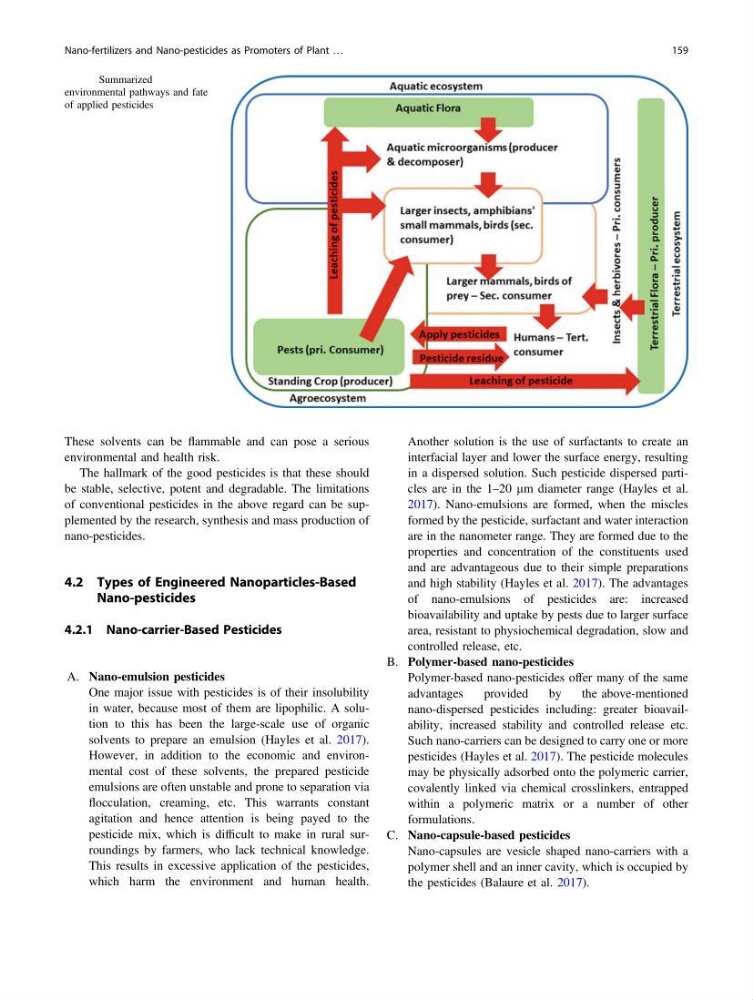
Fig. 3 Summarized
environmental pathways and fate
of applied pesticides
Nano-fertilizers and Nano-pesticides as Promoters of Plant …
159
environmental and health risk.
The hallmark of the good pesticides is that these should
be stable, selective, potent and degradable. The limitations
of conventional pesticides in the above regard can be supplemented by the research, synthesis and mass production of
nano-pesticides.
4.2 Types of Engineered Nanoparticles-Based
Nano-pesticides
4.2.1 Nano-carrier-Based Pesticides
A. Nano-emulsion pesticides
One major issue with pesticides is of their insolubility
in water, because most of them are lipophilic. A solution to this has been the large-scale use of organic
solvents to prepare an emulsion (Hayles et al. 2017).
However, in addition to the economic and environmental cost of these solvents, the prepared pesticide
emulsions are often unstable and prone to separation via
flocculation, creaming, etc. This warrants constant
agitation and hence attention is being payed to the
pesticide mix, which is difficult to make in rural surroundings by farmers, who lack technical knowledge.
This results in excessive application of the pesticides,
which harm the environment and human health.
Another solution is the use of surfactants to create an
interfacial layer and lower the surface energy, resulting
in a dispersed solution. Such pesticide dispersed particles are in the 1–20 lm diameter range (Hayles et al.
2017). Nano-emulsions are formed, when the miscles
formed by the pesticide, surfactant and water interaction
are in the nanometer range. They are formed due to the
properties and concentration of the constituents used
and are advantageous due to their simple preparations
and high stability (Hayles et al. 2017). The advantages
of nano-emulsions of pesticides are: increased
bioavailability and uptake by pests due to larger surface
area, resistant to physiochemical degradation, slow and
controlled release, etc.
B. Polymer-based nano-pesticides
Polymer-based nano-pesticides offer many of the same
advantages
provided
by
the above-mentioned
nano-dispersed pesticides including: greater bioavailability, increased stability and controlled release etc.
Such nano-carriers can be designed to carry one or more
pesticides (Hayles et al. 2017). The pesticide molecules
may be physically adsorbed onto the polymeric carrier,
covalently linked via chemical crosslinkers, entrapped
within a polymeric matrix or a number of other
formulations.
C. Nano-capsule-based pesticides
Nano-capsules are vesicle shaped nano-carriers with a
polymer shell and an inner cavity, which is occupied by
the pesticides (Balaure et al. 2017).
Fig. 3 Summarized
environmental pathways and fate
of applied pesticides
Nano-fertilizers and Nano-pesticides as Promoters of Plant …
159