

3.4.2 Micronutrient Engineered
Nanoparticles-Based Nano-fertilizers
As the name suggests, micronutrients ENPs-based
nano-fertilizers supply required nutrients in smaller quantities, generally less than 10 mg kg
−1 of soil. This type of
nano-fertilizers help in enhancing the metabolism of plants
and thereby promoting the plant growth and nutritional value.
Improved growth of rice was observed under aerobic as well
as submerged conditions, due to the presence of nanosized
Mn-carbonate hollow core shell system, which favours regulated release of Zn. Foliar application of Mn nano-fertilizers
to mung beans (Vigna radiata) increases the length of its
roots by 52%, of shoots and biomass by 38% as compared to
treatment with bulk MnSO 4 (Pradhan et al. 2013). Similarly,
CuO nano-fertilizers are reported to increase the growth of
maize by 51% (Adhikari et al. 2016). The activity of nitrate
reductase in soybean was improved by utilizing SiO 2 –TiO 2
nanoparticles combination as fertilizer, which further results
into better nutrient uptake. FeO nano-fertilizer, when released
to black-eyed peas (Pisum sativum) and soybeans (Glycine
max), increases the content of chlorophyll in leaves.
Maghemite (Fe 2 O 3 ) nanoparticles were used as fertilizer for
peanuts (Arachis hypogaea). Fe-based nano-fertilizers
increase chlorophyll content and photosynthetic activity.
They also significantly increase the concentration of gibberellins and zeatin-riboside, which are growth promoting
hormones (Poddar et al. 2018). Both macronutrient as well as
micronutrient ENPs-based nano-fertilizers show the potential
to increase the biomass or grain yields of plants.
3.4.3 Chitosan Engineered Nanoparticles-Based
Nano-fertilizers
Chitosan is a naturally occurring, biodegradable cationic
biopolymer, which promotes plant growth, and has
antimicrobial and agrochemical potential. Chitosan is
generally prepared in acidic aqueous medium in order to
improve its distribution on plant surfaces and also it is
dialysed to remove the acidity and salinity. It generally
increases the toxicity to the target plant, which further
inhibits the antimicrobial activity of chitosan. As compared
to bulk form of chitosan, its nanoparticles have high solubility in aqueous medium and also have high positive
charge on their surface. The affinity of chitosan nanoparticles towards the biological membranes increases, as a
result of positive surface charge (Adisa et al. 2019). Chitosan comprises nearly 9–10% N, due to which it behaves
as a good source for delivering macronutrients to plants.
Several reports have shown the utilization of chitosan
nanoparticles in combination with polymethacrylic acid for
loading NPK fertilizers. The colloidal suspension of chitosan–polymethacrylic acid along with NPK was found to
be highly stable, due to higher anion charges from the
calcium phosphate (Hasaneen et al. 2014).
3.4.4 Non-nutrient Engineered
Nanoparticles-Based Nano-fertilizers
This is another class of engineered nanoparticles (ENPs),
which do not contain plant nutrients and is also proved to be
useful for plant growth. These include carbon nanotubes
(CNTs), SiO 2 , CeO 2 and TiO 2 , nano-Zn, Fe, InP/ZnS core
shell quantum dots (QDs), ZnCdSe/ZnS core shell QDs,
Mn/ZnSe QDs and gold nanorod (Prasad et al. 2017).
Nano-fertilizer such as nano-silica could improve the plant
growth under the conditions of high temperature humidity by
forming a binary film on the cell wall of bacteria or fungi after
absorption of nutrients and they also prevent infections. The
growth of a seedling and the development of roots could be
improved by utilizing fertilizers based on silicon dioxide
nanoparticles (Duhan et al. 2017). Mesoporous aluminosilicate-based nanoparticles show excellent ability in order to
achieve controlled delivery of macro- and micronutrients in
soil. These ENPs promote the growth and thus enhance the
crop yield. CNTs increase the shoot length of date palm
(Phoenix dactylifera) and also improve the growth of tobacco
plant by 55–60%, when applied at 5–500 lg mL
−1 (Khodakovskaya et al. 2012). On the other hand, CeO 2
nano-fertilizers enhance the growth by 9% and yield by 36%
of wheat (Triticum aestivum L.) (Rico et al. 2014).
3.5 Advantages of Nano-fertilizers Over
Conventional Fertilizers
Nanotechnology using ENPs can help in the manufacture of
better “smarter” fertilizers, nano-fertilizers, in various ways.
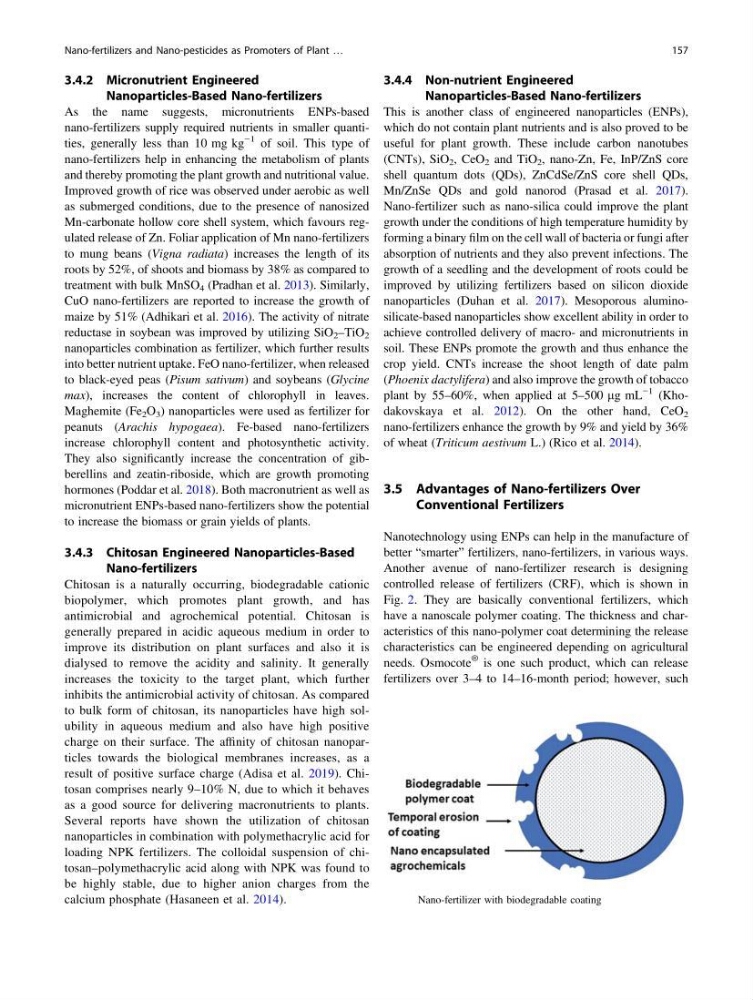
Another avenue of nano-fertilizer research is designing
controlled release of fertilizers (CRF), which is shown in
Fig. 2. They are basically conventional fertilizers, which
have a nanoscale polymer coating. The thickness and characteristics of this nano-polymer coat determining the release
characteristics can be engineered depending on agricultural
needs. Osmocote
® is one such product, which can release
fertilizers over 3–4 to 14–16-month period; however, such
Fig. 2 Nano-fertilizer with biodegradable coating
Nano-fertilizers and Nano-pesticides as Promoters of Plant …
157
Nanoparticles-Based Nano-fertilizers
As the name suggests, micronutrients ENPs-based
nano-fertilizers supply required nutrients in smaller quantities, generally less than 10 mg kg
−1 of soil. This type of
nano-fertilizers help in enhancing the metabolism of plants
and thereby promoting the plant growth and nutritional value.
Improved growth of rice was observed under aerobic as well
as submerged conditions, due to the presence of nanosized
Mn-carbonate hollow core shell system, which favours regulated release of Zn. Foliar application of Mn nano-fertilizers
to mung beans (Vigna radiata) increases the length of its
roots by 52%, of shoots and biomass by 38% as compared to
treatment with bulk MnSO 4 (Pradhan et al. 2013). Similarly,
CuO nano-fertilizers are reported to increase the growth of
maize by 51% (Adhikari et al. 2016). The activity of nitrate
reductase in soybean was improved by utilizing SiO 2 –TiO 2
nanoparticles combination as fertilizer, which further results
into better nutrient uptake. FeO nano-fertilizer, when released
to black-eyed peas (Pisum sativum) and soybeans (Glycine
max), increases the content of chlorophyll in leaves.
Maghemite (Fe 2 O 3 ) nanoparticles were used as fertilizer for
peanuts (Arachis hypogaea). Fe-based nano-fertilizers
increase chlorophyll content and photosynthetic activity.
They also significantly increase the concentration of gibberellins and zeatin-riboside, which are growth promoting
hormones (Poddar et al. 2018). Both macronutrient as well as
micronutrient ENPs-based nano-fertilizers show the potential
to increase the biomass or grain yields of plants.
3.4.3 Chitosan Engineered Nanoparticles-Based
Nano-fertilizers
Chitosan is a naturally occurring, biodegradable cationic
biopolymer, which promotes plant growth, and has
antimicrobial and agrochemical potential. Chitosan is
generally prepared in acidic aqueous medium in order to
improve its distribution on plant surfaces and also it is
dialysed to remove the acidity and salinity. It generally
increases the toxicity to the target plant, which further
inhibits the antimicrobial activity of chitosan. As compared
to bulk form of chitosan, its nanoparticles have high solubility in aqueous medium and also have high positive
charge on their surface. The affinity of chitosan nanoparticles towards the biological membranes increases, as a
result of positive surface charge (Adisa et al. 2019). Chitosan comprises nearly 9–10% N, due to which it behaves
as a good source for delivering macronutrients to plants.
Several reports have shown the utilization of chitosan
nanoparticles in combination with polymethacrylic acid for
loading NPK fertilizers. The colloidal suspension of chitosan–polymethacrylic acid along with NPK was found to
be highly stable, due to higher anion charges from the
calcium phosphate (Hasaneen et al. 2014).
3.4.4 Non-nutrient Engineered
Nanoparticles-Based Nano-fertilizers
This is another class of engineered nanoparticles (ENPs),
which do not contain plant nutrients and is also proved to be
useful for plant growth. These include carbon nanotubes
(CNTs), SiO 2 , CeO 2 and TiO 2 , nano-Zn, Fe, InP/ZnS core
shell quantum dots (QDs), ZnCdSe/ZnS core shell QDs,
Mn/ZnSe QDs and gold nanorod (Prasad et al. 2017).
Nano-fertilizer such as nano-silica could improve the plant
growth under the conditions of high temperature humidity by
forming a binary film on the cell wall of bacteria or fungi after
absorption of nutrients and they also prevent infections. The
growth of a seedling and the development of roots could be
improved by utilizing fertilizers based on silicon dioxide
nanoparticles (Duhan et al. 2017). Mesoporous aluminosilicate-based nanoparticles show excellent ability in order to
achieve controlled delivery of macro- and micronutrients in
soil. These ENPs promote the growth and thus enhance the
crop yield. CNTs increase the shoot length of date palm
(Phoenix dactylifera) and also improve the growth of tobacco
plant by 55–60%, when applied at 5–500 lg mL
−1 (Khodakovskaya et al. 2012). On the other hand, CeO 2
nano-fertilizers enhance the growth by 9% and yield by 36%
of wheat (Triticum aestivum L.) (Rico et al. 2014).
3.5 Advantages of Nano-fertilizers Over
Conventional Fertilizers
Nanotechnology using ENPs can help in the manufacture of
better “smarter” fertilizers, nano-fertilizers, in various ways.
Another avenue of nano-fertilizer research is designing
controlled release of fertilizers (CRF), which is shown in
Fig. 2. They are basically conventional fertilizers, which
have a nanoscale polymer coating. The thickness and characteristics of this nano-polymer coat determining the release
characteristics can be engineered depending on agricultural
needs. Osmocote
® is one such product, which can release
fertilizers over 3–4 to 14–16-month period; however, such
Fig. 2 Nano-fertilizer with biodegradable coating
Nano-fertilizers and Nano-pesticides as Promoters of Plant …
157