

2 Role of Nanotechnology in Agriculture
Nanotechnology helps to promote agricultural practices and
also offers sustainable development. Conventional agrochemicals are usually applied through spraying or broadcasting. As a result of this, small amount of agrochemicals
reach the target sites of plants, which is very less than the
minimum concentration required for plant growth. Agrochemicals are greatly lost due to chemical leaching, hydrolysis, photolysis degradation and also due to microbial
degradation. This largely affects the production of crops and
thus requires better technologies to enhance the crop yield
(Shang et al. 2019). Nanotechnology-based strategies are used
for precise farming and also to meet the food demand for the
increasing population. Improved and environmental-friendly
ENPs are used in nanotechnology to overcome the loss of
nutrients and also to increase the crop yield. These ENPs are
applied in agriculture in the form of nano-biotechnology,
nano-toxicology, nano-fertilizers, nano-pesticides, livestocks,
hydroponics, etc. Nanotechnology is proved to be the alternative method to revolutionize the agricultural practices in the
current scenario (Elemike et al. 2019). Here, we have broadly
discussed the role of these ENPs especially nano-fertilizers
and nano-pesticides to increase the plant growth and also their
advantages over conventional agrochemicals.
3 Engineered Nanoparticles-Based
Nano-fertilizers
3.1 Need for Nano-fertilizers
The application of fertilizers in soil is necessary to increase
the soil fertility for improved crop production. Chemical
fertilizers cause severe damage of the environment and also
destroy the health of the soil. Another problem associated
with conventional fertilizers is the accumulation of large part
of these fertilizers into soil, which leads to environmental
pollution that affect the growth of plants. Due to this reason,
a new cost-effective and eco-friendly technique is a need of
hour for better crop production. For this purpose,
ENPs-based nano-fertilizers are used nowadays, which carry
out controlled release of nutrients in soil and also, they
prevent loss due to chemical fertilizers (Tripathi et al. 2018).
ENPs-based nano-fertilizers are also proved to be helpful in
overcoming severe conditions of eutrophication and also to
enhance concentration of macro- and micronutrients in order
to alleviate the efficiency of nutrients (Shukla et al. 2019).
3.2 Properties of Engineered
Nanoparticles-Based Nano-fertilizers
Engineered nanoparticles-based nano-fertilizers play significant role in agriculture to increase the crop yields and
nutrient efficiency by decreasing excessive use of chemical
fertilizers. The most important properties of ENPs-based
nano-fertilizers, which are responsible for their efficacy,
include eco-friendly nature, requirement of small quantities
of nano-fertilizers and their composition having one or more
macro- or micronutrients. Nano-fertilizers ensure controlled
release of nutrients into the soil through site-targeted delivery. They also exhibit reduced toxicity and increased utilization of nutrients through delivered fertilizers. Their
unique properties also include ultra-high absorption by
plants, enhanced photosynthesis, increased crop production
and remarkable expansion in the leave’s surface area. These
properties enhance plant performance, which further results
into the rise in crop production. The controlled release of
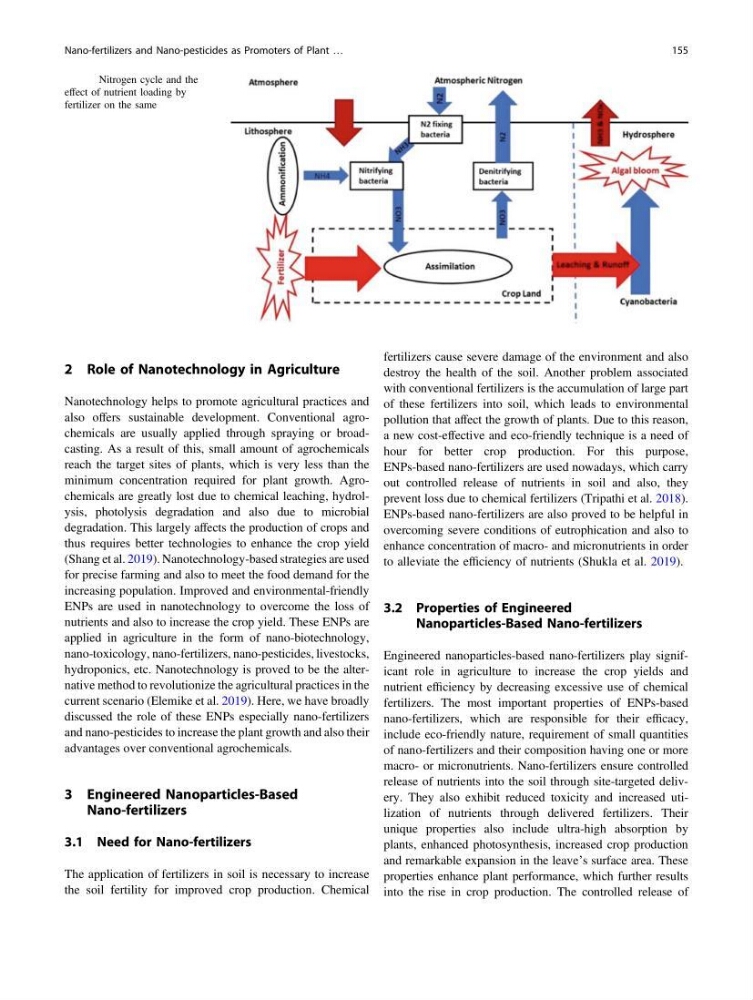
Fig. 1 Nitrogen cycle and the
effect of nutrient loading by
fertilizer on the same
Nano-fertilizers and Nano-pesticides as Promoters of Plant …
155
Nanotechnology helps to promote agricultural practices and
also offers sustainable development. Conventional agrochemicals are usually applied through spraying or broadcasting. As a result of this, small amount of agrochemicals
reach the target sites of plants, which is very less than the
minimum concentration required for plant growth. Agrochemicals are greatly lost due to chemical leaching, hydrolysis, photolysis degradation and also due to microbial
degradation. This largely affects the production of crops and
thus requires better technologies to enhance the crop yield
(Shang et al. 2019). Nanotechnology-based strategies are used
for precise farming and also to meet the food demand for the
increasing population. Improved and environmental-friendly
ENPs are used in nanotechnology to overcome the loss of
nutrients and also to increase the crop yield. These ENPs are
applied in agriculture in the form of nano-biotechnology,
nano-toxicology, nano-fertilizers, nano-pesticides, livestocks,
hydroponics, etc. Nanotechnology is proved to be the alternative method to revolutionize the agricultural practices in the
current scenario (Elemike et al. 2019). Here, we have broadly
discussed the role of these ENPs especially nano-fertilizers
and nano-pesticides to increase the plant growth and also their
advantages over conventional agrochemicals.
3 Engineered Nanoparticles-Based
Nano-fertilizers
3.1 Need for Nano-fertilizers
The application of fertilizers in soil is necessary to increase
the soil fertility for improved crop production. Chemical
fertilizers cause severe damage of the environment and also
destroy the health of the soil. Another problem associated
with conventional fertilizers is the accumulation of large part
of these fertilizers into soil, which leads to environmental
pollution that affect the growth of plants. Due to this reason,
a new cost-effective and eco-friendly technique is a need of
hour for better crop production. For this purpose,
ENPs-based nano-fertilizers are used nowadays, which carry
out controlled release of nutrients in soil and also, they
prevent loss due to chemical fertilizers (Tripathi et al. 2018).
ENPs-based nano-fertilizers are also proved to be helpful in
overcoming severe conditions of eutrophication and also to
enhance concentration of macro- and micronutrients in order
to alleviate the efficiency of nutrients (Shukla et al. 2019).
3.2 Properties of Engineered
Nanoparticles-Based Nano-fertilizers
Engineered nanoparticles-based nano-fertilizers play significant role in agriculture to increase the crop yields and
nutrient efficiency by decreasing excessive use of chemical
fertilizers. The most important properties of ENPs-based
nano-fertilizers, which are responsible for their efficacy,
include eco-friendly nature, requirement of small quantities
of nano-fertilizers and their composition having one or more
macro- or micronutrients. Nano-fertilizers ensure controlled
release of nutrients into the soil through site-targeted delivery. They also exhibit reduced toxicity and increased utilization of nutrients through delivered fertilizers. Their
unique properties also include ultra-high absorption by
plants, enhanced photosynthesis, increased crop production
and remarkable expansion in the leave’s surface area. These
properties enhance plant performance, which further results
into the rise in crop production. The controlled release of
Fig. 1 Nitrogen cycle and the
effect of nutrient loading by
fertilizer on the same
Nano-fertilizers and Nano-pesticides as Promoters of Plant …
155