

electrochemical, optical) have been used for monitoring of
soil and water contamination for detecting the traces of
heavy metals (Ion et al. 2010). Similarly, nano–nano interaction is being tapped to remove the toxic elements in
agricultural soils for obtaining healthy foods (Ion et al. 2010;
Dixit et al. 2015). NMs catalyze degradation of waste and
toxic materials directly as well as indirectly (via improving
the
efficiency
of
microorganisms),
helping
in
bio-remediation of the polluted agro-ecosystems. A general
assessment of the risks of ENPs is difficult, owing to their
diverse inherent and acquired activity under varied set of
environmental conditions (Prasad et al. 2014). ENPs may
affect the chemical composition, shape, surface properties,
extent of particle aggregation (clumping), or disaggregation
of other particles, depending on their sizes variability, which
may lead to their toxic effects (Ion et al. 2010).
3.1 Engineered Nanoparticles (ENPs)
in Agriculture
In recent years, new engineered NMs, using inorganic,
polymeric, and lipid nanoparticles, have been synthesized,
via techniques called emulsification, ionic gelation, polymerization, oxido-reduction, etc., in order to sustainably
increase the agricultural productivity. Such ENPs, which are
engineered for distinct physical (shape, size), and associated
electrical properties (such as surface properties), further
bring a distinct catalytic activity, enhancement in strength
and conductivity (thermal and electrical), and controlled
delivery of host molecules. Using these remarkably unique
nano-systems, bringing nutrient immobilization and their
controlled real-time release in soils, as per plant needs, may
bring efficiency and economy in resource use in
agro-ecosystems. As an effect, it minimizes nutrient leaching
and eutrophication and improves the nutrient uptake by
plants (Liu and Lal 2015). Similarly, improvement in pesticides characteristics such as enhancing their solubility
potential and resistance against the activity loss, and ability
of a highly specific and controlled delivery toward targeted
organisms in recent years, may have considerably made the
agricultural practices safe, without any off-site repercussion
(Mishra and Singh 2015; Grillo et al. 2016; Nuruzzaman
et al. 2016). Similarly, the use of hydrogels, nano-clays, and
nano-zeolites to improve water holding capacity and
capacity of soils to slowly release the water during dry
seasons has also been explored. This might help in agricultural sustainability as well as in the most required reforestation programs of degraded lands, limited mostly due to
water scarcity. In this regard, organic (polymer and carbon
nanotubes) as well as inorganic (nano-metals and metal
oxides) NMs have also shown great promise, due to their
great capability in quick absorption of the contaminants
present in the environment (Khin et al. 2012), helping to
remediate soils in cost- and time-effective manner (Sarkar
et al 2019).
Quite recently, nanoparticles are also being explored to
revolutionize plant genetic engineering aspects in order to
develop plants with improved resistance and qualities,
easily. Most such studies on how NMs can be used effectively in plant genetic engineering have been observed via
plant tissue culture. Recently, carbon nanotubes scaffolds
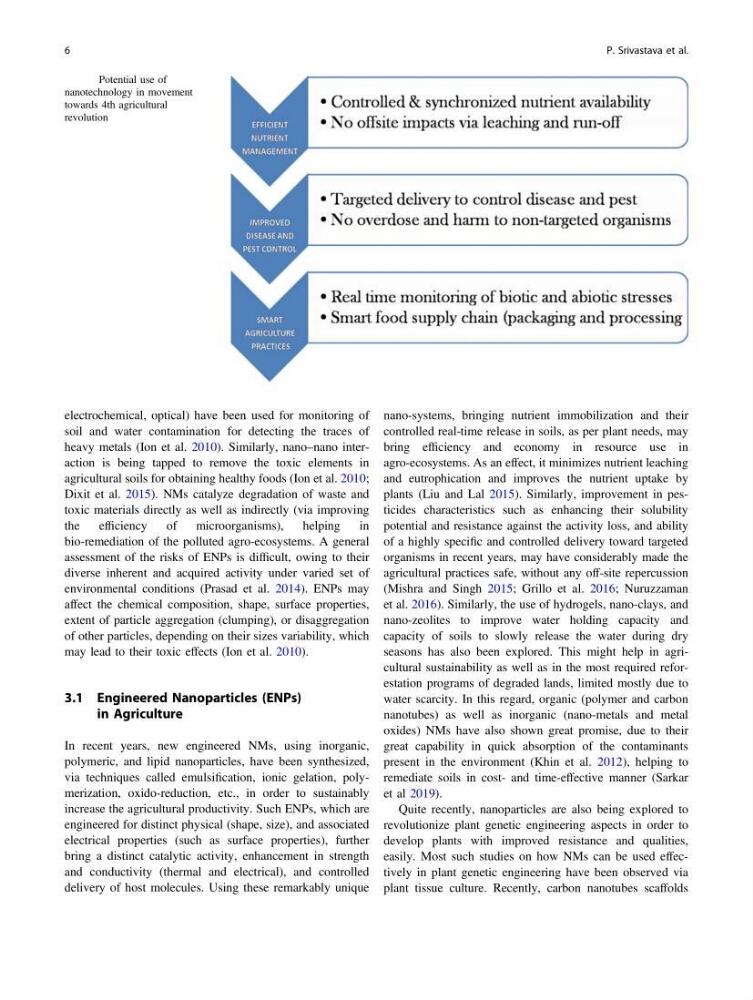
Fig. 1 Potential use of
nanotechnology in movement
towards 4th agricultural
revolution
6
P. Srivastava et al.
soil and water contamination for detecting the traces of
heavy metals (Ion et al. 2010). Similarly, nano–nano interaction is being tapped to remove the toxic elements in
agricultural soils for obtaining healthy foods (Ion et al. 2010;
Dixit et al. 2015). NMs catalyze degradation of waste and
toxic materials directly as well as indirectly (via improving
the
efficiency
of
microorganisms),
helping
in
bio-remediation of the polluted agro-ecosystems. A general
assessment of the risks of ENPs is difficult, owing to their
diverse inherent and acquired activity under varied set of
environmental conditions (Prasad et al. 2014). ENPs may
affect the chemical composition, shape, surface properties,
extent of particle aggregation (clumping), or disaggregation
of other particles, depending on their sizes variability, which
may lead to their toxic effects (Ion et al. 2010).
3.1 Engineered Nanoparticles (ENPs)
in Agriculture
In recent years, new engineered NMs, using inorganic,
polymeric, and lipid nanoparticles, have been synthesized,
via techniques called emulsification, ionic gelation, polymerization, oxido-reduction, etc., in order to sustainably
increase the agricultural productivity. Such ENPs, which are
engineered for distinct physical (shape, size), and associated
electrical properties (such as surface properties), further
bring a distinct catalytic activity, enhancement in strength
and conductivity (thermal and electrical), and controlled
delivery of host molecules. Using these remarkably unique
nano-systems, bringing nutrient immobilization and their
controlled real-time release in soils, as per plant needs, may
bring efficiency and economy in resource use in
agro-ecosystems. As an effect, it minimizes nutrient leaching
and eutrophication and improves the nutrient uptake by
plants (Liu and Lal 2015). Similarly, improvement in pesticides characteristics such as enhancing their solubility
potential and resistance against the activity loss, and ability
of a highly specific and controlled delivery toward targeted
organisms in recent years, may have considerably made the
agricultural practices safe, without any off-site repercussion
(Mishra and Singh 2015; Grillo et al. 2016; Nuruzzaman
et al. 2016). Similarly, the use of hydrogels, nano-clays, and
nano-zeolites to improve water holding capacity and
capacity of soils to slowly release the water during dry
seasons has also been explored. This might help in agricultural sustainability as well as in the most required reforestation programs of degraded lands, limited mostly due to
water scarcity. In this regard, organic (polymer and carbon
nanotubes) as well as inorganic (nano-metals and metal
oxides) NMs have also shown great promise, due to their
great capability in quick absorption of the contaminants
present in the environment (Khin et al. 2012), helping to
remediate soils in cost- and time-effective manner (Sarkar
et al 2019).
Quite recently, nanoparticles are also being explored to
revolutionize plant genetic engineering aspects in order to
develop plants with improved resistance and qualities,
easily. Most such studies on how NMs can be used effectively in plant genetic engineering have been observed via
plant tissue culture. Recently, carbon nanotubes scaffolds
Fig. 1 Potential use of
nanotechnology in movement
towards 4th agricultural
revolution
6
P. Srivastava et al.