

nitrate slowly. It prolongs the time of action and reduces loss
by leaching (Shalaby et al. 2016).
5.3 Zinc Oxide Nanoparticles
Zinc is a micronutrient that removes the zinc deficiency of
the soil. It enhances the various parts and activities of the
plants (like shoot, root, biomass, activities of chlorophyll,
protein, antioxidant, and enzyme related). ZnO nanoparticles
have better solubility than bulk ZnO particles. Tarafdar et al.
(2014) have reported that bio-synthesized zinc nanoparticles
are used as nanofertilizer application in the plant pearl millet
(Pennisetum americanum L.) cv. HHB 67. Considerable
improvement in the various contents and activities of the
plant such as shoot length (15%), root area (24%), root
length (4%), plant dry biomass (13%), chlorophyll (24%),
total soluble leaf protein (39%), and enzyme activities (acid
phosphatase: 77%, alkaline phosphatase: 62%, phytase:
322%, and dehydrogenase: 21%) are found. After the
application of zinc nanofertilizer, grain yield at the maturity
of crop up to 38% has improved (Tarafdar et al. 2014).
Zinc oxide and titanium dioxide nanoparticles are incorporated on the leaves of the tomato plants using novel
aerosolization techniques. As a result, light and minerals are
absorbed more effectively by the plants and the fruit had
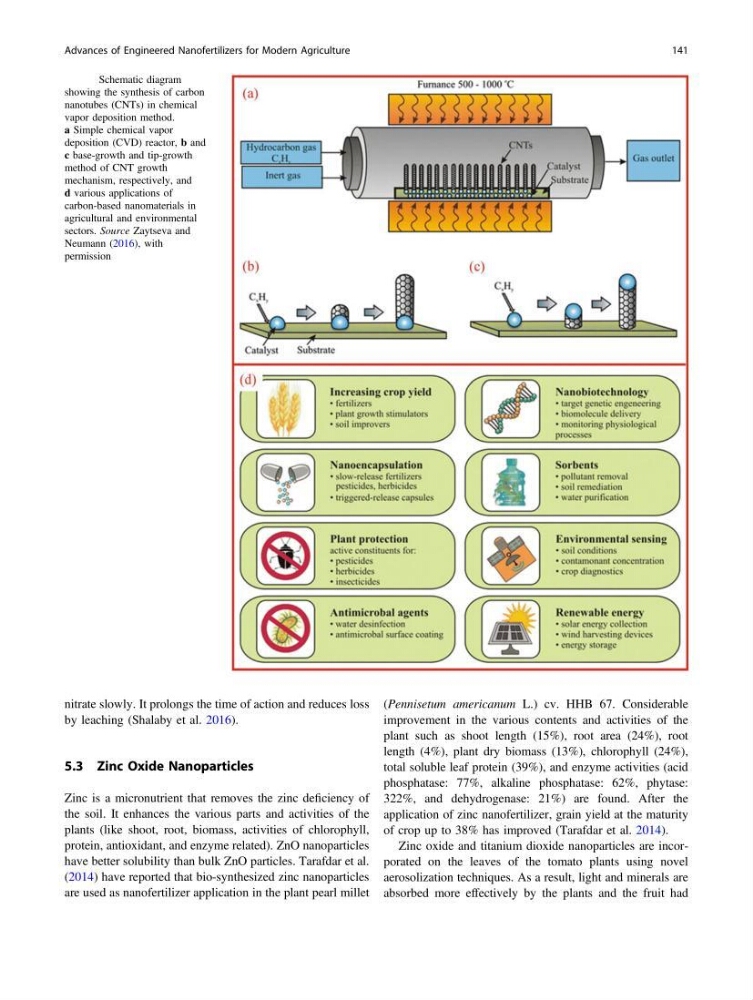
Fig. 6 Schematic diagram
showing the synthesis of carbon
nanotubes (CNTs) in chemical
vapor deposition method.
a Simple chemical vapor
deposition (CVD) reactor, b and
c base-growth and tip-growth
method of CNT growth
mechanism, respectively, and
d various applications of
carbon-based nanomaterials in
agricultural and environmental
sectors. Source Zaytseva and
Neumann (2016), with
permission
Advances of Engineered Nanofertilizers for Modern Agriculture
141
by leaching (Shalaby et al. 2016).
5.3 Zinc Oxide Nanoparticles
Zinc is a micronutrient that removes the zinc deficiency of
the soil. It enhances the various parts and activities of the
plants (like shoot, root, biomass, activities of chlorophyll,
protein, antioxidant, and enzyme related). ZnO nanoparticles
have better solubility than bulk ZnO particles. Tarafdar et al.
(2014) have reported that bio-synthesized zinc nanoparticles
are used as nanofertilizer application in the plant pearl millet
(Pennisetum americanum L.) cv. HHB 67. Considerable
improvement in the various contents and activities of the
plant such as shoot length (15%), root area (24%), root
length (4%), plant dry biomass (13%), chlorophyll (24%),
total soluble leaf protein (39%), and enzyme activities (acid
phosphatase: 77%, alkaline phosphatase: 62%, phytase:
322%, and dehydrogenase: 21%) are found. After the
application of zinc nanofertilizer, grain yield at the maturity
of crop up to 38% has improved (Tarafdar et al. 2014).
Zinc oxide and titanium dioxide nanoparticles are incorporated on the leaves of the tomato plants using novel
aerosolization techniques. As a result, light and minerals are
absorbed more effectively by the plants and the fruit had
Fig. 6 Schematic diagram
showing the synthesis of carbon
nanotubes (CNTs) in chemical
vapor deposition method.
a Simple chemical vapor
deposition (CVD) reactor, b and
c base-growth and tip-growth
method of CNT growth
mechanism, respectively, and
d various applications of
carbon-based nanomaterials in
agricultural and environmental
sectors. Source Zaytseva and
Neumann (2016), with
permission
Advances of Engineered Nanofertilizers for Modern Agriculture
141