

purposes. In addition, the predecided dosage of different
nanoparticles, therefore, would help to improve the productivity of soil in an economical manner.
5 Application of Nanoparticles
in Reclamation of Degraded Agricultural
Lands
Myriads of nanoparticles with diverse application in environmental decontamination, medicine, and enhancement in
agricultural productivity based on different physico-chemical
methods are synthesized to date. Varying degree of influences of ENPs on crops, soil properties, and ecological
functioning is reported by various authors. Apart from
considerable toxicological impacts on agro-ecosystem,
engineered nanomaterials could be exploited successfully for
the reclamation of ecologically degraded lands. Successful
reclamation would provide additional cultivable land areas
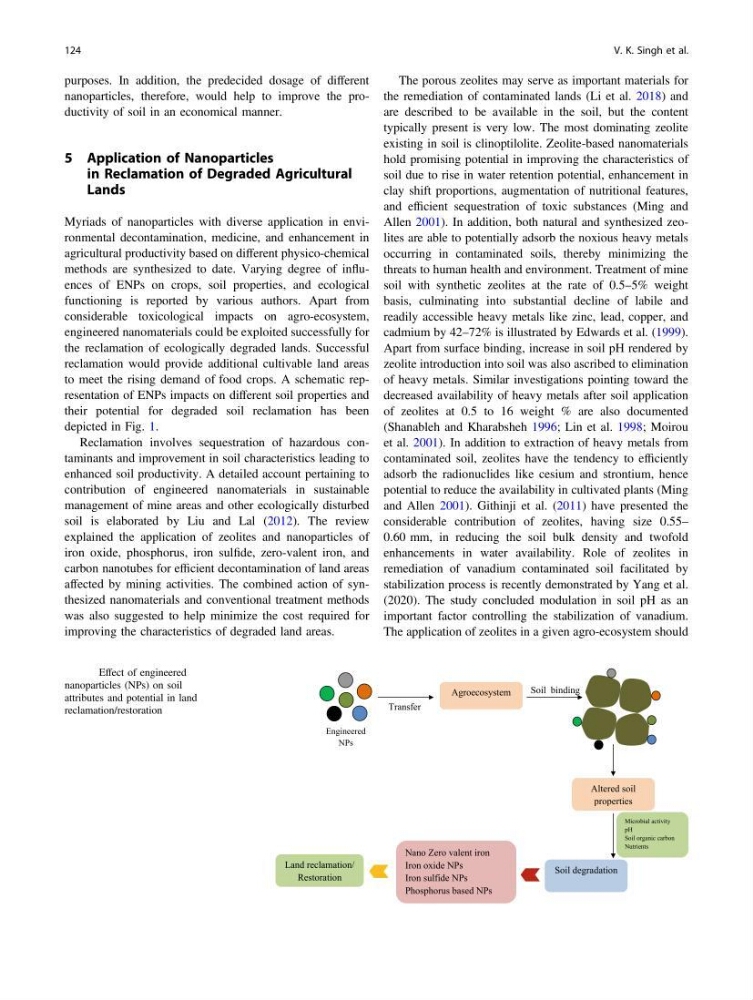
to meet the rising demand of food crops. A schematic representation of ENPs impacts on different soil properties and
their potential for degraded soil reclamation has been
depicted in Fig. 1.
Reclamation involves sequestration of hazardous contaminants and improvement in soil characteristics leading to
enhanced soil productivity. A detailed account pertaining to
contribution of engineered nanomaterials in sustainable
management of mine areas and other ecologically disturbed
soil is elaborated by Liu and Lal (2012). The review
explained the application of zeolites and nanoparticles of
iron oxide, phosphorus, iron sulfide, zero-valent iron, and
carbon nanotubes for efficient decontamination of land areas
affected by mining activities. The combined action of synthesized nanomaterials and conventional treatment methods
was also suggested to help minimize the cost required for
improving the characteristics of degraded land areas.
The porous zeolites may serve as important materials for
the remediation of contaminated lands (Li et al. 2018) and
are described to be available in the soil, but the content
typically present is very low. The most dominating zeolite
existing in soil is clinoptilolite. Zeolite-based nanomaterials
hold promising potential in improving the characteristics of
soil due to rise in water retention potential, enhancement in
clay shift proportions, augmentation of nutritional features,
and efficient sequestration of toxic substances (Ming and
Allen 2001). In addition, both natural and synthesized zeolites are able to potentially adsorb the noxious heavy metals
occurring in contaminated soils, thereby minimizing the
threats to human health and environment. Treatment of mine
soil with synthetic zeolites at the rate of 0.5–5% weight
basis, culminating into substantial decline of labile and
readily accessible heavy metals like zinc, lead, copper, and
cadmium by 42–72% is illustrated by Edwards et al. (1999).
Apart from surface binding, increase in soil pH rendered by
zeolite introduction into soil was also ascribed to elimination
of heavy metals. Similar investigations pointing toward the
decreased availability of heavy metals after soil application
of zeolites at 0.5 to 16 weight % are also documented
(Shanableh and Kharabsheh 1996; Lin et al. 1998; Moirou
et al. 2001). In addition to extraction of heavy metals from
contaminated soil, zeolites have the tendency to efficiently
adsorb the radionuclides like cesium and strontium, hence
potential to reduce the availability in cultivated plants (Ming
and Allen 2001). Githinji et al. (2011) have presented the
considerable contribution of zeolites, having size 0.55–
0.60 mm, in reducing the soil bulk density and twofold
enhancements in water availability. Role of zeolites in
remediation of vanadium contaminated soil facilitated by
stabilization process is recently demonstrated by Yang et al.
(2020). The study concluded modulation in soil pH as an
important factor controlling the stabilization of vanadium.
The application of zeolites in a given agro-ecosystem should
Engineered
NPs
Transfer
Soil binding
Agroecosystem
Altered soil
properties
Soil degradation
Land reclamation/
Restoration
Nano Zero valent iron
Iron oxide NPs
Iron sulfide NPs
Phosphorus based NPs
Microbial activity
pH
Soil organic carbon
Nutrients
Fig. 1 Effect of engineered
nanoparticles (NPs) on soil
attributes and potential in land
reclamation/restoration
124
V. K. Singh et al.
nanoparticles, therefore, would help to improve the productivity of soil in an economical manner.
5 Application of Nanoparticles
in Reclamation of Degraded Agricultural
Lands
Myriads of nanoparticles with diverse application in environmental decontamination, medicine, and enhancement in
agricultural productivity based on different physico-chemical
methods are synthesized to date. Varying degree of influences of ENPs on crops, soil properties, and ecological
functioning is reported by various authors. Apart from
considerable toxicological impacts on agro-ecosystem,
engineered nanomaterials could be exploited successfully for
the reclamation of ecologically degraded lands. Successful
reclamation would provide additional cultivable land areas
to meet the rising demand of food crops. A schematic representation of ENPs impacts on different soil properties and
their potential for degraded soil reclamation has been
depicted in Fig. 1.
Reclamation involves sequestration of hazardous contaminants and improvement in soil characteristics leading to
enhanced soil productivity. A detailed account pertaining to
contribution of engineered nanomaterials in sustainable
management of mine areas and other ecologically disturbed
soil is elaborated by Liu and Lal (2012). The review
explained the application of zeolites and nanoparticles of
iron oxide, phosphorus, iron sulfide, zero-valent iron, and
carbon nanotubes for efficient decontamination of land areas
affected by mining activities. The combined action of synthesized nanomaterials and conventional treatment methods
was also suggested to help minimize the cost required for
improving the characteristics of degraded land areas.
The porous zeolites may serve as important materials for
the remediation of contaminated lands (Li et al. 2018) and
are described to be available in the soil, but the content
typically present is very low. The most dominating zeolite
existing in soil is clinoptilolite. Zeolite-based nanomaterials
hold promising potential in improving the characteristics of
soil due to rise in water retention potential, enhancement in
clay shift proportions, augmentation of nutritional features,
and efficient sequestration of toxic substances (Ming and
Allen 2001). In addition, both natural and synthesized zeolites are able to potentially adsorb the noxious heavy metals
occurring in contaminated soils, thereby minimizing the
threats to human health and environment. Treatment of mine
soil with synthetic zeolites at the rate of 0.5–5% weight
basis, culminating into substantial decline of labile and
readily accessible heavy metals like zinc, lead, copper, and
cadmium by 42–72% is illustrated by Edwards et al. (1999).
Apart from surface binding, increase in soil pH rendered by
zeolite introduction into soil was also ascribed to elimination
of heavy metals. Similar investigations pointing toward the
decreased availability of heavy metals after soil application
of zeolites at 0.5 to 16 weight % are also documented
(Shanableh and Kharabsheh 1996; Lin et al. 1998; Moirou
et al. 2001). In addition to extraction of heavy metals from
contaminated soil, zeolites have the tendency to efficiently
adsorb the radionuclides like cesium and strontium, hence
potential to reduce the availability in cultivated plants (Ming
and Allen 2001). Githinji et al. (2011) have presented the
considerable contribution of zeolites, having size 0.55–
0.60 mm, in reducing the soil bulk density and twofold
enhancements in water availability. Role of zeolites in
remediation of vanadium contaminated soil facilitated by
stabilization process is recently demonstrated by Yang et al.
(2020). The study concluded modulation in soil pH as an
important factor controlling the stabilization of vanadium.
The application of zeolites in a given agro-ecosystem should
Engineered
NPs
Transfer
Soil binding
Agroecosystem
Altered soil
properties
Soil degradation
Land reclamation/
Restoration
Nano Zero valent iron
Iron oxide NPs
Iron sulfide NPs
Phosphorus based NPs
Microbial activity
pH
Soil organic carbon
Nutrients
Fig. 1 Effect of engineered
nanoparticles (NPs) on soil
attributes and potential in land
reclamation/restoration
124
V. K. Singh et al.