

aggregation, sedimentation, dissolution, oxidation, reduction, and deposition of ENPs and eventually modify the
bioavailability and toxicity for soil environment. The release
of metal ions from certain ENPs and metal ion complexes
causes toxicity to microorganism and the dissolved organic
matter could significantly alter their release by blocking
ENPs oxidation sites. Recent research about this has clearly
stated that the reduction of Ag
+ through dissolved organic
matter has diminished the acute toxicity in Daphnia magna
(Zhang et al. 2016). Also, in different natural organic
macromolecules types, such as humic acid, fulvic acid,
alginic acid, and tannic acid have collectively alleviated the
ZnO induced antimicrobial activity in Bacillus subtilis due to
their binding of Zn
+2 with natural organic matter (Ma et al.
2013). Similar findings were also observed by Nie et al.
(2020) who showed that soil organic matter reduces Ag
+ to
Ag NPs which was mediated through free organic radicals
and reducing surface groups of organic matter. The interaction of Ag
+ with soil organic matter has helped in elucidating the formation of silver nanoparticles (Nie et al. 2020).
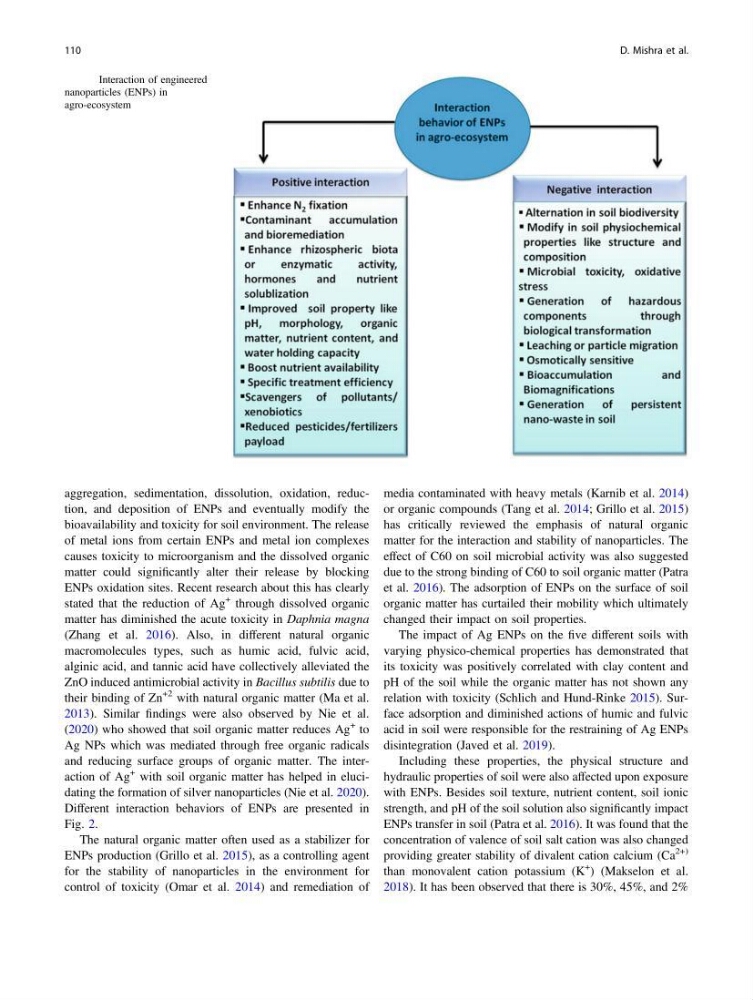
Different interaction behaviors of ENPs are presented in
Fig. 2.
The natural organic matter often used as a stabilizer for
ENPs production (Grillo et al. 2015), as a controlling agent
for the stability of nanoparticles in the environment for
control of toxicity (Omar et al. 2014) and remediation of
media contaminated with heavy metals (Karnib et al. 2014)
or organic compounds (Tang et al. 2014; Grillo et al. 2015)
has critically reviewed the emphasis of natural organic
matter for the interaction and stability of nanoparticles. The
effect of C60 on soil microbial activity was also suggested
due to the strong binding of C60 to soil organic matter (Patra
et al. 2016). The adsorption of ENPs on the surface of soil
organic matter has curtailed their mobility which ultimately
changed their impact on soil properties.
The impact of Ag ENPs on the five different soils with
varying physico-chemical properties has demonstrated that
its toxicity was positively correlated with clay content and
pH of the soil while the organic matter has not shown any
relation with toxicity (Schlich and Hund-Rinke 2015). Surface adsorption and diminished actions of humic and fulvic
acid in soil were responsible for the restraining of Ag ENPs
disintegration (Javed et al. 2019).
Including these properties, the physical structure and
hydraulic properties of soil were also affected upon exposure
with ENPs. Besides soil texture, nutrient content, soil ionic
strength, and pH of the soil solution also significantly impact
ENPs transfer in soil (Patra et al. 2016). It was found that the
concentration of valence of soil salt cation was also changed
providing greater stability of divalent cation calcium (Ca
2+)
than monovalent cation potassium (K
+ ) (Makselon et al.
2018). It has been observed that there is 30%, 45%, and 2%
Fig. 2 Interaction of engineered
nanoparticles (ENPs) in
agro-ecosystem
110
D. Mishra et al.
bioavailability and toxicity for soil environment. The release
of metal ions from certain ENPs and metal ion complexes
causes toxicity to microorganism and the dissolved organic
matter could significantly alter their release by blocking
ENPs oxidation sites. Recent research about this has clearly
stated that the reduction of Ag
+ through dissolved organic
matter has diminished the acute toxicity in Daphnia magna
(Zhang et al. 2016). Also, in different natural organic
macromolecules types, such as humic acid, fulvic acid,
alginic acid, and tannic acid have collectively alleviated the
ZnO induced antimicrobial activity in Bacillus subtilis due to
their binding of Zn
+2 with natural organic matter (Ma et al.
2013). Similar findings were also observed by Nie et al.
(2020) who showed that soil organic matter reduces Ag
+ to
Ag NPs which was mediated through free organic radicals
and reducing surface groups of organic matter. The interaction of Ag
+ with soil organic matter has helped in elucidating the formation of silver nanoparticles (Nie et al. 2020).
Different interaction behaviors of ENPs are presented in
Fig. 2.
The natural organic matter often used as a stabilizer for
ENPs production (Grillo et al. 2015), as a controlling agent
for the stability of nanoparticles in the environment for
control of toxicity (Omar et al. 2014) and remediation of
media contaminated with heavy metals (Karnib et al. 2014)
or organic compounds (Tang et al. 2014; Grillo et al. 2015)
has critically reviewed the emphasis of natural organic
matter for the interaction and stability of nanoparticles. The
effect of C60 on soil microbial activity was also suggested
due to the strong binding of C60 to soil organic matter (Patra
et al. 2016). The adsorption of ENPs on the surface of soil
organic matter has curtailed their mobility which ultimately
changed their impact on soil properties.
The impact of Ag ENPs on the five different soils with
varying physico-chemical properties has demonstrated that
its toxicity was positively correlated with clay content and
pH of the soil while the organic matter has not shown any
relation with toxicity (Schlich and Hund-Rinke 2015). Surface adsorption and diminished actions of humic and fulvic
acid in soil were responsible for the restraining of Ag ENPs
disintegration (Javed et al. 2019).
Including these properties, the physical structure and
hydraulic properties of soil were also affected upon exposure
with ENPs. Besides soil texture, nutrient content, soil ionic
strength, and pH of the soil solution also significantly impact
ENPs transfer in soil (Patra et al. 2016). It was found that the
concentration of valence of soil salt cation was also changed
providing greater stability of divalent cation calcium (Ca
2+)
than monovalent cation potassium (K
+ ) (Makselon et al.
2018). It has been observed that there is 30%, 45%, and 2%
Fig. 2 Interaction of engineered
nanoparticles (ENPs) in
agro-ecosystem
110
D. Mishra et al.