

reaction reviews, see: [12–18]). In this review, we wish to summarize these results.
The often used ligands in this article are outlined in Fig. 1 (for Pd-catalyzed
reactions) and Fig. 2 (for Cu-catalyzed reactions).
2 Indoles and Related Heterocycles
The indole moiety exists widely in bioactive natural products and artificial
molecules. Establishing efficient methods for constructing the indole compounds
has been an active area in organic synthesis for over 100 years (for reviews,
see: [19–23]). The newly developed C–N bond formation reactions allow indole
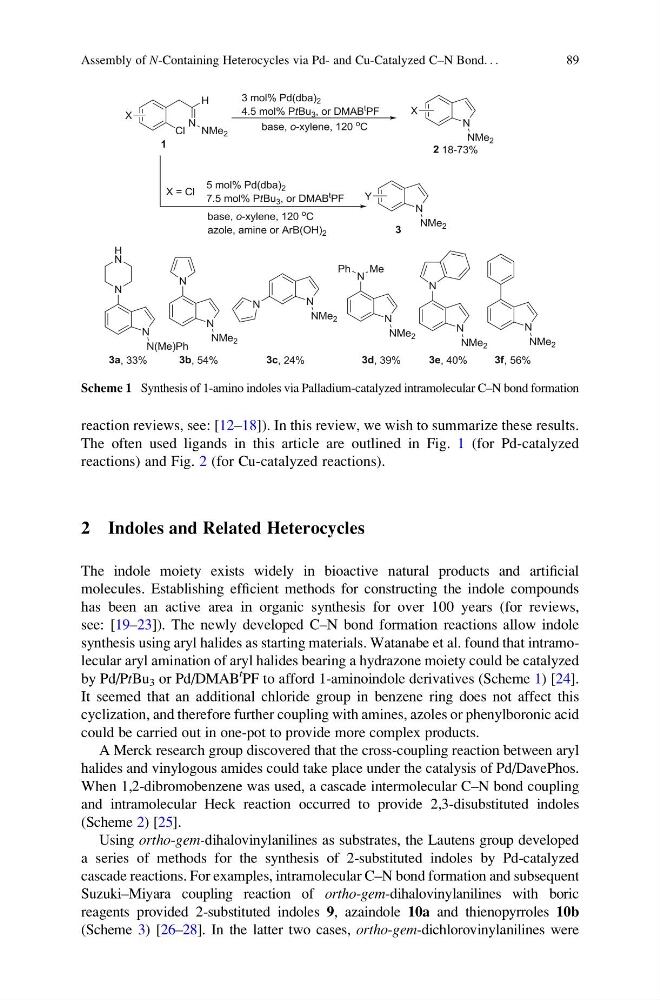
synthesis using aryl halides as starting materials. Watanabe et al. found that intramolecular aryl amination of aryl halides bearing a hydrazone moiety could be catalyzed
by Pd/PtBu 3 or Pd/DMAB
t
PF to afford 1-aminoindole derivatives (Scheme 1) [24].
It seemed that an additional chloride group in benzene ring does not affect this
cyclization, and therefore further coupling with amines, azoles or phenylboronic acid
could be carried out in one-pot to provide more complex products.
A Merck research group discovered that the cross-coupling reaction between aryl
halides and vinylogous amides could take place under the catalysis of Pd/DavePhos.
When 1,2-dibromobenzene was used, a cascade intermolecular C–N bond coupling
and intramolecular Heck reaction occurred to provide 2,3-disubstituted indoles
(Scheme 2) [25].
Using ortho-gem-dihalovinylanilines as substrates, the Lautens group developed
a series of methods for the synthesis of 2-substituted indoles by Pd-catalyzed
cascade reactions. For examples, intramolecular C–N bond formation and subsequent
Suzuki–Miyara coupling reaction of ortho-gem-dihalovinylanilines with boric
reagents provided 2-substituted indoles 9, azaindole 10a and thienopyrroles 10b
(Scheme 3) [26–28]. In the latter two cases, ortho-gem-dichlorovinylanilines were
Scheme 1 Synthesis of 1-amino indoles via Palladium-catalyzed intramolecular C–N bond formation
Assembly of N-Containing Heterocycles via Pd- and Cu-Catalyzed C–N Bond. . .
89
The often used ligands in this article are outlined in Fig. 1 (for Pd-catalyzed
reactions) and Fig. 2 (for Cu-catalyzed reactions).
2 Indoles and Related Heterocycles
The indole moiety exists widely in bioactive natural products and artificial
molecules. Establishing efficient methods for constructing the indole compounds
has been an active area in organic synthesis for over 100 years (for reviews,
see: [19–23]). The newly developed C–N bond formation reactions allow indole
synthesis using aryl halides as starting materials. Watanabe et al. found that intramolecular aryl amination of aryl halides bearing a hydrazone moiety could be catalyzed
by Pd/PtBu 3 or Pd/DMAB
t
PF to afford 1-aminoindole derivatives (Scheme 1) [24].
It seemed that an additional chloride group in benzene ring does not affect this
cyclization, and therefore further coupling with amines, azoles or phenylboronic acid
could be carried out in one-pot to provide more complex products.
A Merck research group discovered that the cross-coupling reaction between aryl
halides and vinylogous amides could take place under the catalysis of Pd/DavePhos.
When 1,2-dibromobenzene was used, a cascade intermolecular C–N bond coupling
and intramolecular Heck reaction occurred to provide 2,3-disubstituted indoles
(Scheme 2) [25].
Using ortho-gem-dihalovinylanilines as substrates, the Lautens group developed
a series of methods for the synthesis of 2-substituted indoles by Pd-catalyzed
cascade reactions. For examples, intramolecular C–N bond formation and subsequent
Suzuki–Miyara coupling reaction of ortho-gem-dihalovinylanilines with boric
reagents provided 2-substituted indoles 9, azaindole 10a and thienopyrroles 10b
(Scheme 3) [26–28]. In the latter two cases, ortho-gem-dichlorovinylanilines were
Scheme 1 Synthesis of 1-amino indoles via Palladium-catalyzed intramolecular C–N bond formation
Assembly of N-Containing Heterocycles via Pd- and Cu-Catalyzed C–N Bond. . .
89