

I
Br
F 3 C
H 2 N
+
Pd 2 (dba) 3 (1.25 mol %)
dppf (5 mol %)
N
H
F 3 C
64%
NaOtBu, toluene
rt to 140 ºC
ð48Þ
N
Cl
I
N
N
NH 2
+
Pd(OAc) (4 mol %)
Xantphos (2 mol %)
N
N
N
N
94%
Cs 2 CO 3 , toluene
110 ºC
ð49Þ
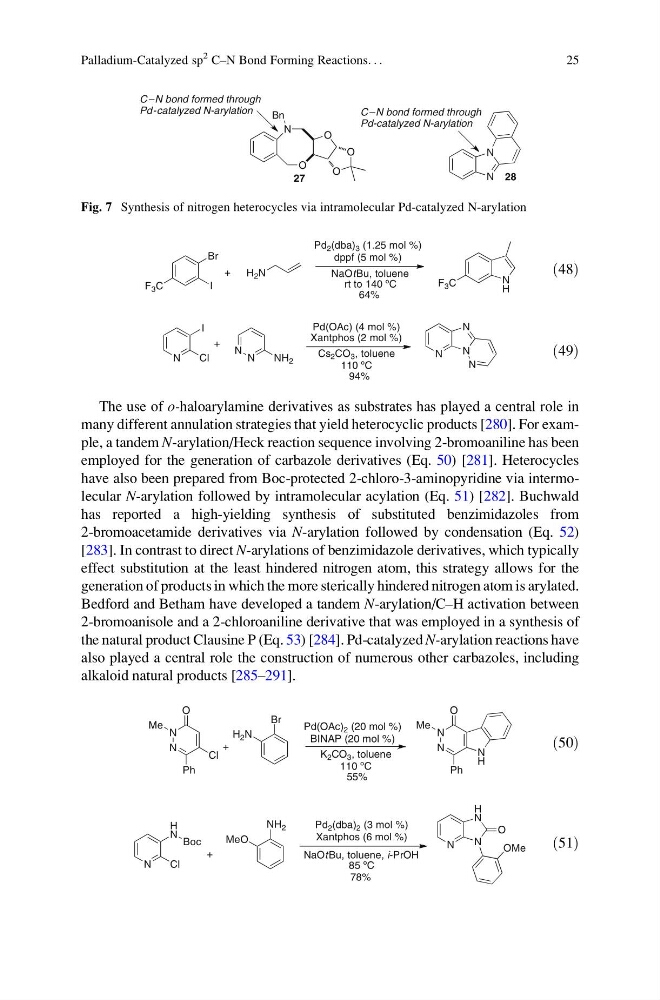
The use of o-haloarylamine derivatives as substrates has played a central role in
many different annulation strategies that yield heterocyclic products [280]. For example, a tandem N-arylation/Heck reaction sequence involving 2-bromoaniline has been
employed for the generation of carbazole derivatives (Eq. 50) [281]. Heterocycles
have also been prepared from Boc-protected 2-chloro-3-aminopyridine via intermolecular N-arylation followed by intramolecular acylation (Eq. 51) [282]. Buchwald
has reported a high-yielding synthesis of substituted benzimidazoles from
2-bromoacetamide derivatives via N-arylation followed by condensation (Eq. 52)
[283]. In contrast to direct N-arylations of benzimidazole derivatives, which typically
effect substitution at the least hindered nitrogen atom, this strategy allows for the
generation of products in which the more sterically hindered nitrogen atom is arylated.
Bedford and Betham have developed a tandem N-arylation/C–H activation between
2-bromoanisole and a 2-chloroaniline derivative that was employed in a synthesis of
the natural product Clausine P (Eq. 53) [284]. Pd-catalyzed N-arylation reactions have
also played a central role the construction of numerous other carbazoles, including
alkaloid natural products [285–291].
N
N
Me
O
Cl
Ph
Br
H 2 N
+
Pd(OAc) 2 (20 mol %)
BINAP (20 mol %)
N
N
N
H
O
Me
Ph
55%
K 2 CO 3 , toluene
110 ºC
ð50Þ
N
H
N
Cl
NH 2
MeO
+
Pd 2 (dba) 2 (3 mol %)
Xantphos (6 mol %)
N
N
H
N
O
OMe
78%
Boc
NaOt Bu, toluene, i-PrOH
85 ºC
ð51Þ
O
N
O
O
O
Bn
27
N
N
28
C –N bond formed through
Pd-catalyzed N-arylation
C– N bond formed through
Pd-catalyzed N-arylation
Fig. 7 Synthesis of nitrogen heterocycles via intramolecular Pd-catalyzed N-arylation
Palladium-Catalyzed sp
2 C–N Bond Forming Reactions. . .
25
Br
F 3 C
H 2 N
+
Pd 2 (dba) 3 (1.25 mol %)
dppf (5 mol %)
N
H
F 3 C
64%
NaOtBu, toluene
rt to 140 ºC
ð48Þ
N
Cl
I
N
N
NH 2
+
Pd(OAc) (4 mol %)
Xantphos (2 mol %)
N
N
N
N
94%
Cs 2 CO 3 , toluene
110 ºC
ð49Þ
The use of o-haloarylamine derivatives as substrates has played a central role in
many different annulation strategies that yield heterocyclic products [280]. For example, a tandem N-arylation/Heck reaction sequence involving 2-bromoaniline has been
employed for the generation of carbazole derivatives (Eq. 50) [281]. Heterocycles
have also been prepared from Boc-protected 2-chloro-3-aminopyridine via intermolecular N-arylation followed by intramolecular acylation (Eq. 51) [282]. Buchwald
has reported a high-yielding synthesis of substituted benzimidazoles from
2-bromoacetamide derivatives via N-arylation followed by condensation (Eq. 52)
[283]. In contrast to direct N-arylations of benzimidazole derivatives, which typically
effect substitution at the least hindered nitrogen atom, this strategy allows for the
generation of products in which the more sterically hindered nitrogen atom is arylated.
Bedford and Betham have developed a tandem N-arylation/C–H activation between
2-bromoanisole and a 2-chloroaniline derivative that was employed in a synthesis of
the natural product Clausine P (Eq. 53) [284]. Pd-catalyzed N-arylation reactions have
also played a central role the construction of numerous other carbazoles, including
alkaloid natural products [285–291].
N
N
Me
O
Cl
Ph
Br
H 2 N
+
Pd(OAc) 2 (20 mol %)
BINAP (20 mol %)
N
N
N
H
O
Me
Ph
55%
K 2 CO 3 , toluene
110 ºC
ð50Þ
N
H
N
Cl
NH 2
MeO
+
Pd 2 (dba) 2 (3 mol %)
Xantphos (6 mol %)
N
N
H
N
O
OMe
78%
Boc
NaOt Bu, toluene, i-PrOH
85 ºC
ð51Þ
O
N
O
O
O
Bn
27
N
N
28
C –N bond formed through
Pd-catalyzed N-arylation
C– N bond formed through
Pd-catalyzed N-arylation
Fig. 7 Synthesis of nitrogen heterocycles via intramolecular Pd-catalyzed N-arylation
Palladium-Catalyzed sp
2 C–N Bond Forming Reactions. . .
25