

S
O
NH
Ph
Br
Pd(OAc) 2 (1 mol %)
BINAP (1.5 mol %)
S
O
N
Ph
+
98%
NaOt Bu, toluene
110 ºC
ð18Þ
NH
Br
Ph
N
Ph
Pd 2 (dba) 3 (2 mol %)
BINAP (6 mol %)
75%
+
NaOtBu, toluene
90 ºC
ð19Þ
Pd 2 (dba) 3 (5 mol %)
X-Phos (10 mol %)
74%
N
H
NC
+
OEt
O
OTf
N
NC
O
OEt
K 3 PO 4 , toluene
60 80 ºC
ð20Þ
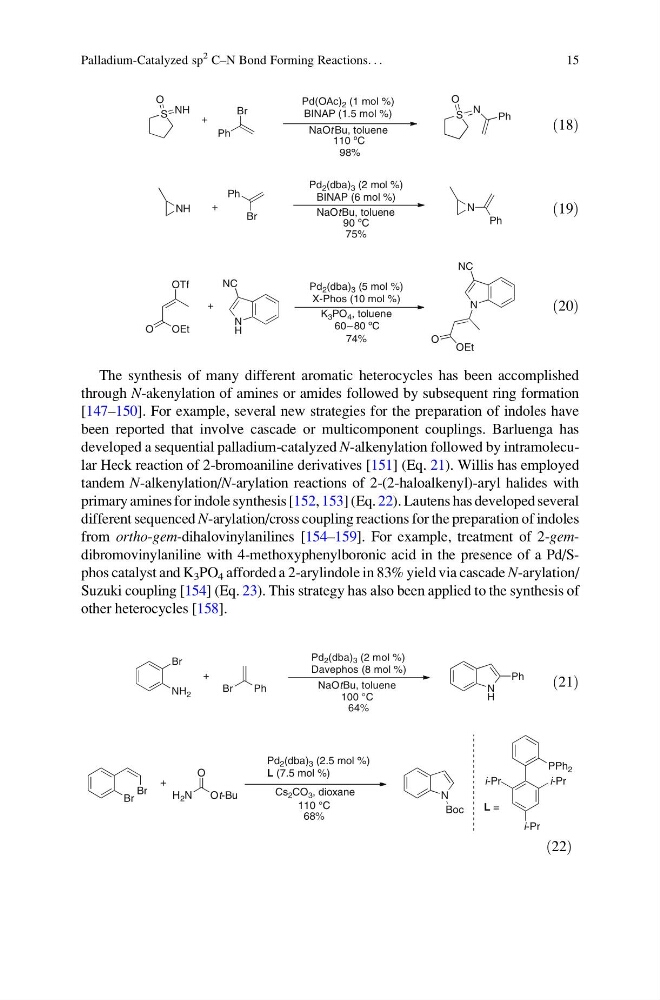
The synthesis of many different aromatic heterocycles has been accomplished
through N-akenylation of amines or amides followed by subsequent ring formation
[147–150]. For example, several new strategies for the preparation of indoles have
been reported that involve cascade or multicomponent couplings. Barluenga has
developed a sequential palladium-catalyzed N-alkenylation followed by intramolecular Heck reaction of 2-bromoaniline derivatives [151] (Eq. 21). Willis has employed
tandem N-alkenylation/N-arylation reactions of 2-(2-haloalkenyl)-aryl halides with
primary amines for indole synthesis [152, 153] (Eq. 22). Lautens has developed several
different sequenced N-arylation/cross coupling reactions for the preparation of indoles
from ortho-gem-dihalovinylanilines [154–159]. For example, treatment of 2-gemdibromovinylaniline with 4-methoxyphenylboronic acid in the presence of a Pd/Sphos catalyst and K 3 PO 4 afforded a 2-arylindole in 83% yield via cascade N-arylation/
Suzuki coupling [154] (Eq. 23). This strategy has also been applied to the synthesis of
other heterocycles [158].
Br
NH 2
+
Ph
Br
N
H
Ph
Pd 2 (dba) 3 (2 mol %)
Davephos (8 mol %)
NaOtBu, toluene
100 °C
64%
ð21Þ
Br
+
O
Ot-Bu
H 2 N
N
Pd 2 (dba) 3 (2.5 mol %)
L (7.5 mol %)
Cs 2 CO 3 , dioxane
110 °C
68%
Br
Boc
i-Pr
i-Pr
i-Pr
PPh 2
L =
ð22Þ
Palladium-Catalyzed sp
2 C–N Bond Forming Reactions. . .
15
O
NH
Ph
Br
Pd(OAc) 2 (1 mol %)
BINAP (1.5 mol %)
S
O
N
Ph
+
98%
NaOt Bu, toluene
110 ºC
ð18Þ
NH
Br
Ph
N
Ph
Pd 2 (dba) 3 (2 mol %)
BINAP (6 mol %)
75%
+
NaOtBu, toluene
90 ºC
ð19Þ
Pd 2 (dba) 3 (5 mol %)
X-Phos (10 mol %)
74%
N
H
NC
+
OEt
O
OTf
N
NC
O
OEt
K 3 PO 4 , toluene
60 80 ºC
ð20Þ
The synthesis of many different aromatic heterocycles has been accomplished
through N-akenylation of amines or amides followed by subsequent ring formation
[147–150]. For example, several new strategies for the preparation of indoles have
been reported that involve cascade or multicomponent couplings. Barluenga has
developed a sequential palladium-catalyzed N-alkenylation followed by intramolecular Heck reaction of 2-bromoaniline derivatives [151] (Eq. 21). Willis has employed
tandem N-alkenylation/N-arylation reactions of 2-(2-haloalkenyl)-aryl halides with
primary amines for indole synthesis [152, 153] (Eq. 22). Lautens has developed several
different sequenced N-arylation/cross coupling reactions for the preparation of indoles
from ortho-gem-dihalovinylanilines [154–159]. For example, treatment of 2-gemdibromovinylaniline with 4-methoxyphenylboronic acid in the presence of a Pd/Sphos catalyst and K 3 PO 4 afforded a 2-arylindole in 83% yield via cascade N-arylation/
Suzuki coupling [154] (Eq. 23). This strategy has also been applied to the synthesis of
other heterocycles [158].
Br
NH 2
+
Ph
Br
N
H
Ph
Pd 2 (dba) 3 (2 mol %)
Davephos (8 mol %)
NaOtBu, toluene
100 °C
64%
ð21Þ
Br
+
O
Ot-Bu
H 2 N
N
Pd 2 (dba) 3 (2.5 mol %)
L (7.5 mol %)
Cs 2 CO 3 , dioxane
110 °C
68%
Br
Boc
i-Pr
i-Pr
i-Pr
PPh 2
L =
ð22Þ
Palladium-Catalyzed sp
2 C–N Bond Forming Reactions. . .
15