

presence of K 2 CO 3 as base and water as solvent to give the N-arylated products in
good to excellent yields. For aryl iodides, the reaction proceeded at 80
C, whereas a
higher reaction temperature of 95–100
C was needed to activate aryl bromides.
Ortho-substituted aryl iodides afforded poor yields of the product owing to steric
reasons.
This copper catalyst system along with the aqueous phase were recyclable up to
four times without loss of catalytic activity, and FT-IR spectrum on the used
catalyst did not indicate any copper oxide formation.
Chaudhari et al. reported encapsulation of copper complexes in zeolite-Y and
MCM-41 or by tethering of copper complexes on various supports like zeolite-Y,
silica, charcoal, or clay [87]. These materials were then characterized by a plethora
of sophisticated analytical techniques like EPR, diffused reflectance UV–vis, XRD,
IAS, ICPES, SEM, and TEM and employed for the amination of aryl iodide to
synthesize diphenyl aniline or triphenyl amine (Scheme 21).
For encapsulated catalysts, amination reaction was carried out in a high pressure
autoclave containing aniline, iodobenzene, catalyst, and potassium tert-butoxide
(KOt-Bu) at 408 K for 14 h. For tethered catalysts, the amination reaction was
carried out in a two necked flask under reflux at 385 K for 10–12 h.
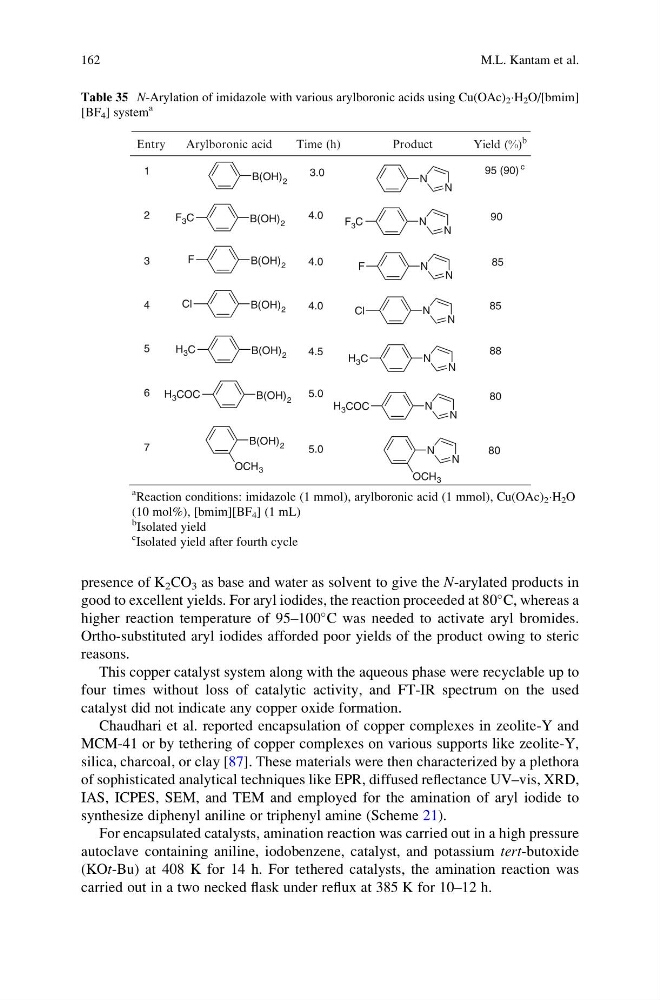
Table 35 N-Arylation of imidazole with various arylboronic acids using Cu(OAc) 2 ÁH 2 O/[bmim]
[BF 4 ] system
a
B(OH) 2
Entry
1
2
3
4
Arylboronic acid
Time (h)
Product
Yield (%)
b
B(OH) 2
B(OH) 2
B(OH) 2
B(OH) 2
B(OH) 2
B(OH) 2
5
6
7
3.0
4.0
4.0
4.0
4.5
5.0
5.0
N
N
N
N
N
N
N
N
N
N
N
N
N
N
95 (90)
c
90
85
85
88
80
80
F 3 C
F 3 C
F
F
Cl
Cl
H 3 C
H 3 C
H 3 COC
H 3 COC
OCH 3
OCH 3
a Reaction conditions: imidazole (1 mmol), arylboronic acid (1 mmol), Cu(OAc) 2 ÁH 2 O
(10 mol%), [bmim][BF 4 ] (1 mL)
b Isolated yield
c Isolated yield after fourth cycle
162
M.L. Kantam et al.
good to excellent yields. For aryl iodides, the reaction proceeded at 80
C, whereas a
higher reaction temperature of 95–100
C was needed to activate aryl bromides.
Ortho-substituted aryl iodides afforded poor yields of the product owing to steric
reasons.
This copper catalyst system along with the aqueous phase were recyclable up to
four times without loss of catalytic activity, and FT-IR spectrum on the used
catalyst did not indicate any copper oxide formation.
Chaudhari et al. reported encapsulation of copper complexes in zeolite-Y and
MCM-41 or by tethering of copper complexes on various supports like zeolite-Y,
silica, charcoal, or clay [87]. These materials were then characterized by a plethora
of sophisticated analytical techniques like EPR, diffused reflectance UV–vis, XRD,
IAS, ICPES, SEM, and TEM and employed for the amination of aryl iodide to
synthesize diphenyl aniline or triphenyl amine (Scheme 21).
For encapsulated catalysts, amination reaction was carried out in a high pressure
autoclave containing aniline, iodobenzene, catalyst, and potassium tert-butoxide
(KOt-Bu) at 408 K for 14 h. For tethered catalysts, the amination reaction was
carried out in a two necked flask under reflux at 385 K for 10–12 h.
Table 35 N-Arylation of imidazole with various arylboronic acids using Cu(OAc) 2 ÁH 2 O/[bmim]
[BF 4 ] system
a
B(OH) 2
Entry
1
2
3
4
Arylboronic acid
Time (h)
Product
Yield (%)
b
B(OH) 2
B(OH) 2
B(OH) 2
B(OH) 2
B(OH) 2
B(OH) 2
5
6
7
3.0
4.0
4.0
4.0
4.5
5.0
5.0
N
N
N
N
N
N
N
N
N
N
N
N
N
N
95 (90)
c
90
85
85
88
80
80
F 3 C
F 3 C
F
F
Cl
Cl
H 3 C
H 3 C
H 3 COC
H 3 COC
OCH 3
OCH 3
a Reaction conditions: imidazole (1 mmol), arylboronic acid (1 mmol), Cu(OAc) 2 ÁH 2 O
(10 mol%), [bmim][BF 4 ] (1 mL)
b Isolated yield
c Isolated yield after fourth cycle
162
M.L. Kantam et al.