

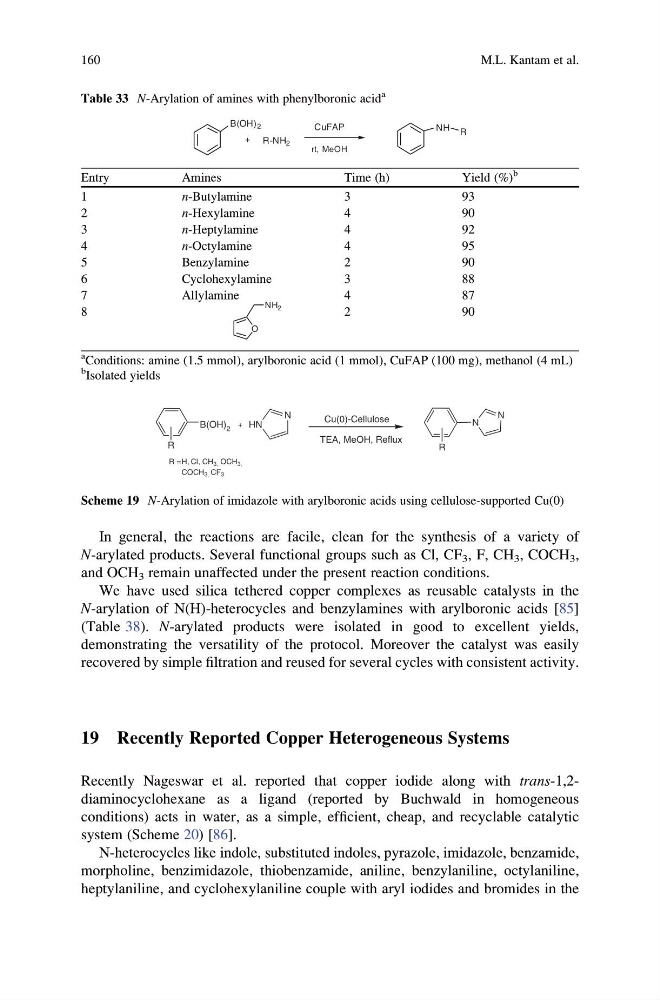
In general, the reactions are facile, clean for the synthesis of a variety of
N-arylated products. Several functional groups such as Cl, CF 3 , F, CH 3 , COCH 3 ,
and OCH 3 remain unaffected under the present reaction conditions.
We have used silica tethered copper complexes as reusable catalysts in the
N-arylation of N(H)-heterocycles and benzylamines with arylboronic acids [85]
(Table 38). N-arylated products were isolated in good to excellent yields,
demonstrating the versatility of the protocol. Moreover the catalyst was easily
recovered by simple filtration and reused for several cycles with consistent activity.
19 Recently Reported Copper Heterogeneous Systems
Recently Nageswar et al. reported that copper iodide along with trans-1,2diaminocyclohexane as a ligand (reported by Buchwald in homogeneous
conditions) acts in water, as a simple, efficient, cheap, and recyclable catalytic
system (Scheme 20) [86].
N-heterocycles like indole, substituted indoles, pyrazole, imidazole, benzamide,
morpholine, benzimidazole, thiobenzamide, aniline, benzylaniline, octylaniline,
heptylaniline, and cyclohexylaniline couple with aryl iodides and bromides in the
Table 33 N-Arylation of amines with phenylboronic acid
a
B(OH) 2
+
CuFAP
R-NH 2
NH R
rt, MeOH
Entry
Amines
Time (h)
Yield (%)
b
1
n-Butylamine
3
93
2
n-Hexylamine
4
90
3
n-Heptylamine
4
92
4
n-Octylamine
4
95
5
Benzylamine
2
90
6
Cyclohexylamine
3
88
7
Allylamine
4
87
8
O
NH 2
2
9 0
a
Conditions: amine (1.5 mmol), arylboronic acid (1 mmol), CuFAP (100 mg), methanol (4 mL)
b
Isolated yields
B(OH) 2
N
HN
+
Cu(0)-Cellulose
TEA, MeOH, Reflux
N
N
R
R
R =H, Cl, CH 3, OCH 3,
COCH 3, CF 3
Scheme 19 N-Arylation of imidazole with arylboronic acids using cellulose-supported Cu(0)
160
M.L. Kantam et al.
N-arylated products. Several functional groups such as Cl, CF 3 , F, CH 3 , COCH 3 ,
and OCH 3 remain unaffected under the present reaction conditions.
We have used silica tethered copper complexes as reusable catalysts in the
N-arylation of N(H)-heterocycles and benzylamines with arylboronic acids [85]
(Table 38). N-arylated products were isolated in good to excellent yields,
demonstrating the versatility of the protocol. Moreover the catalyst was easily
recovered by simple filtration and reused for several cycles with consistent activity.
19 Recently Reported Copper Heterogeneous Systems
Recently Nageswar et al. reported that copper iodide along with trans-1,2diaminocyclohexane as a ligand (reported by Buchwald in homogeneous
conditions) acts in water, as a simple, efficient, cheap, and recyclable catalytic
system (Scheme 20) [86].
N-heterocycles like indole, substituted indoles, pyrazole, imidazole, benzamide,
morpholine, benzimidazole, thiobenzamide, aniline, benzylaniline, octylaniline,
heptylaniline, and cyclohexylaniline couple with aryl iodides and bromides in the
Table 33 N-Arylation of amines with phenylboronic acid
a
B(OH) 2
+
CuFAP
R-NH 2
NH R
rt, MeOH
Entry
Amines
Time (h)
Yield (%)
b
1
n-Butylamine
3
93
2
n-Hexylamine
4
90
3
n-Heptylamine
4
92
4
n-Octylamine
4
95
5
Benzylamine
2
90
6
Cyclohexylamine
3
88
7
Allylamine
4
87
8
O
NH 2
2
9 0
a
Conditions: amine (1.5 mmol), arylboronic acid (1 mmol), CuFAP (100 mg), methanol (4 mL)
b
Isolated yields
B(OH) 2
N
HN
+
Cu(0)-Cellulose
TEA, MeOH, Reflux
N
N
R
R
R =H, Cl, CH 3, OCH 3,
COCH 3, CF 3
Scheme 19 N-Arylation of imidazole with arylboronic acids using cellulose-supported Cu(0)
160
M.L. Kantam et al.