

12 Cu 2 O-Coated Cu Nanoparticles
Hyeon [21] synthesized uniform Cu 2 O-coated Cu nanoparticles from the thermal
decomposition of copper acetylacetone followed by air oxidation and used these
nanoparticles as catalysts for Ullmann-type amination coupling reaction of aryl
chlorides.
Ullmann-type amination reaction of imidazole with various aryl chlorides having electron-withdrawing groups were conducted using the Cu 2 O coated copper
nanoparticles as catalysts, the reactions proceeded very well (Table 15, entries 1–8).
The high catalytic activity of the Cu 2 O-coated Cu nanoparticles seems to result
from the high surface area derived from the nanoparticles. In the case of unactivated aryl chlorides such as chlorobenzene and 4-methoxychlorobenzene,
there is no reaction (Table 15, entries 9 and 10). Various amines were screened to
obtain the coupled products with 4-chloroacetophenone (Table 16). In the case of
benzimidazole, pyrazole, and pyrrole, the yield of the product is good to moderate.
13 Resin-Supported Sulfonato-Cu-(salen) Complex
Salen ligands are recognized as efficient auxiliaries, and many metallosalen
complexes have been found to serve as excellent catalysts for various
organic transformations [46]. Styring et al. have reported the Suzuki–Miyaura
cross-coupling reaction by using a polymer-supported salen-type palladium complex [47, 48]. Taillefer et al. examined the efficiency of salen ligands in the Narylation of imidazole with bromobenzene in moderate yields [49, 50]. We
synthesized a resin-supported sulfonato-Cu(salen) catalyst 1 (Scheme 10) from
2 (Scheme 11) [51] and tested for the N-arylation of heterocycles with chloroand fluoroarenes in the presence of an inexpensive and mild base K 2 CO 3 .
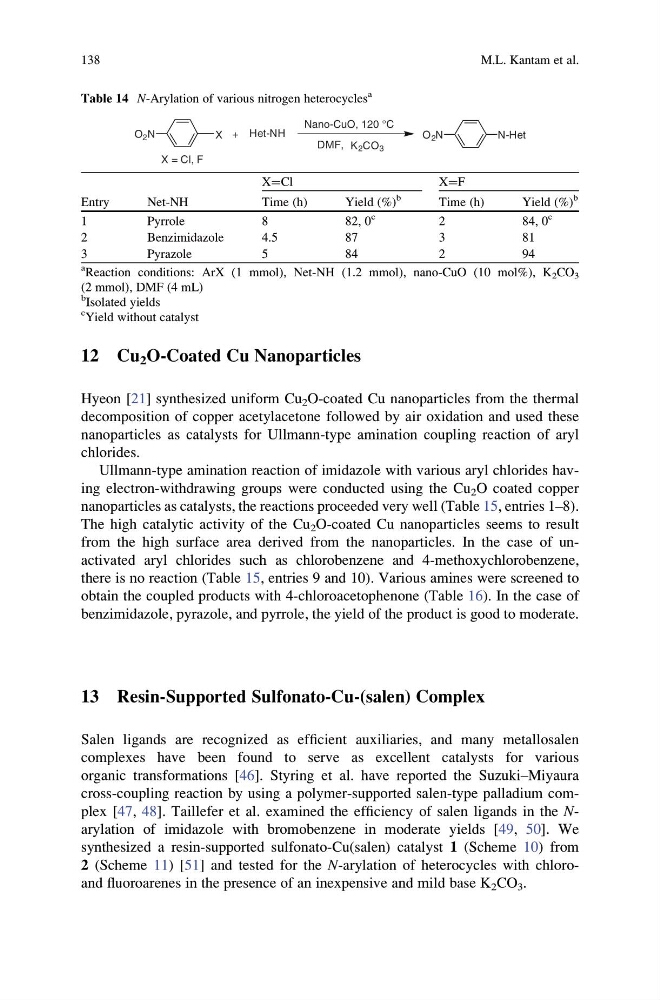
Table 14 N-Arylation of various nitrogen heterocycles
a
X
O 2 N
+ Het-NH
N-Het
O 2 N
X = Cl, F
Nano-CuO, 120 °C
DMF, K 2 CO 3
Entry
Net-NH
X¼Cl
X¼F
Time (h)
Yield (%)
b
Time (h)
Yield (%)
b
1
Pyrrole
8
82, 0
c
2
84, 0
c
2
Benzimidazole
4.5
87
3
81
3
Pyrazole
5
84
2
94
a
Reaction conditions: ArX (1 mmol), Net-NH (1.2 mmol), nano-CuO (10 mol%), K 2 CO 3
(2 mmol), DMF (4 mL)
b
Isolated yields
c
Yield without catalyst
138
M.L. Kantam et al.
Hyeon [21] synthesized uniform Cu 2 O-coated Cu nanoparticles from the thermal
decomposition of copper acetylacetone followed by air oxidation and used these
nanoparticles as catalysts for Ullmann-type amination coupling reaction of aryl
chlorides.
Ullmann-type amination reaction of imidazole with various aryl chlorides having electron-withdrawing groups were conducted using the Cu 2 O coated copper
nanoparticles as catalysts, the reactions proceeded very well (Table 15, entries 1–8).
The high catalytic activity of the Cu 2 O-coated Cu nanoparticles seems to result
from the high surface area derived from the nanoparticles. In the case of unactivated aryl chlorides such as chlorobenzene and 4-methoxychlorobenzene,
there is no reaction (Table 15, entries 9 and 10). Various amines were screened to
obtain the coupled products with 4-chloroacetophenone (Table 16). In the case of
benzimidazole, pyrazole, and pyrrole, the yield of the product is good to moderate.
13 Resin-Supported Sulfonato-Cu-(salen) Complex
Salen ligands are recognized as efficient auxiliaries, and many metallosalen
complexes have been found to serve as excellent catalysts for various
organic transformations [46]. Styring et al. have reported the Suzuki–Miyaura
cross-coupling reaction by using a polymer-supported salen-type palladium complex [47, 48]. Taillefer et al. examined the efficiency of salen ligands in the Narylation of imidazole with bromobenzene in moderate yields [49, 50]. We
synthesized a resin-supported sulfonato-Cu(salen) catalyst 1 (Scheme 10) from
2 (Scheme 11) [51] and tested for the N-arylation of heterocycles with chloroand fluoroarenes in the presence of an inexpensive and mild base K 2 CO 3 .
Table 14 N-Arylation of various nitrogen heterocycles
a
X
O 2 N
+ Het-NH
N-Het
O 2 N
X = Cl, F
Nano-CuO, 120 °C
DMF, K 2 CO 3
Entry
Net-NH
X¼Cl
X¼F
Time (h)
Yield (%)
b
Time (h)
Yield (%)
b
1
Pyrrole
8
82, 0
c
2
84, 0
c
2
Benzimidazole
4.5
87
3
81
3
Pyrazole
5
84
2
94
a
Reaction conditions: ArX (1 mmol), Net-NH (1.2 mmol), nano-CuO (10 mol%), K 2 CO 3
(2 mmol), DMF (4 mL)
b
Isolated yields
c
Yield without catalyst
138
M.L. Kantam et al.