

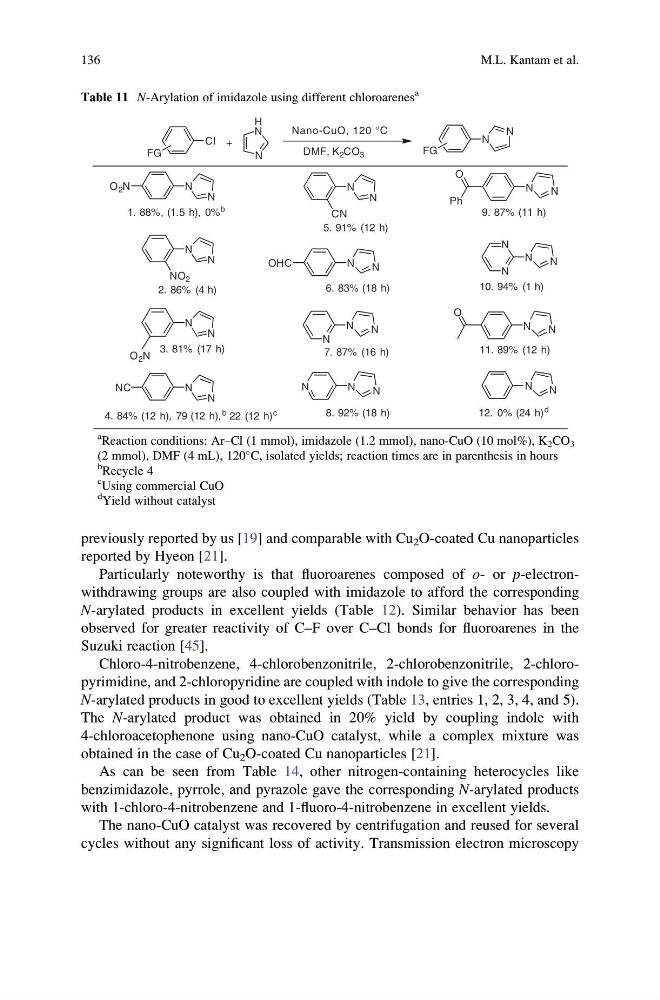
previously reported by us [19] and comparable with Cu 2 O-coated Cu nanoparticles
reported by Hyeon [21].
Particularly noteworthy is that fluoroarenes composed of o- or p-electronwithdrawing groups are also coupled with imidazole to afford the corresponding
N-arylated products in excellent yields (Table 12). Similar behavior has been
observed for greater reactivity of C–F over C–Cl bonds for fluoroarenes in the
Suzuki reaction [45].
Chloro-4-nitrobenzene, 4-chlorobenzonitrile, 2-chlorobenzonitrile, 2-chloropyrimidine, and 2-chloropyridine are coupled with indole to give the corresponding
N-arylated products in good to excellent yields (Table 13, entries 1, 2, 3, 4, and 5).
The N-arylated product was obtained in 20% yield by coupling indole with
4-chloroacetophenone using nano-CuO catalyst, while a complex mixture was
obtained in the case of Cu 2 O-coated Cu nanoparticles [21].
As can be seen from Table 14, other nitrogen-containing heterocycles like
benzimidazole, pyrrole, and pyrazole gave the corresponding N-arylated products
with 1-chloro-4-nitrobenzene and 1-fluoro-4-nitrobenzene in excellent yields.
The nano-CuO catalyst was recovered by centrifugation and reused for several
cycles without any significant loss of activity. Transmission electron microscopy
Table 11 N-Arylation of imidazole using different chloroarenes
a
1. 88%, (1.5 h), 0%
b
2. 86% (4 h)
3. 81% (17 h)
4. 84% (12 h), 79 (12 h),
b 22 (12 h)
c
5. 91% (12 h)
6. 83% (18 h)
7. 87% (16 h)
9. 87% (11 h)
10. 94% (1 h)
11. 89% (12 h)
8. 92% (18 h)
Ph
O
N
N
O 2 N
O 2 N
N
NO 2
N
N
NC
N
CN
N
OHC
N
N
N
N
N
N
N
O
N
N
12. 0% (24 h)
d
N
N
N
N
N
N
N
N
N
N
N
N
DMF, K 2 CO 3
+
N
H
N
N
N
Nano-CuO, 120 °C
FG
Cl
FG
a
Reaction conditions: Ar–Cl (1 mmol), imidazole (1.2 mmol), nano-CuO (10 mol%), K 2 CO 3
(2 mmol), DMF (4 mL), 120
C, isolated yields; reaction times are in parenthesis in hours
b
Recycle 4
c
Using commercial CuO
d
Yield without catalyst
136
M.L. Kantam et al.
reported by Hyeon [21].
Particularly noteworthy is that fluoroarenes composed of o- or p-electronwithdrawing groups are also coupled with imidazole to afford the corresponding
N-arylated products in excellent yields (Table 12). Similar behavior has been
observed for greater reactivity of C–F over C–Cl bonds for fluoroarenes in the
Suzuki reaction [45].
Chloro-4-nitrobenzene, 4-chlorobenzonitrile, 2-chlorobenzonitrile, 2-chloropyrimidine, and 2-chloropyridine are coupled with indole to give the corresponding
N-arylated products in good to excellent yields (Table 13, entries 1, 2, 3, 4, and 5).
The N-arylated product was obtained in 20% yield by coupling indole with
4-chloroacetophenone using nano-CuO catalyst, while a complex mixture was
obtained in the case of Cu 2 O-coated Cu nanoparticles [21].
As can be seen from Table 14, other nitrogen-containing heterocycles like
benzimidazole, pyrrole, and pyrazole gave the corresponding N-arylated products
with 1-chloro-4-nitrobenzene and 1-fluoro-4-nitrobenzene in excellent yields.
The nano-CuO catalyst was recovered by centrifugation and reused for several
cycles without any significant loss of activity. Transmission electron microscopy
Table 11 N-Arylation of imidazole using different chloroarenes
a
1. 88%, (1.5 h), 0%
b
2. 86% (4 h)
3. 81% (17 h)
4. 84% (12 h), 79 (12 h),
b 22 (12 h)
c
5. 91% (12 h)
6. 83% (18 h)
7. 87% (16 h)
9. 87% (11 h)
10. 94% (1 h)
11. 89% (12 h)
8. 92% (18 h)
Ph
O
N
N
O 2 N
O 2 N
N
NO 2
N
N
NC
N
CN
N
OHC
N
N
N
N
N
N
N
O
N
N
12. 0% (24 h)
d
N
N
N
N
N
N
N
N
N
N
N
N
DMF, K 2 CO 3
+
N
H
N
N
N
Nano-CuO, 120 °C
FG
Cl
FG
a
Reaction conditions: Ar–Cl (1 mmol), imidazole (1.2 mmol), nano-CuO (10 mol%), K 2 CO 3
(2 mmol), DMF (4 mL), 120
C, isolated yields; reaction times are in parenthesis in hours
b
Recycle 4
c
Using commercial CuO
d
Yield without catalyst
136
M.L. Kantam et al.