

7 Cu 2 O Catalyst
In 2008, Xu et al. [18] reported the use of simple Cu 2 O (10 mol%) as an efficient
reusable catalyst for the N-arylation of various heterocycles such as imidazole,
benzimidazole, indole, pyrazole, and pyrrole with aryl iodides, whereas bromides
and chlorides react with imidazole in the presence of two equivalents of a base,
typically KOH. Other bases such as Cs 2 CO 3 , K 3 PO 4 , and K 2 CO 3 resulted in
moderate to poor yields. Significantly, poor conversion (ca. 24%) was observed
under these reaction conditions when using CuO as catalyst.
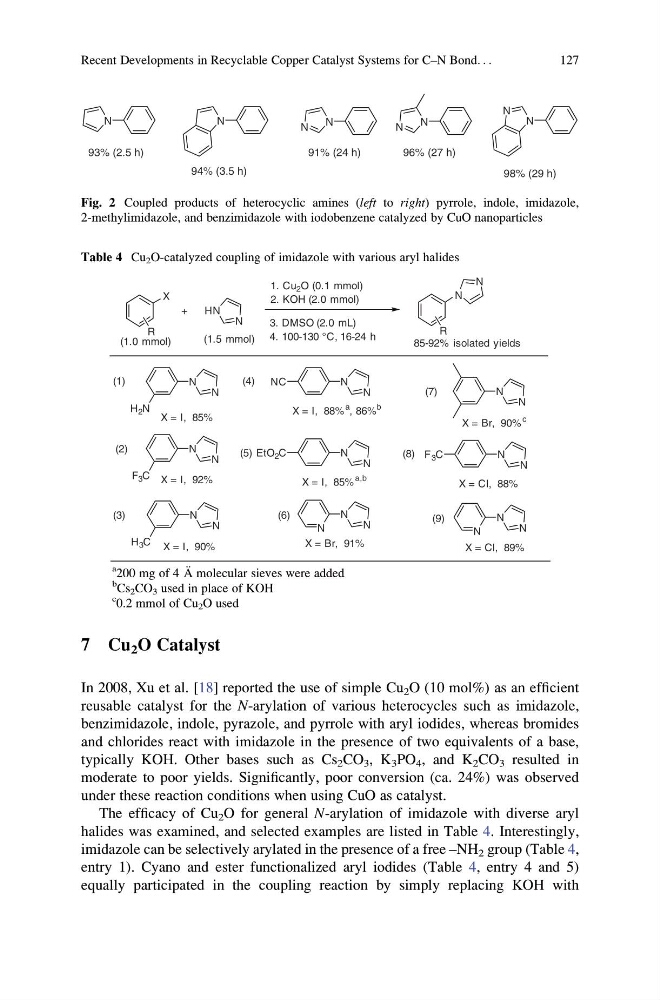
The efficacy of Cu 2 O for general N-arylation of imidazole with diverse aryl
halides was examined, and selected examples are listed in Table 4. Interestingly,
imidazole can be selectively arylated in the presence of a free –NH 2 group (Table 4,
entry 1). Cyano and ester functionalized aryl iodides (Table 4, entry 4 and 5)
equally participated in the coupling reaction by simply replacing KOH with
N
N
93% (2.5 h)
94% (3.5 h)
N
N
N
N
N
N
98% (29 h)
91% (24 h)
96% (27 h)
Fig. 2 Coupled products of heterocyclic amines (left to right) pyrrole, indole, imidazole,
2-methylimidazole, and benzimidazole with iodobenzene catalyzed by CuO nanoparticles
Table 4 Cu 2 O-catalyzed coupling of imidazole with various aryl halides
1. Cu 2 O (0.1 mmol)
2. KOH (2.0 mmol)
3. DMSO (2.0 mL)
4. 100-130 °C, 16-24 h
+
N
N
(1.0 mmol)
(1.5 mmol)
85-92% isolated yields
HN
N
N
N
H 2 N
X = I, 85%
N
N
F 3 C X = I, 92%
N
N
X = I, 88%
a
, 86%
b
N
N
NC
EtO 2 C
X = I, 85%
a,b
N
N
X = Br, 90%
c
N
N
H 3 C X = I, 90%
N
N
N
X = Br, 91%
N
N
N
X = Cl, 89%
N
N
F 3 C
X = Cl, 88%
(1)
(2)
(3)
(5)
(4)
(6)
(7)
(8)
(9)
R
X
R
a
200 mg of 4 A ¨ molecular sieves were added
b
Cs 2 CO 3 used in place of KOH
c
0.2 mmol of Cu 2 O used
Recent Developments in Recyclable Copper Catalyst Systems for C–N Bond. . .
127
In 2008, Xu et al. [18] reported the use of simple Cu 2 O (10 mol%) as an efficient
reusable catalyst for the N-arylation of various heterocycles such as imidazole,
benzimidazole, indole, pyrazole, and pyrrole with aryl iodides, whereas bromides
and chlorides react with imidazole in the presence of two equivalents of a base,
typically KOH. Other bases such as Cs 2 CO 3 , K 3 PO 4 , and K 2 CO 3 resulted in
moderate to poor yields. Significantly, poor conversion (ca. 24%) was observed
under these reaction conditions when using CuO as catalyst.
The efficacy of Cu 2 O for general N-arylation of imidazole with diverse aryl
halides was examined, and selected examples are listed in Table 4. Interestingly,
imidazole can be selectively arylated in the presence of a free –NH 2 group (Table 4,
entry 1). Cyano and ester functionalized aryl iodides (Table 4, entry 4 and 5)
equally participated in the coupling reaction by simply replacing KOH with
N
N
93% (2.5 h)
94% (3.5 h)
N
N
N
N
N
N
98% (29 h)
91% (24 h)
96% (27 h)
Fig. 2 Coupled products of heterocyclic amines (left to right) pyrrole, indole, imidazole,
2-methylimidazole, and benzimidazole with iodobenzene catalyzed by CuO nanoparticles
Table 4 Cu 2 O-catalyzed coupling of imidazole with various aryl halides
1. Cu 2 O (0.1 mmol)
2. KOH (2.0 mmol)
3. DMSO (2.0 mL)
4. 100-130 °C, 16-24 h
+
N
N
(1.0 mmol)
(1.5 mmol)
85-92% isolated yields
HN
N
N
N
H 2 N
X = I, 85%
N
N
F 3 C X = I, 92%
N
N
X = I, 88%
a
, 86%
b
N
N
NC
EtO 2 C
X = I, 85%
a,b
N
N
X = Br, 90%
c
N
N
H 3 C X = I, 90%
N
N
N
X = Br, 91%
N
N
N
X = Cl, 89%
N
N
F 3 C
X = Cl, 88%
(1)
(2)
(3)
(5)
(4)
(6)
(7)
(8)
(9)
R
X
R
a
200 mg of 4 A ¨ molecular sieves were added
b
Cs 2 CO 3 used in place of KOH
c
0.2 mmol of Cu 2 O used
Recent Developments in Recyclable Copper Catalyst Systems for C–N Bond. . .
127