

15 Miscellaneous
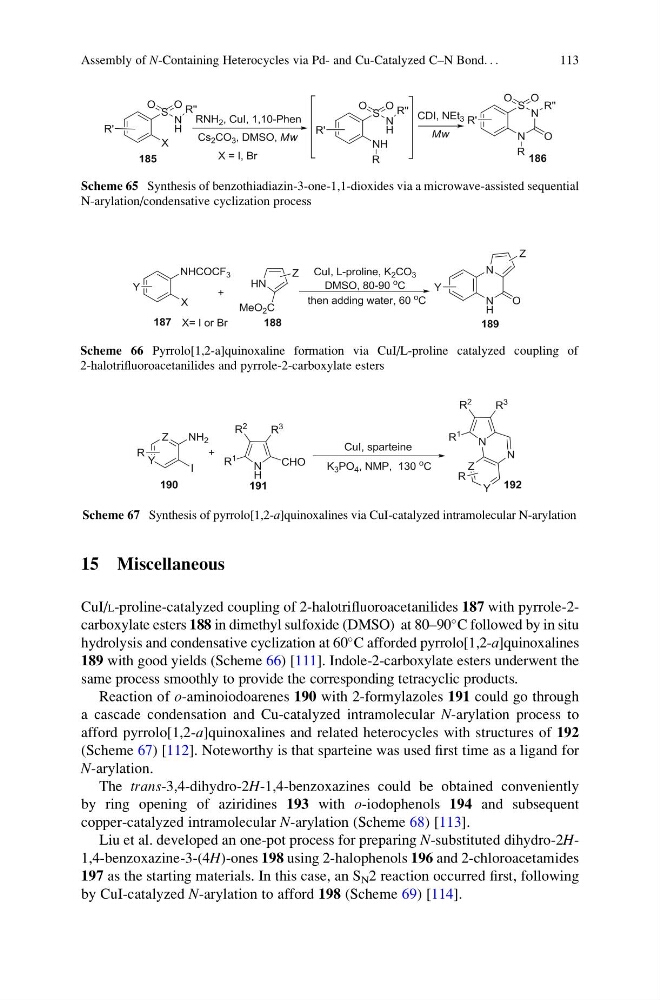
CuI/L-proline-catalyzed coupling of 2-halotrifluoroacetanilides 187 with pyrrole-2carboxylate esters 188 in dimethyl sulfoxide (DMSO) at 80–90
C followed by in situ
hydrolysis and condensative cyclization at 60
C afforded pyrrolo[1,2-a]quinoxalines
189 with good yields (Scheme 66) [111]. Indole-2-carboxylate esters underwent the
same process smoothly to provide the corresponding tetracyclic products.
Reaction of o-aminoiodoarenes 190 with 2-formylazoles 191 could go through
a cascade condensation and Cu-catalyzed intramolecular N-arylation process to
afford pyrrolo[1,2-a]quinoxalines and related heterocycles with structures of 192
(Scheme 67) [112]. Noteworthy is that sparteine was used first time as a ligand for
N-arylation.
The trans-3,4-dihydro-2H-1,4-benzoxazines could be obtained conveniently
by ring opening of aziridines 193 with o-iodophenols 194 and subsequent
copper-catalyzed intramolecular N-arylation (Scheme 68) [113].
Liu et al. developed an one-pot process for preparing N-substituted dihydro-2H1,4-benzoxazine-3-(4H)-ones 198 using 2-halophenols 196 and 2-chloroacetamides
197 as the starting materials. In this case, an S N 2 reaction occurred first, following
by CuI-catalyzed N-arylation to afford 198 (Scheme 69) [114].
Scheme 66 Pyrrolo[1,2-a]quinoxaline formation via CuI/L-proline catalyzed coupling of
2-halotrifluoroacetanilides and pyrrole-2-carboxylate esters
Scheme 67 Synthesis of pyrrolo[1,2-a]quinoxalines via CuI-catalyzed intramolecular N-arylation
Scheme 65 Synthesis of benzothiadiazin-3-one-1,1-dioxides via a microwave-assisted sequential
N-arylation/condensative cyclization process
Assembly of N-Containing Heterocycles via Pd- and Cu-Catalyzed C–N Bond. . .
113
CuI/L-proline-catalyzed coupling of 2-halotrifluoroacetanilides 187 with pyrrole-2carboxylate esters 188 in dimethyl sulfoxide (DMSO) at 80–90
C followed by in situ
hydrolysis and condensative cyclization at 60
C afforded pyrrolo[1,2-a]quinoxalines
189 with good yields (Scheme 66) [111]. Indole-2-carboxylate esters underwent the
same process smoothly to provide the corresponding tetracyclic products.
Reaction of o-aminoiodoarenes 190 with 2-formylazoles 191 could go through
a cascade condensation and Cu-catalyzed intramolecular N-arylation process to
afford pyrrolo[1,2-a]quinoxalines and related heterocycles with structures of 192
(Scheme 67) [112]. Noteworthy is that sparteine was used first time as a ligand for
N-arylation.
The trans-3,4-dihydro-2H-1,4-benzoxazines could be obtained conveniently
by ring opening of aziridines 193 with o-iodophenols 194 and subsequent
copper-catalyzed intramolecular N-arylation (Scheme 68) [113].
Liu et al. developed an one-pot process for preparing N-substituted dihydro-2H1,4-benzoxazine-3-(4H)-ones 198 using 2-halophenols 196 and 2-chloroacetamides
197 as the starting materials. In this case, an S N 2 reaction occurred first, following
by CuI-catalyzed N-arylation to afford 198 (Scheme 69) [114].
Scheme 66 Pyrrolo[1,2-a]quinoxaline formation via CuI/L-proline catalyzed coupling of
2-halotrifluoroacetanilides and pyrrole-2-carboxylate esters
Scheme 67 Synthesis of pyrrolo[1,2-a]quinoxalines via CuI-catalyzed intramolecular N-arylation
Scheme 65 Synthesis of benzothiadiazin-3-one-1,1-dioxides via a microwave-assisted sequential
N-arylation/condensative cyclization process
Assembly of N-Containing Heterocycles via Pd- and Cu-Catalyzed C–N Bond. . .
113