

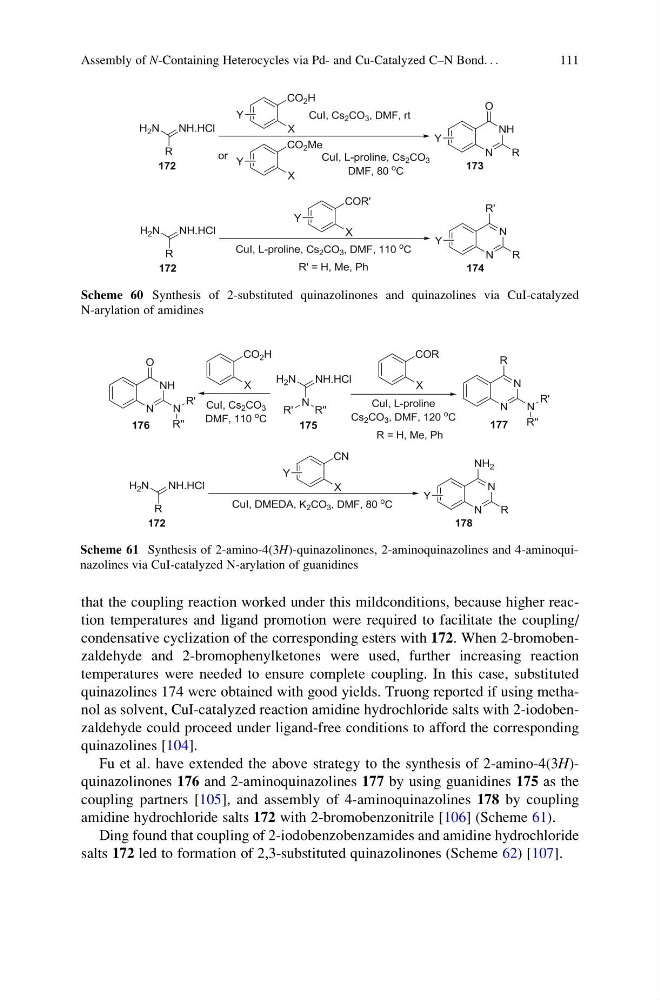
that the coupling reaction worked under this mildconditions, because higher reaction temperatures and ligand promotion were required to facilitate the coupling/
condensative cyclization of the corresponding esters with 172. When 2-bromobenzaldehyde and 2-bromophenylketones were used, further increasing reaction
temperatures were needed to ensure complete coupling. In this case, substituted
quinazolines 174 were obtained with good yields. Truong reported if using methanol as solvent, CuI-catalyzed reaction amidine hydrochloride salts with 2-iodobenzaldehyde could proceed under ligand-free conditions to afford the corresponding
quinazolines [104].
Fu et al. have extended the above strategy to the synthesis of 2-amino-4(3H)quinazolinones 176 and 2-aminoquinazolines 177 by using guanidines 175 as the
coupling partners [105], and assembly of 4-aminoquinazolines 178 by coupling
amidine hydrochloride salts 172 with 2-bromobenzonitrile [106] (Scheme 61).
Ding found that coupling of 2-iodobenzobenzamides and amidine hydrochloride
salts 172 led to formation of 2,3-substituted quinazolinones (Scheme 62) [107].
Scheme 61 Synthesis of 2-amino-4(3H)-quinazolinones, 2-aminoquinazolines and 4-aminoquinazolines via CuI-catalyzed N-arylation of guanidines
Scheme 60 Synthesis of 2-substituted quinazolinones and quinazolines via CuI-catalyzed
N-arylation of amidines
Assembly of N-Containing Heterocycles via Pd- and Cu-Catalyzed C–N Bond. . .
111
condensative cyclization of the corresponding esters with 172. When 2-bromobenzaldehyde and 2-bromophenylketones were used, further increasing reaction
temperatures were needed to ensure complete coupling. In this case, substituted
quinazolines 174 were obtained with good yields. Truong reported if using methanol as solvent, CuI-catalyzed reaction amidine hydrochloride salts with 2-iodobenzaldehyde could proceed under ligand-free conditions to afford the corresponding
quinazolines [104].
Fu et al. have extended the above strategy to the synthesis of 2-amino-4(3H)quinazolinones 176 and 2-aminoquinazolines 177 by using guanidines 175 as the
coupling partners [105], and assembly of 4-aminoquinazolines 178 by coupling
amidine hydrochloride salts 172 with 2-bromobenzonitrile [106] (Scheme 61).
Ding found that coupling of 2-iodobenzobenzamides and amidine hydrochloride
salts 172 led to formation of 2,3-substituted quinazolinones (Scheme 62) [107].
Scheme 61 Synthesis of 2-amino-4(3H)-quinazolinones, 2-aminoquinazolines and 4-aminoquinazolines via CuI-catalyzed N-arylation of guanidines
Scheme 60 Synthesis of 2-substituted quinazolinones and quinazolines via CuI-catalyzed
N-arylation of amidines
Assembly of N-Containing Heterocycles via Pd- and Cu-Catalyzed C–N Bond. . .
111