

oxidation, indolo[1,2-b]indazole derivatives 109 were isolated, which are potential
inhibitors for DNA topoisomers I and II.
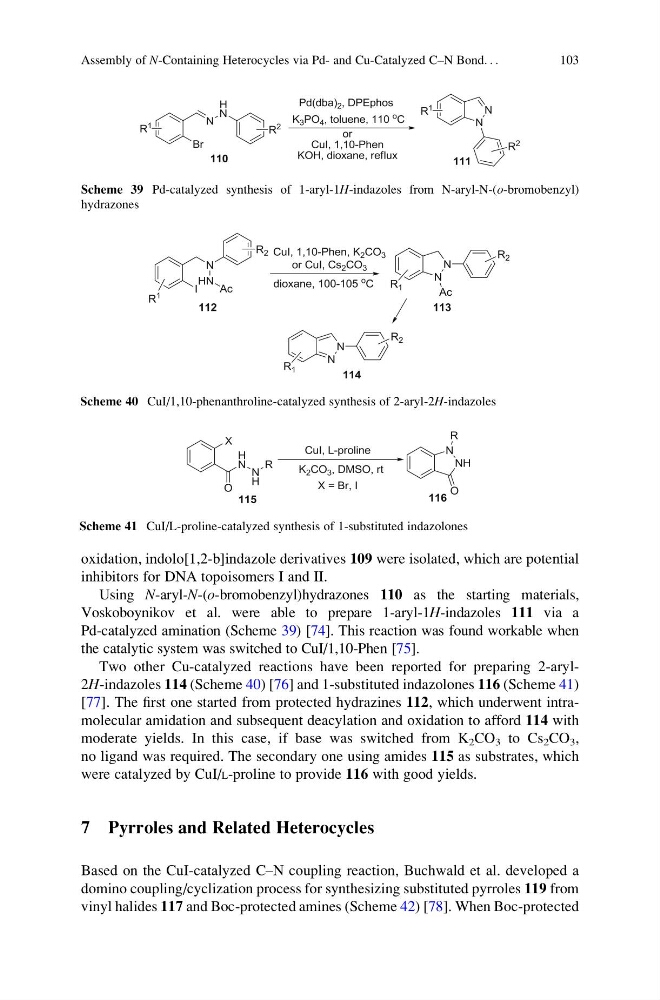
Using N-aryl-N-(o-bromobenzyl)hydrazones 110 as the starting materials,
Voskoboynikov et al. were able to prepare 1-aryl-1H-indazoles 111 via a
Pd-catalyzed amination (Scheme 39) [74]. This reaction was found workable when
the catalytic system was switched to CuI/1,10-Phen [75].
Two other Cu-catalyzed reactions have been reported for preparing 2-aryl2H-indazoles 114 (Scheme 40) [76] and 1-substituted indazolones 116 (Scheme 41)
[77]. The first one started from protected hydrazines 112, which underwent intramolecular amidation and subsequent deacylation and oxidation to afford 114 with
moderate yields. In this case, if base was switched from K 2 CO 3 to Cs 2 CO 3 ,
no ligand was required. The secondary one using amides 115 as substrates, which
were catalyzed by CuI/L-proline to provide 116 with good yields.
7 Pyrroles and Related Heterocycles
Based on the CuI-catalyzed C–N coupling reaction, Buchwald et al. developed a
domino coupling/cyclization process for synthesizing substituted pyrroles 119 from
vinyl halides 117 and Boc-protected amines (Scheme 42) [78]. When Boc-protected
Scheme 39 Pd-catalyzed synthesis of 1-aryl-1H-indazoles from N-aryl-N-(o-bromobenzyl)
hydrazones
Scheme 40 CuI/1,10-phenanthroline-catalyzed synthesis of 2-aryl-2H-indazoles
Scheme 41 CuI/L-proline-catalyzed synthesis of 1-substituted indazolones
Assembly of N-Containing Heterocycles via Pd- and Cu-Catalyzed C–N Bond. . .
103
inhibitors for DNA topoisomers I and II.
Using N-aryl-N-(o-bromobenzyl)hydrazones 110 as the starting materials,
Voskoboynikov et al. were able to prepare 1-aryl-1H-indazoles 111 via a
Pd-catalyzed amination (Scheme 39) [74]. This reaction was found workable when
the catalytic system was switched to CuI/1,10-Phen [75].
Two other Cu-catalyzed reactions have been reported for preparing 2-aryl2H-indazoles 114 (Scheme 40) [76] and 1-substituted indazolones 116 (Scheme 41)
[77]. The first one started from protected hydrazines 112, which underwent intramolecular amidation and subsequent deacylation and oxidation to afford 114 with
moderate yields. In this case, if base was switched from K 2 CO 3 to Cs 2 CO 3 ,
no ligand was required. The secondary one using amides 115 as substrates, which
were catalyzed by CuI/L-proline to provide 116 with good yields.
7 Pyrroles and Related Heterocycles
Based on the CuI-catalyzed C–N coupling reaction, Buchwald et al. developed a
domino coupling/cyclization process for synthesizing substituted pyrroles 119 from
vinyl halides 117 and Boc-protected amines (Scheme 42) [78]. When Boc-protected
Scheme 39 Pd-catalyzed synthesis of 1-aryl-1H-indazoles from N-aryl-N-(o-bromobenzyl)
hydrazones
Scheme 40 CuI/1,10-phenanthroline-catalyzed synthesis of 2-aryl-2H-indazoles
Scheme 41 CuI/L-proline-catalyzed synthesis of 1-substituted indazolones
Assembly of N-Containing Heterocycles via Pd- and Cu-Catalyzed C–N Bond. . .
103