

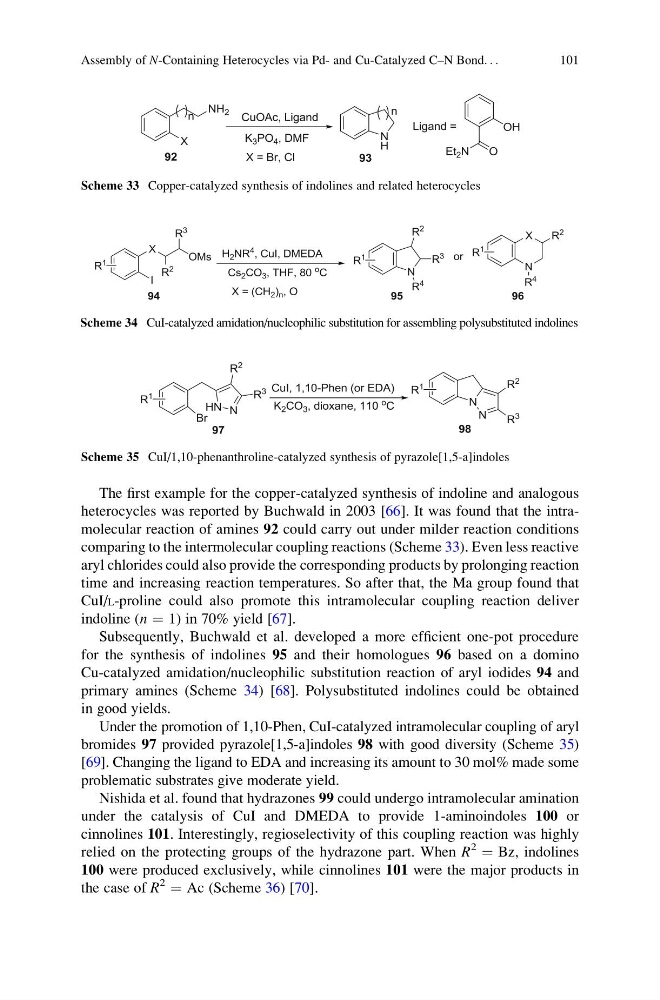
The first example for the copper-catalyzed synthesis of indoline and analogous
heterocycles was reported by Buchwald in 2003 [66]. It was found that the intramolecular reaction of amines 92 could carry out under milder reaction conditions
comparing to the intermolecular coupling reactions (Scheme 33). Even less reactive
aryl chlorides could also provide the corresponding products by prolonging reaction
time and increasing reaction temperatures. So after that, the Ma group found that
CuI/L-proline could also promote this intramolecular coupling reaction deliver
indoline (n ¼ 1) in 70% yield [67].
Subsequently, Buchwald et al. developed a more efficient one-pot procedure
for the synthesis of indolines 95 and their homologues 96 based on a domino
Cu-catalyzed amidation/nucleophilic substitution reaction of aryl iodides 94 and
primary amines (Scheme 34) [68]. Polysubstituted indolines could be obtained
in good yields.
Under the promotion of 1,10-Phen, CuI-catalyzed intramolecular coupling of aryl
bromides 97 provided pyrazole[1,5-a]indoles 98 with good diversity (Scheme 35)
[69]. Changing the ligand to EDA and increasing its amount to 30 mol% made some
problematic substrates give moderate yield.
Nishida et al. found that hydrazones 99 could undergo intramolecular amination
under the catalysis of CuI and DMEDA to provide 1-aminoindoles 100 or
cinnolines 101. Interestingly, regioselectivity of this coupling reaction was highly
relied on the protecting groups of the hydrazone part. When R
2
¼ Bz, indolines
100 were produced exclusively, while cinnolines 101 were the major products in
the case of R
2
¼ Ac (Scheme 36) [70].
Scheme 33 Copper-catalyzed synthesis of indolines and related heterocycles
Scheme 34 CuI-catalyzed amidation/nucleophilic substitution for assembling polysubstituted indolines
Scheme 35 CuI/1,10-phenanthroline-catalyzed synthesis of pyrazole[1,5-a]indoles
Assembly of N-Containing Heterocycles via Pd- and Cu-Catalyzed C–N Bond. . .
101
heterocycles was reported by Buchwald in 2003 [66]. It was found that the intramolecular reaction of amines 92 could carry out under milder reaction conditions
comparing to the intermolecular coupling reactions (Scheme 33). Even less reactive
aryl chlorides could also provide the corresponding products by prolonging reaction
time and increasing reaction temperatures. So after that, the Ma group found that
CuI/L-proline could also promote this intramolecular coupling reaction deliver
indoline (n ¼ 1) in 70% yield [67].
Subsequently, Buchwald et al. developed a more efficient one-pot procedure
for the synthesis of indolines 95 and their homologues 96 based on a domino
Cu-catalyzed amidation/nucleophilic substitution reaction of aryl iodides 94 and
primary amines (Scheme 34) [68]. Polysubstituted indolines could be obtained
in good yields.
Under the promotion of 1,10-Phen, CuI-catalyzed intramolecular coupling of aryl
bromides 97 provided pyrazole[1,5-a]indoles 98 with good diversity (Scheme 35)
[69]. Changing the ligand to EDA and increasing its amount to 30 mol% made some
problematic substrates give moderate yield.
Nishida et al. found that hydrazones 99 could undergo intramolecular amination
under the catalysis of CuI and DMEDA to provide 1-aminoindoles 100 or
cinnolines 101. Interestingly, regioselectivity of this coupling reaction was highly
relied on the protecting groups of the hydrazone part. When R
2
¼ Bz, indolines
100 were produced exclusively, while cinnolines 101 were the major products in
the case of R
2
¼ Ac (Scheme 36) [70].
Scheme 33 Copper-catalyzed synthesis of indolines and related heterocycles
Scheme 34 CuI-catalyzed amidation/nucleophilic substitution for assembling polysubstituted indolines
Scheme 35 CuI/1,10-phenanthroline-catalyzed synthesis of pyrazole[1,5-a]indoles
Assembly of N-Containing Heterocycles via Pd- and Cu-Catalyzed C–N Bond. . .
101