

78
4 Development of a Mathematical Model for an Aerobic Fixed-Bed …
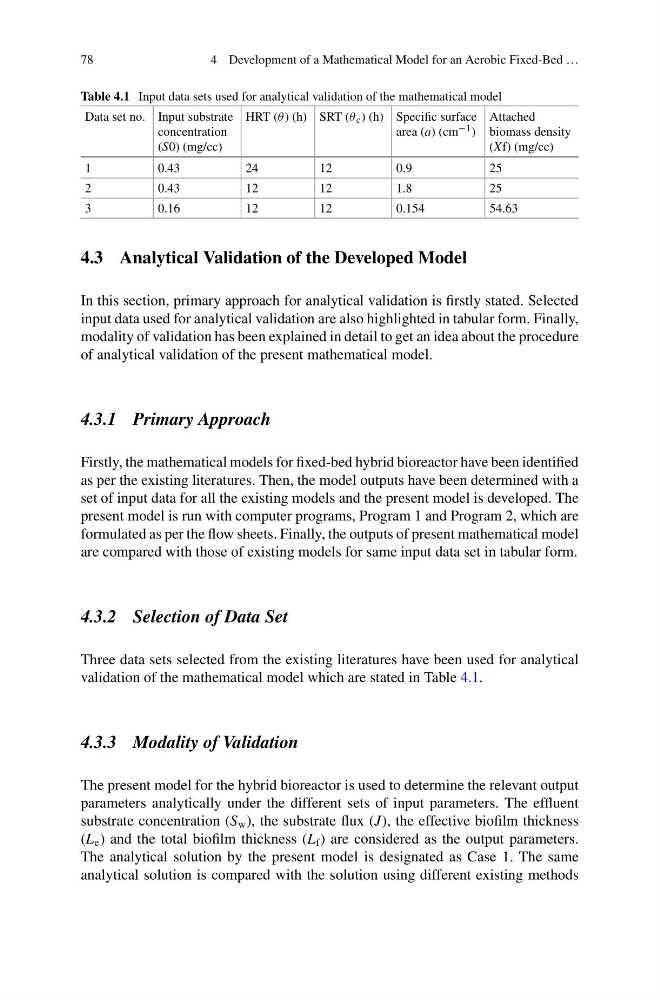
Table 4.1 Input data sets used for analytical validation of the mathematical model
Data set no. Input substrate
concentration
(S0) (mg/cc)
HRT (θ) (h) SRT (θ c ) (h) Specific surface
area (a) (cm −1 )
Attached
biomass density
(Xf) (mg/cc)
1
0.43
24
12
0.9
25
2
0.43
12
12
1.8
25
3
0.16
12
12
0.154
54.63
4.3 Analytical Validation of the Developed Model
In this section, primary approach for analytical validation is firstly stated. Selected
input data used for analytical validation are also highlighted in tabular form. Finally,
modality of validation has been explained in detail to get an idea about the procedure
of analytical validation of the present mathematical model.
4.3.1 Primary Approach
Firstly, the mathematical models for fixed-bed hybrid bioreactor have been identified
as per the existing literatures. Then, the model outputs have been determined with a
set of input data for all the existing models and the present model is developed. The
present model is run with computer programs, Program 1 and Program 2, which are
formulated as per the flow sheets. Finally, the outputs of present mathematical model
are compared with those of existing models for same input data set in tabular form.
4.3.2 Selection of Data Set
Three data sets selected from the existing literatures have been used for analytical
validation of the mathematical model which are stated in Table 4.1.
4.3.3 Modality of Validation
The present model for the hybrid bioreactor is used to determine the relevant output
parameters analytically under the different sets of input parameters. The effluent
substrate concentration (S w ), the substrate flux (J), the effective biofilm thickness
(L e ) and the total biofilm thickness (L f ) are considered as the output parameters.
The analytical solution by the present model is designated as Case 1. The same
analytical solution is compared with the solution using different existing methods
4 Development of a Mathematical Model for an Aerobic Fixed-Bed …
Table 4.1 Input data sets used for analytical validation of the mathematical model
Data set no. Input substrate
concentration
(S0) (mg/cc)
HRT (θ) (h) SRT (θ c ) (h) Specific surface
area (a) (cm −1 )
Attached
biomass density
(Xf) (mg/cc)
1
0.43
24
12
0.9
25
2
0.43
12
12
1.8
25
3
0.16
12
12
0.154
54.63
4.3 Analytical Validation of the Developed Model
In this section, primary approach for analytical validation is firstly stated. Selected
input data used for analytical validation are also highlighted in tabular form. Finally,
modality of validation has been explained in detail to get an idea about the procedure
of analytical validation of the present mathematical model.
4.3.1 Primary Approach
Firstly, the mathematical models for fixed-bed hybrid bioreactor have been identified
as per the existing literatures. Then, the model outputs have been determined with a
set of input data for all the existing models and the present model is developed. The
present model is run with computer programs, Program 1 and Program 2, which are
formulated as per the flow sheets. Finally, the outputs of present mathematical model
are compared with those of existing models for same input data set in tabular form.
4.3.2 Selection of Data Set
Three data sets selected from the existing literatures have been used for analytical
validation of the mathematical model which are stated in Table 4.1.
4.3.3 Modality of Validation
The present model for the hybrid bioreactor is used to determine the relevant output
parameters analytically under the different sets of input parameters. The effluent
substrate concentration (S w ), the substrate flux (J), the effective biofilm thickness
(L e ) and the total biofilm thickness (L f ) are considered as the output parameters.
The analytical solution by the present model is designated as Case 1. The same
analytical solution is compared with the solution using different existing methods