

64
4 Development of a Mathematical Model for an Aerobic Fixed-Bed …
like exiting substrate concentration, substrate flux, effective and total biofilm thickness. A simplified and functionally efficient model helps in the process design of
a hybrid bioreactor. One of the targets of the present research work is to derive a
process design modality in respect of aerobic hybrid biological reactor. The model is
also developed with an objective to desire a methodology for determining the kinetic
coefficients of the hybrid bioreactor.
4.2.1 Problem Scenario
There is no process design model so far for a hybrid bioreactor system without which
it is difficult to build up such a reactor system for the treatment of wastewater. In
order to go for a suitable process design, a simplified mathematical model is required
for determining the outputs rationally. Obviously, all the outputs are finally required
for finalizing the design of an aerobic hybrid bioreactor. The mathematical model of
a hybrid bioreactor is an integration of the biofilm model and the classical suspendedgrowth model. Out of these two models, suspended-growth model is almost unique
and simple which is based on Monod’s growth kinetics. But, the analysis of biofilm
model appears to be cumbersome on account of its complexity. Besides, the characteristic of biofilm uptake is quite different from the suspended-growth biomass.
Although there are many existing models on biofilm, the procedure of solution is
very tedious and the results of outputs are found approximate. There are a limited
number of modelings in the integrated biofilm and suspended-growth process which
is required for the design of hybrid bioreactor. Thus, the necessity of a model for
hybrid bioreactor can be reasonably thought for the process design of the reactor.
4.2.2 Model Description
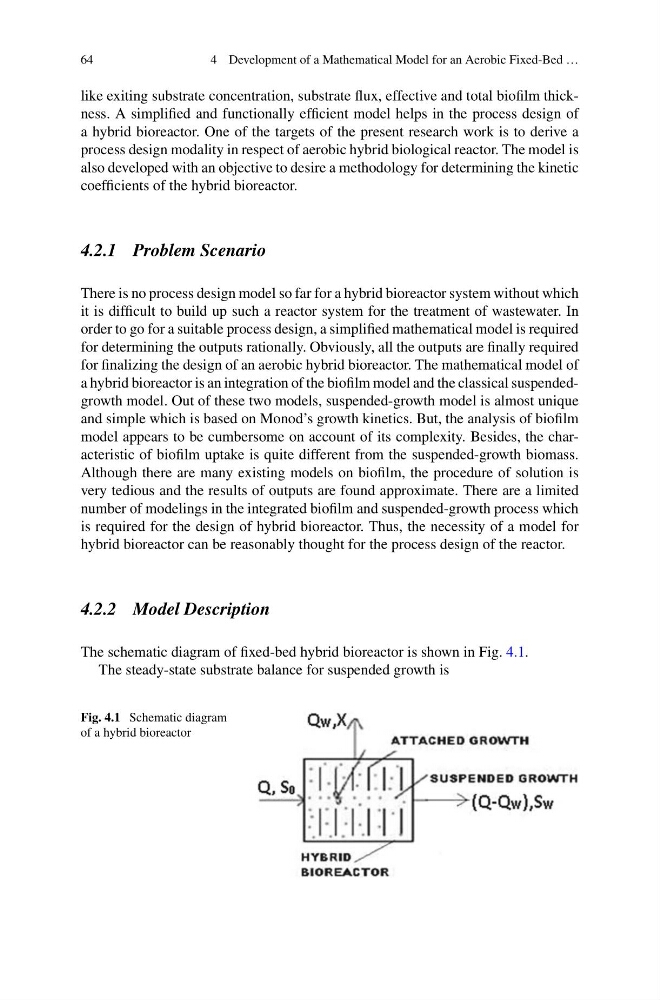
The schematic diagram of fixed-bed hybrid bioreactor is shown in Fig. 4.1.
The steady-state substrate balance for suspended growth is
Fig. 4.1 Schematic diagram
of a hybrid bioreactor
4 Development of a Mathematical Model for an Aerobic Fixed-Bed …
like exiting substrate concentration, substrate flux, effective and total biofilm thickness. A simplified and functionally efficient model helps in the process design of
a hybrid bioreactor. One of the targets of the present research work is to derive a
process design modality in respect of aerobic hybrid biological reactor. The model is
also developed with an objective to desire a methodology for determining the kinetic
coefficients of the hybrid bioreactor.
4.2.1 Problem Scenario
There is no process design model so far for a hybrid bioreactor system without which
it is difficult to build up such a reactor system for the treatment of wastewater. In
order to go for a suitable process design, a simplified mathematical model is required
for determining the outputs rationally. Obviously, all the outputs are finally required
for finalizing the design of an aerobic hybrid bioreactor. The mathematical model of
a hybrid bioreactor is an integration of the biofilm model and the classical suspendedgrowth model. Out of these two models, suspended-growth model is almost unique
and simple which is based on Monod’s growth kinetics. But, the analysis of biofilm
model appears to be cumbersome on account of its complexity. Besides, the characteristic of biofilm uptake is quite different from the suspended-growth biomass.
Although there are many existing models on biofilm, the procedure of solution is
very tedious and the results of outputs are found approximate. There are a limited
number of modelings in the integrated biofilm and suspended-growth process which
is required for the design of hybrid bioreactor. Thus, the necessity of a model for
hybrid bioreactor can be reasonably thought for the process design of the reactor.
4.2.2 Model Description
The schematic diagram of fixed-bed hybrid bioreactor is shown in Fig. 4.1.
The steady-state substrate balance for suspended growth is
Fig. 4.1 Schematic diagram
of a hybrid bioreactor