

22
2 Advantages of Hybrid Bioreactor
nomograph that correlates dimensionless substrate concentration at biofilm–liquid
interface, dimensionless substrate flux, dimensionless biofilm thickness and dimensionless minimum substrate concentration that is needed to sustain the flux [70]. The
solution of this model was also approximate one and only the total biofilm thickness could be determined. Another biofilm model was developed using normalized
loading curves with dimensionless variables [71]. The model derived an approximate
solution, which could not determine the effective biofilm thickness. There was also
a chance of human error while studying the output variables from the normalized
loading curves. Normalized loading curve is given for a particular value of S min* (i.e.,
S min /K); for any other value of S
* interpolation needs to be done between the values
of two curves yielding an approximate output result. Moreover, normalized loading
curve can be used only if effluent substrate concentration is known, i.e., targeted to a
certain value. By normalized loading curve, the substrate flux (J) can only be evaluated. Saez et al. [72] proposed an accurate pseudo-analytical solution for steady state
biofilm model. However, it has also not considered any substrate balance in attached
growth including the term specific surface area, hydraulic retention time, etc., which
are the crucial variables in designing the biofilm reactor. The effective thickness of
biofilm could also not be calculated using this model.
Biomass loss from the attachment surface is a critical issue in a biofilm reactor.
The biomass loss rate from the attachment surface for a steady-state biofilm reactor
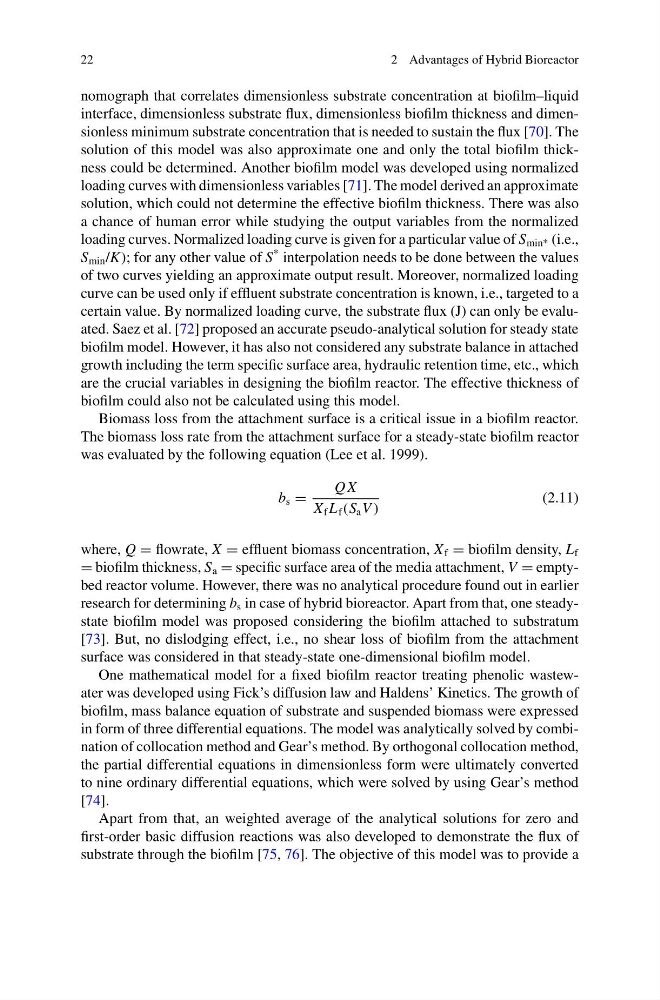
was evaluated by the following equation (Lee et al. 1999).
b s =
Q X
X f L f (S a V )
(2.11)
where, Q = flowrate, X = effluent biomass concentration, X f = biofilm density, L f
= biofilm thickness, S a = specific surface area of the media attachment, V = emptybed reactor volume. However, there was no analytical procedure found out in earlier
research for determining b s in case of hybrid bioreactor. Apart from that, one steadystate biofilm model was proposed considering the biofilm attached to substratum
[73]. But, no dislodging effect, i.e., no shear loss of biofilm from the attachment
surface was considered in that steady-state one-dimensional biofilm model.
One mathematical model for a fixed biofilm reactor treating phenolic wastewater was developed using Fick’s diffusion law and Haldens’ Kinetics. The growth of
biofilm, mass balance equation of substrate and suspended biomass were expressed
in form of three differential equations. The model was analytically solved by combination of collocation method and Gear’s method. By orthogonal collocation method,
the partial differential equations in dimensionless form were ultimately converted
to nine ordinary differential equations, which were solved by using Gear’s method
[74].
Apart from that, an weighted average of the analytical solutions for zero and
first-order basic diffusion reactions was also developed to demonstrate the flux of
substrate through the biofilm [75, 76]. The objective of this model was to provide a
2 Advantages of Hybrid Bioreactor
nomograph that correlates dimensionless substrate concentration at biofilm–liquid
interface, dimensionless substrate flux, dimensionless biofilm thickness and dimensionless minimum substrate concentration that is needed to sustain the flux [70]. The
solution of this model was also approximate one and only the total biofilm thickness could be determined. Another biofilm model was developed using normalized
loading curves with dimensionless variables [71]. The model derived an approximate
solution, which could not determine the effective biofilm thickness. There was also
a chance of human error while studying the output variables from the normalized
loading curves. Normalized loading curve is given for a particular value of S min* (i.e.,
S min /K); for any other value of S
* interpolation needs to be done between the values
of two curves yielding an approximate output result. Moreover, normalized loading
curve can be used only if effluent substrate concentration is known, i.e., targeted to a
certain value. By normalized loading curve, the substrate flux (J) can only be evaluated. Saez et al. [72] proposed an accurate pseudo-analytical solution for steady state
biofilm model. However, it has also not considered any substrate balance in attached
growth including the term specific surface area, hydraulic retention time, etc., which
are the crucial variables in designing the biofilm reactor. The effective thickness of
biofilm could also not be calculated using this model.
Biomass loss from the attachment surface is a critical issue in a biofilm reactor.
The biomass loss rate from the attachment surface for a steady-state biofilm reactor
was evaluated by the following equation (Lee et al. 1999).
b s =
Q X
X f L f (S a V )
(2.11)
where, Q = flowrate, X = effluent biomass concentration, X f = biofilm density, L f
= biofilm thickness, S a = specific surface area of the media attachment, V = emptybed reactor volume. However, there was no analytical procedure found out in earlier
research for determining b s in case of hybrid bioreactor. Apart from that, one steadystate biofilm model was proposed considering the biofilm attached to substratum
[73]. But, no dislodging effect, i.e., no shear loss of biofilm from the attachment
surface was considered in that steady-state one-dimensional biofilm model.
One mathematical model for a fixed biofilm reactor treating phenolic wastewater was developed using Fick’s diffusion law and Haldens’ Kinetics. The growth of
biofilm, mass balance equation of substrate and suspended biomass were expressed
in form of three differential equations. The model was analytically solved by combination of collocation method and Gear’s method. By orthogonal collocation method,
the partial differential equations in dimensionless form were ultimately converted
to nine ordinary differential equations, which were solved by using Gear’s method
[74].
Apart from that, an weighted average of the analytical solutions for zero and
first-order basic diffusion reactions was also developed to demonstrate the flux of
substrate through the biofilm [75, 76]. The objective of this model was to provide a