

20
2 Advantages of Hybrid Bioreactor
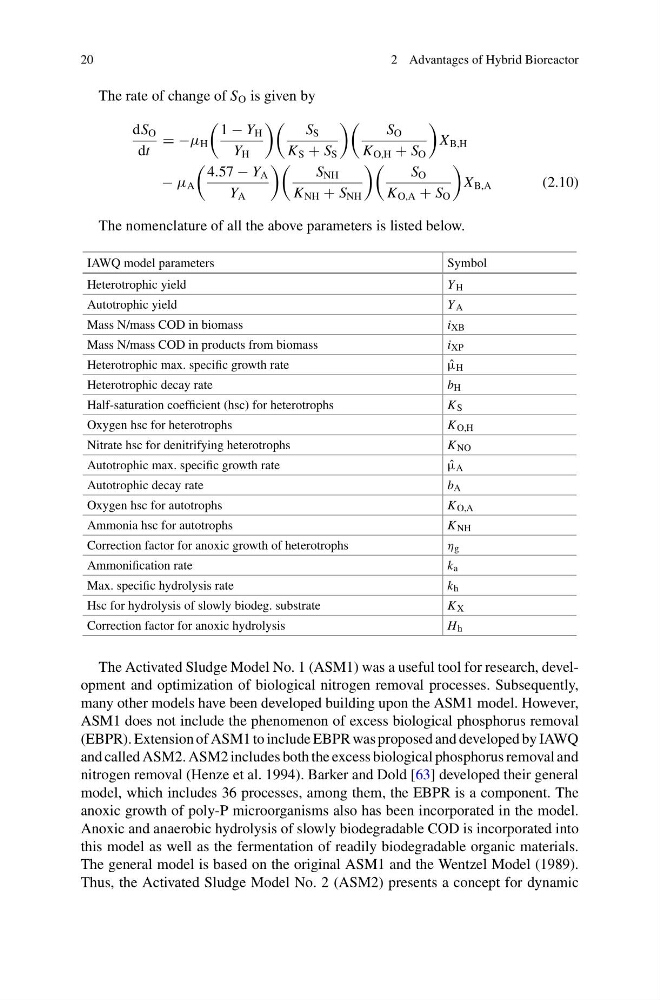
The rate of change of S O is given by
dS O
dt
= −μ H
1 − Y H
Y H
S S
K S + S S
S O
K O,H + S O
X B,H
− μ A
4.57 − Y A
Y A
S NH
K NH + S NH
S O
K O,A + S O
X B,A
(2.10)
The nomenclature of all the above parameters is listed below.
IAWQ model parameters
Symbol
Heterotrophic yield
Y H
Autotrophic yield
Y A
Mass N/mass COD in biomass
i XB
Mass N/mass COD in products from biomass
i XP
Heterotrophic max. specific growth rate
ˆ
µ H
Heterotrophic decay rate
b H
Half-saturation coefficient (hsc) for heterotrophs
K S
Oxygen hsc for heterotrophs
K O,H
Nitrate hsc for denitrifying heterotrophs
K NO
Autotrophic max. specific growth rate
ˆ
µ A
Autotrophic decay rate
b A
Oxygen hsc for autotrophs
K O,A
Ammonia hsc for autotrophs
K NH
Correction factor for anoxic growth of heterotrophs
η g
Ammonification rate
k a
Max. specific hydrolysis rate
k h
Hsc for hydrolysis of slowly biodeg. substrate
K X
Correction factor for anoxic hydrolysis
H h
The Activated Sludge Model No. 1 (ASM1) was a useful tool for research, development and optimization of biological nitrogen removal processes. Subsequently,
many other models have been developed building upon the ASM1 model. However,
ASM1 does not include the phenomenon of excess biological phosphorus removal
(EBPR). Extension of ASM1 to include EBPR was proposed and developed by IAWQ
and called ASM2. ASM2 includes both the excess biological phosphorus removal and
nitrogen removal (Henze et al. 1994). Barker and Dold [63] developed their general
model, which includes 36 processes, among them, the EBPR is a component. The
anoxic growth of poly-P microorganisms also has been incorporated in the model.
Anoxic and anaerobic hydrolysis of slowly biodegradable COD is incorporated into
this model as well as the fermentation of readily biodegradable organic materials.
The general model is based on the original ASM1 and the Wentzel Model (1989).
Thus, the Activated Sludge Model No. 2 (ASM2) presents a concept for dynamic
2 Advantages of Hybrid Bioreactor
The rate of change of S O is given by
dS O
dt
= −μ H
1 − Y H
Y H
S S
K S + S S
S O
K O,H + S O
X B,H
− μ A
4.57 − Y A
Y A
S NH
K NH + S NH
S O
K O,A + S O
X B,A
(2.10)
The nomenclature of all the above parameters is listed below.
IAWQ model parameters
Symbol
Heterotrophic yield
Y H
Autotrophic yield
Y A
Mass N/mass COD in biomass
i XB
Mass N/mass COD in products from biomass
i XP
Heterotrophic max. specific growth rate
ˆ
µ H
Heterotrophic decay rate
b H
Half-saturation coefficient (hsc) for heterotrophs
K S
Oxygen hsc for heterotrophs
K O,H
Nitrate hsc for denitrifying heterotrophs
K NO
Autotrophic max. specific growth rate
ˆ
µ A
Autotrophic decay rate
b A
Oxygen hsc for autotrophs
K O,A
Ammonia hsc for autotrophs
K NH
Correction factor for anoxic growth of heterotrophs
η g
Ammonification rate
k a
Max. specific hydrolysis rate
k h
Hsc for hydrolysis of slowly biodeg. substrate
K X
Correction factor for anoxic hydrolysis
H h
The Activated Sludge Model No. 1 (ASM1) was a useful tool for research, development and optimization of biological nitrogen removal processes. Subsequently,
many other models have been developed building upon the ASM1 model. However,
ASM1 does not include the phenomenon of excess biological phosphorus removal
(EBPR). Extension of ASM1 to include EBPR was proposed and developed by IAWQ
and called ASM2. ASM2 includes both the excess biological phosphorus removal and
nitrogen removal (Henze et al. 1994). Barker and Dold [63] developed their general
model, which includes 36 processes, among them, the EBPR is a component. The
anoxic growth of poly-P microorganisms also has been incorporated in the model.
Anoxic and anaerobic hydrolysis of slowly biodegradable COD is incorporated into
this model as well as the fermentation of readily biodegradable organic materials.
The general model is based on the original ASM1 and the Wentzel Model (1989).
Thus, the Activated Sludge Model No. 2 (ASM2) presents a concept for dynamic