

Production of Lactose-Free Cheese Using Partially Purified …
41
(Microbial Type Culture Collection & Gene Bank), Chandigarh. 16S rRNA amplification and phylogenetic tree analysis were developed and verified by BioAxis DNA
Research Centre (P) Ltd., Hyderabad.
2.3 β-Galactosidase Production and Purification
Fermentation for β-galactosidase production was carried out into 150-ml Erlenmeyer
flask containing 50-mL prestrerilized modified lactose broth containing nutrients
(g/L) lactose 10, peptone 10, yeast extract 10, (NH 4 ) 2 SO 4 5, NaH 2 PO 4 1, MgSO 4
0.5, 7H 2 O, MnCl 2 0.5, potato starch 10, and pH 7 at 37 °C for 32 h at static condition. Microbial cells were harvested, suspended in 0.05 mM phosphate buffer, lyzed
by sonicator (250 W, Piezo-U-Sonic Ultrasonic Cleaner) for 20 min at 4 °C and
centrifuged at 6000 rpm for 15 min. Crude intracellular β-galactosidase thus obtained
was concentrated by lyophilization and was assayed according to Iqbal et al. (2010)
with some modifications. β-galactosidase was further purified through cold acetone
precipitation method according to Sumathy et al. (2012).
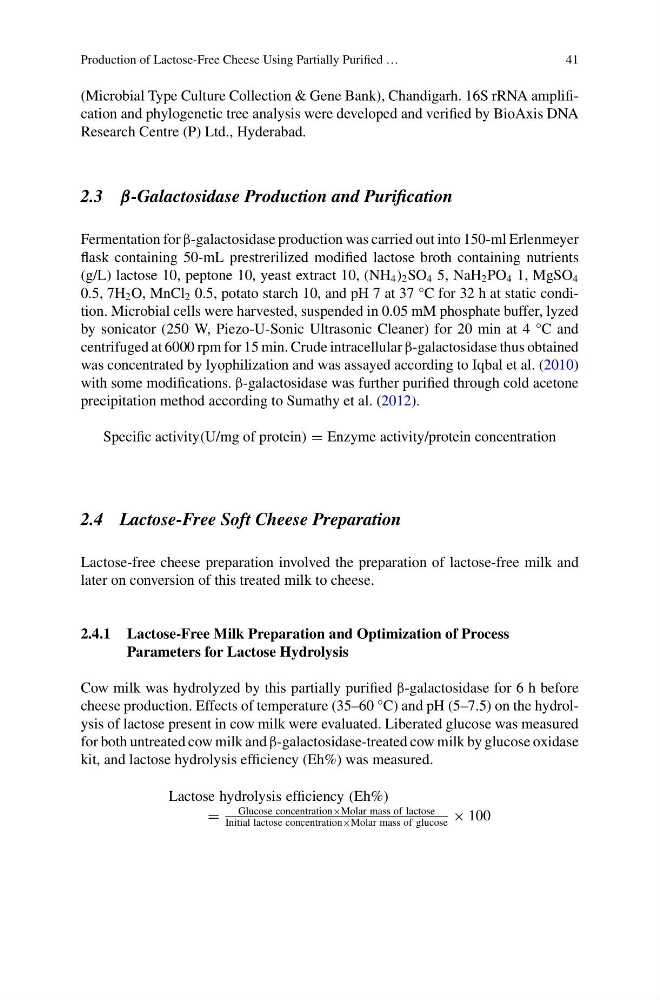
Specific activity(U/mg of protein) = Enzyme activity/protein concentration
2.4 Lactose-Free Soft Cheese Preparation
Lactose-free cheese preparation involved the preparation of lactose-free milk and
later on conversion of this treated milk to cheese.
2.4.1 Lactose-Free Milk Preparation and Optimization of Process
Parameters for Lactose Hydrolysis
Cow milk was hydrolyzed by this partially purified β-galactosidase for 6 h before
cheese production. Effects of temperature (35–60 °C) and pH (5–7.5) on the hydrolysis of lactose present in cow milk were evaluated. Liberated glucose was measured
for both untreated cow milk and β-galactosidase-treated cow milk by glucose oxidase
kit, and lactose hydrolysis efficiency (Eh%) was measured.
Lactose hydrolysis efficiency (Eh%)
=
Glucose concentration×Molar mass of lactose
Initial lactose concentration×Molar mass of glucose
× 100
41
(Microbial Type Culture Collection & Gene Bank), Chandigarh. 16S rRNA amplification and phylogenetic tree analysis were developed and verified by BioAxis DNA
Research Centre (P) Ltd., Hyderabad.
2.3 β-Galactosidase Production and Purification
Fermentation for β-galactosidase production was carried out into 150-ml Erlenmeyer
flask containing 50-mL prestrerilized modified lactose broth containing nutrients
(g/L) lactose 10, peptone 10, yeast extract 10, (NH 4 ) 2 SO 4 5, NaH 2 PO 4 1, MgSO 4
0.5, 7H 2 O, MnCl 2 0.5, potato starch 10, and pH 7 at 37 °C for 32 h at static condition. Microbial cells were harvested, suspended in 0.05 mM phosphate buffer, lyzed
by sonicator (250 W, Piezo-U-Sonic Ultrasonic Cleaner) for 20 min at 4 °C and
centrifuged at 6000 rpm for 15 min. Crude intracellular β-galactosidase thus obtained
was concentrated by lyophilization and was assayed according to Iqbal et al. (2010)
with some modifications. β-galactosidase was further purified through cold acetone
precipitation method according to Sumathy et al. (2012).
Specific activity(U/mg of protein) = Enzyme activity/protein concentration
2.4 Lactose-Free Soft Cheese Preparation
Lactose-free cheese preparation involved the preparation of lactose-free milk and
later on conversion of this treated milk to cheese.
2.4.1 Lactose-Free Milk Preparation and Optimization of Process
Parameters for Lactose Hydrolysis
Cow milk was hydrolyzed by this partially purified β-galactosidase for 6 h before
cheese production. Effects of temperature (35–60 °C) and pH (5–7.5) on the hydrolysis of lactose present in cow milk were evaluated. Liberated glucose was measured
for both untreated cow milk and β-galactosidase-treated cow milk by glucose oxidase
kit, and lactose hydrolysis efficiency (Eh%) was measured.
Lactose hydrolysis efficiency (Eh%)
=
Glucose concentration×Molar mass of lactose
Initial lactose concentration×Molar mass of glucose
× 100