

460
M. Paul et al.
Table 1 Range of values for independent variables used in Box–Behnken design (BBD)
Independent variables
Symbols
Units
−1 (low value)
0
+1 (high value)
Incubation time
A
hour
12
42
72
pH
B
–
4.50
6.75
9.00
Substrate concentration
C
gm/L
2.0
8.5
15.0
Temperature
D
°C
30
37.5
45
each bacterial supernatant was measured using spectrophotometer at an absorbance
value of 540 nm. During the spectrophotometric analysis, 1.5 mL DNS and 1 mL
ddH 2 O were taken as reference. 1 unit of cellulase activity was expressed as 1 µ/mol
of glucose liberated per mL of enzyme per minute.
2.5 Optimization of Cellulase Enzyme
2.5.1 Experimental Design of Process Parameters for Cellulase
Optimization Using RSM
For determining the optimum condition of cellulase activity, Box–Behnken designs
(BBD) was used. Box–Behnken designs are used to generate higher order response
surfaces using fewer required runs than a normal factorial technique. This technique essentially suppresses selected runs in an attempt to maintain the higher order
surface definition. Using four independent variables and BBD approach, the combinatorial effects of the incubation time, pH, substrate concentration, and temperature
were studied on cellulase enzyme production by the cellulolytic strain SCB9. Using
Box–Behnken method, the first and higher order may be the effects of each factor
and the interaction among them on cellulase activity was investigated. A total of 27
experimental conditions were designed using Design Expert 12 software optimization toolbox to perform response surface methodology (RSM). The minimum and
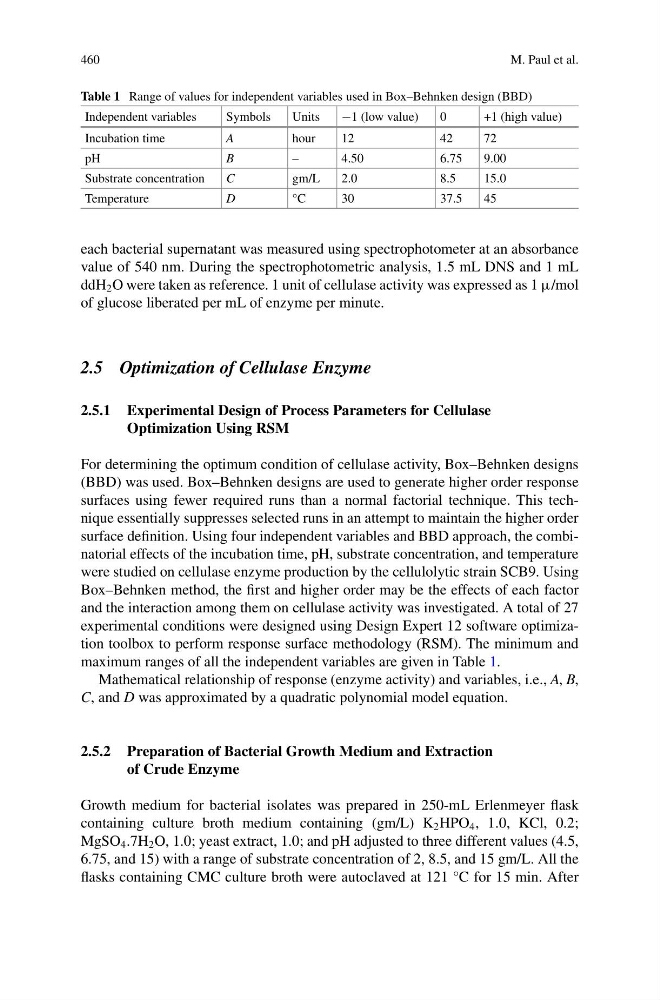
maximum ranges of all the independent variables are given in Table 1.
Mathematical relationship of response (enzyme activity) and variables, i.e., A, B,
C, and D was approximated by a quadratic polynomial model equation.
2.5.2 Preparation of Bacterial Growth Medium and Extraction
of Crude Enzyme
Growth medium for bacterial isolates was prepared in 250-mL Erlenmeyer flask
containing culture broth medium containing (gm/L) K 2 HPO 4 , 1.0, KCl, 0.2;
MgSO 4 .7H 2 O, 1.0; yeast extract, 1.0; and pH adjusted to three different values (4.5,
6.75, and 15) with a range of substrate concentration of 2, 8.5, and 15 gm/L. All the
flasks containing CMC culture broth were autoclaved at 121 °C for 15 min. After
M. Paul et al.
Table 1 Range of values for independent variables used in Box–Behnken design (BBD)
Independent variables
Symbols
Units
−1 (low value)
0
+1 (high value)
Incubation time
A
hour
12
42
72
pH
B
–
4.50
6.75
9.00
Substrate concentration
C
gm/L
2.0
8.5
15.0
Temperature
D
°C
30
37.5
45
each bacterial supernatant was measured using spectrophotometer at an absorbance
value of 540 nm. During the spectrophotometric analysis, 1.5 mL DNS and 1 mL
ddH 2 O were taken as reference. 1 unit of cellulase activity was expressed as 1 µ/mol
of glucose liberated per mL of enzyme per minute.
2.5 Optimization of Cellulase Enzyme
2.5.1 Experimental Design of Process Parameters for Cellulase
Optimization Using RSM
For determining the optimum condition of cellulase activity, Box–Behnken designs
(BBD) was used. Box–Behnken designs are used to generate higher order response
surfaces using fewer required runs than a normal factorial technique. This technique essentially suppresses selected runs in an attempt to maintain the higher order
surface definition. Using four independent variables and BBD approach, the combinatorial effects of the incubation time, pH, substrate concentration, and temperature
were studied on cellulase enzyme production by the cellulolytic strain SCB9. Using
Box–Behnken method, the first and higher order may be the effects of each factor
and the interaction among them on cellulase activity was investigated. A total of 27
experimental conditions were designed using Design Expert 12 software optimization toolbox to perform response surface methodology (RSM). The minimum and
maximum ranges of all the independent variables are given in Table 1.
Mathematical relationship of response (enzyme activity) and variables, i.e., A, B,
C, and D was approximated by a quadratic polynomial model equation.
2.5.2 Preparation of Bacterial Growth Medium and Extraction
of Crude Enzyme
Growth medium for bacterial isolates was prepared in 250-mL Erlenmeyer flask
containing culture broth medium containing (gm/L) K 2 HPO 4 , 1.0, KCl, 0.2;
MgSO 4 .7H 2 O, 1.0; yeast extract, 1.0; and pH adjusted to three different values (4.5,
6.75, and 15) with a range of substrate concentration of 2, 8.5, and 15 gm/L. All the
flasks containing CMC culture broth were autoclaved at 121 °C for 15 min. After