

444
N. Paul
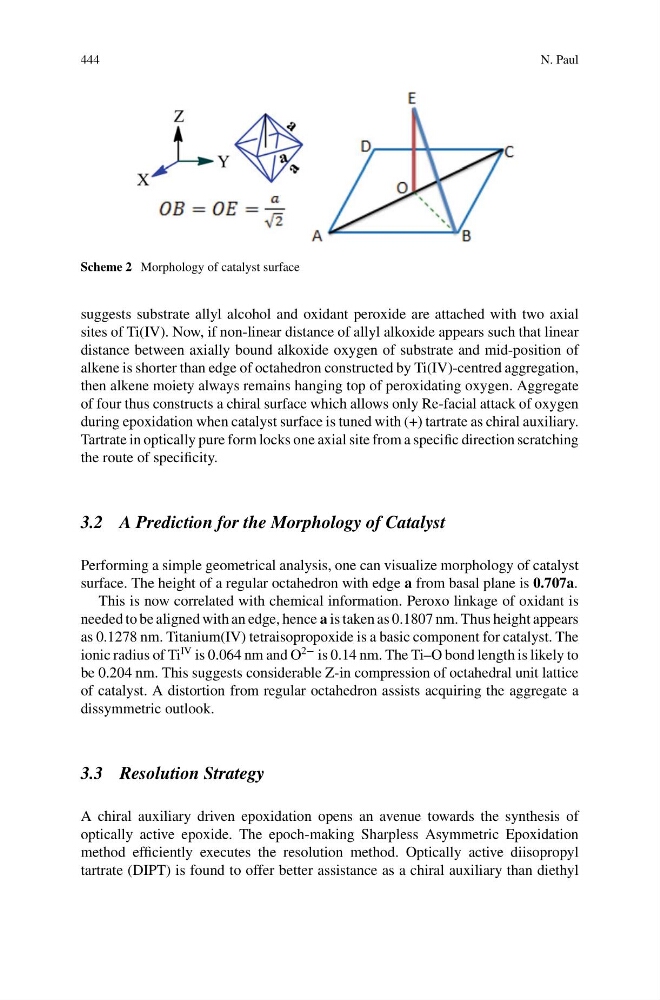
Scheme 2 Morphology of catalyst surface
suggests substrate allyl alcohol and oxidant peroxide are attached with two axial
sites of Ti(IV). Now, if non-linear distance of allyl alkoxide appears such that linear
distance between axially bound alkoxide oxygen of substrate and mid-position of
alkene is shorter than edge of octahedron constructed by Ti(IV)-centred aggregation,
then alkene moiety always remains hanging top of peroxidating oxygen. Aggregate
of four thus constructs a chiral surface which allows only Re-facial attack of oxygen
during epoxidation when catalyst surface is tuned with (+) tartrate as chiral auxiliary.
Tartrate in optically pure form locks one axial site from a specific direction scratching
the route of specificity.
3.2 A Prediction for the Morphology of Catalyst
Performing a simple geometrical analysis, one can visualize morphology of catalyst
surface. The height of a regular octahedron with edge a from basal plane is 0.707a.
This is now correlated with chemical information. Peroxo linkage of oxidant is
needed to be aligned with an edge, hence a is taken as 0.1807 nm. Thus height appears
as 0.1278 nm. Titanium(IV) tetraisopropoxide is a basic component for catalyst. The
ionic radius of Ti
IV is 0.064 nm and O
2− is 0.14 nm. The Ti–O bond length is likely to
be 0.204 nm. This suggests considerable Z-in compression of octahedral unit lattice
of catalyst. A distortion from regular octahedron assists acquiring the aggregate a
dissymmetric outlook.
3.3 Resolution Strategy
A chiral auxiliary driven epoxidation opens an avenue towards the synthesis of
optically active epoxide. The epoch-making Sharpless Asymmetric Epoxidation
method efficiently executes the resolution method. Optically active diisopropyl
tartrate (DIPT) is found to offer better assistance as a chiral auxiliary than diethyl
N. Paul
Scheme 2 Morphology of catalyst surface
suggests substrate allyl alcohol and oxidant peroxide are attached with two axial
sites of Ti(IV). Now, if non-linear distance of allyl alkoxide appears such that linear
distance between axially bound alkoxide oxygen of substrate and mid-position of
alkene is shorter than edge of octahedron constructed by Ti(IV)-centred aggregation,
then alkene moiety always remains hanging top of peroxidating oxygen. Aggregate
of four thus constructs a chiral surface which allows only Re-facial attack of oxygen
during epoxidation when catalyst surface is tuned with (+) tartrate as chiral auxiliary.
Tartrate in optically pure form locks one axial site from a specific direction scratching
the route of specificity.
3.2 A Prediction for the Morphology of Catalyst
Performing a simple geometrical analysis, one can visualize morphology of catalyst
surface. The height of a regular octahedron with edge a from basal plane is 0.707a.
This is now correlated with chemical information. Peroxo linkage of oxidant is
needed to be aligned with an edge, hence a is taken as 0.1807 nm. Thus height appears
as 0.1278 nm. Titanium(IV) tetraisopropoxide is a basic component for catalyst. The
ionic radius of Ti
IV is 0.064 nm and O
2− is 0.14 nm. The Ti–O bond length is likely to
be 0.204 nm. This suggests considerable Z-in compression of octahedral unit lattice
of catalyst. A distortion from regular octahedron assists acquiring the aggregate a
dissymmetric outlook.
3.3 Resolution Strategy
A chiral auxiliary driven epoxidation opens an avenue towards the synthesis of
optically active epoxide. The epoch-making Sharpless Asymmetric Epoxidation
method efficiently executes the resolution method. Optically active diisopropyl
tartrate (DIPT) is found to offer better assistance as a chiral auxiliary than diethyl