

406
B. Bej et al.
of pollutants such as NO x , SO x , and greenhouse gases. In this context, hydrogen
is considered as the best fuel because of its high fuel density and no emission of
pollutants when it burns. It also offers high efficiency when used in polymer electrolyte membrane (PEM) fuel cells (Patel and Pant 2006). Fuel cell technology, one
of the most promising sources of power generation, offers highly efficient conversion of chemical energy into electrical energy. However, hydrogen fuel cell as well
as fuel cell vehicle presents some technological limitations with generation, storage,
transportation, and distribution of pure H 2 . For safety, fuel cell vehicle would run on
onboard H 2 generation by reforming of liquid fuel.
Among the liquid fuels to be reformed, methanol has been preferred as an appropriate source of hydrogen because of its low cost, high availability, low boiling point,
and high ratio of H/C (4:1). Moreover, it can be converted to hydrogen at relatively low
reforming temperature. It contains no C–C bonds, which in turn drastically reduces
the risk of coke formation and catalyst fouling and makes its reactions energetically
favorable. Among the various processes of hydrogen production, steam reforming of
methanol (SRM) seems to be more attractive one to produce hydrogen as it produces
theoretically higher H 2 yield and syngas with highest H 2 /CO ratio.
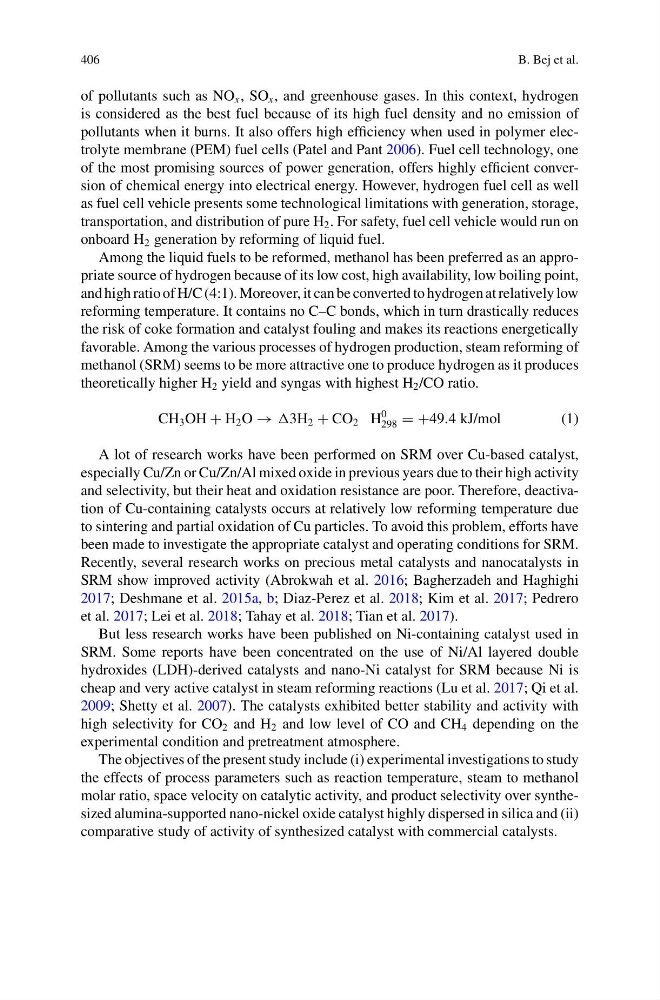
CH 3 OH + H 2 O → 3H 2 + CO 2 H
0
298 = +49.4 kJ/mol
(1)
A lot of research works have been performed on SRM over Cu-based catalyst,
especially Cu/Zn or Cu/Zn/Al mixed oxide in previous years due to their high activity
and selectivity, but their heat and oxidation resistance are poor. Therefore, deactivation of Cu-containing catalysts occurs at relatively low reforming temperature due
to sintering and partial oxidation of Cu particles. To avoid this problem, efforts have
been made to investigate the appropriate catalyst and operating conditions for SRM.
Recently, several research works on precious metal catalysts and nanocatalysts in
SRM show improved activity (Abrokwah et al. 2016; Bagherzadeh and Haghighi
2017; Deshmane et al. 2015a, b; Diaz-Perez et al. 2018; Kim et al. 2017; Pedrero
et al. 2017; Lei et al. 2018; Tahay et al. 2018; Tian et al. 2017).
But less research works have been published on Ni-containing catalyst used in
SRM. Some reports have been concentrated on the use of Ni/Al layered double
hydroxides (LDH)-derived catalysts and nano-Ni catalyst for SRM because Ni is
cheap and very active catalyst in steam reforming reactions (Lu et al. 2017; Qi et al.
2009; Shetty et al. 2007). The catalysts exhibited better stability and activity with
high selectivity for CO 2 and H 2 and low level of CO and CH 4 depending on the
experimental condition and pretreatment atmosphere.
The objectives of the present study include (i) experimental investigations to study
the effects of process parameters such as reaction temperature, steam to methanol
molar ratio, space velocity on catalytic activity, and product selectivity over synthesized alumina-supported nano-nickel oxide catalyst highly dispersed in silica and (ii)
comparative study of activity of synthesized catalyst with commercial catalysts.
B. Bej et al.
of pollutants such as NO x , SO x , and greenhouse gases. In this context, hydrogen
is considered as the best fuel because of its high fuel density and no emission of
pollutants when it burns. It also offers high efficiency when used in polymer electrolyte membrane (PEM) fuel cells (Patel and Pant 2006). Fuel cell technology, one
of the most promising sources of power generation, offers highly efficient conversion of chemical energy into electrical energy. However, hydrogen fuel cell as well
as fuel cell vehicle presents some technological limitations with generation, storage,
transportation, and distribution of pure H 2 . For safety, fuel cell vehicle would run on
onboard H 2 generation by reforming of liquid fuel.
Among the liquid fuels to be reformed, methanol has been preferred as an appropriate source of hydrogen because of its low cost, high availability, low boiling point,
and high ratio of H/C (4:1). Moreover, it can be converted to hydrogen at relatively low
reforming temperature. It contains no C–C bonds, which in turn drastically reduces
the risk of coke formation and catalyst fouling and makes its reactions energetically
favorable. Among the various processes of hydrogen production, steam reforming of
methanol (SRM) seems to be more attractive one to produce hydrogen as it produces
theoretically higher H 2 yield and syngas with highest H 2 /CO ratio.
CH 3 OH + H 2 O → 3H 2 + CO 2 H
0
298 = +49.4 kJ/mol
(1)
A lot of research works have been performed on SRM over Cu-based catalyst,
especially Cu/Zn or Cu/Zn/Al mixed oxide in previous years due to their high activity
and selectivity, but their heat and oxidation resistance are poor. Therefore, deactivation of Cu-containing catalysts occurs at relatively low reforming temperature due
to sintering and partial oxidation of Cu particles. To avoid this problem, efforts have
been made to investigate the appropriate catalyst and operating conditions for SRM.
Recently, several research works on precious metal catalysts and nanocatalysts in
SRM show improved activity (Abrokwah et al. 2016; Bagherzadeh and Haghighi
2017; Deshmane et al. 2015a, b; Diaz-Perez et al. 2018; Kim et al. 2017; Pedrero
et al. 2017; Lei et al. 2018; Tahay et al. 2018; Tian et al. 2017).
But less research works have been published on Ni-containing catalyst used in
SRM. Some reports have been concentrated on the use of Ni/Al layered double
hydroxides (LDH)-derived catalysts and nano-Ni catalyst for SRM because Ni is
cheap and very active catalyst in steam reforming reactions (Lu et al. 2017; Qi et al.
2009; Shetty et al. 2007). The catalysts exhibited better stability and activity with
high selectivity for CO 2 and H 2 and low level of CO and CH 4 depending on the
experimental condition and pretreatment atmosphere.
The objectives of the present study include (i) experimental investigations to study
the effects of process parameters such as reaction temperature, steam to methanol
molar ratio, space velocity on catalytic activity, and product selectivity over synthesized alumina-supported nano-nickel oxide catalyst highly dispersed in silica and (ii)
comparative study of activity of synthesized catalyst with commercial catalysts.