

378
S. Mitra et al.
shifted to a higher wavenumber, then we can infer that multilayer graphene is formed
(Bose et al. 2012). In our current study, the 2D band is fitted with more than one
Lorentzian function (shown in inset of Fig. 2b) and also the peak position is shifted
toward higher wavenumber (2690 cm
−1 ). The band at 2690 cm
−1 was absent in the
spectra of GO suggesting the formation of a multilayered graphene (Ferrari 2007).
3.3 Thermogravimetric Analysis (TGA)
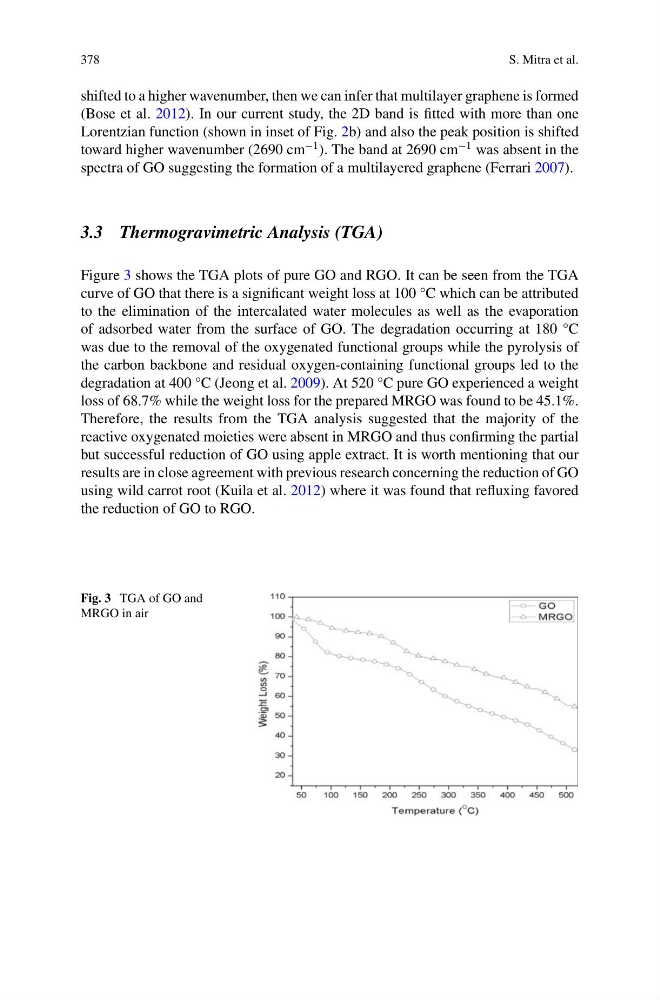
Figure 3 shows the TGA plots of pure GO and RGO. It can be seen from the TGA
curve of GO that there is a significant weight loss at 100 °C which can be attributed
to the elimination of the intercalated water molecules as well as the evaporation
of adsorbed water from the surface of GO. The degradation occurring at 180 °C
was due to the removal of the oxygenated functional groups while the pyrolysis of
the carbon backbone and residual oxygen-containing functional groups led to the
degradation at 400 °C (Jeong et al. 2009). At 520 °C pure GO experienced a weight
loss of 68.7% while the weight loss for the prepared MRGO was found to be 45.1%.
Therefore, the results from the TGA analysis suggested that the majority of the
reactive oxygenated moieties were absent in MRGO and thus confirming the partial
but successful reduction of GO using apple extract. It is worth mentioning that our
results are in close agreement with previous research concerning the reduction of GO
using wild carrot root (Kuila et al. 2012) where it was found that refluxing favored
the reduction of GO to RGO.
Fig. 3 TGA of GO and
MRGO in air
S. Mitra et al.
shifted to a higher wavenumber, then we can infer that multilayer graphene is formed
(Bose et al. 2012). In our current study, the 2D band is fitted with more than one
Lorentzian function (shown in inset of Fig. 2b) and also the peak position is shifted
toward higher wavenumber (2690 cm
−1 ). The band at 2690 cm
−1 was absent in the
spectra of GO suggesting the formation of a multilayered graphene (Ferrari 2007).
3.3 Thermogravimetric Analysis (TGA)
Figure 3 shows the TGA plots of pure GO and RGO. It can be seen from the TGA
curve of GO that there is a significant weight loss at 100 °C which can be attributed
to the elimination of the intercalated water molecules as well as the evaporation
of adsorbed water from the surface of GO. The degradation occurring at 180 °C
was due to the removal of the oxygenated functional groups while the pyrolysis of
the carbon backbone and residual oxygen-containing functional groups led to the
degradation at 400 °C (Jeong et al. 2009). At 520 °C pure GO experienced a weight
loss of 68.7% while the weight loss for the prepared MRGO was found to be 45.1%.
Therefore, the results from the TGA analysis suggested that the majority of the
reactive oxygenated moieties were absent in MRGO and thus confirming the partial
but successful reduction of GO using apple extract. It is worth mentioning that our
results are in close agreement with previous research concerning the reduction of GO
using wild carrot root (Kuila et al. 2012) where it was found that refluxing favored
the reduction of GO to RGO.
Fig. 3 TGA of GO and
MRGO in air