

Optimization of Process Parameters for Biodegradation …
369
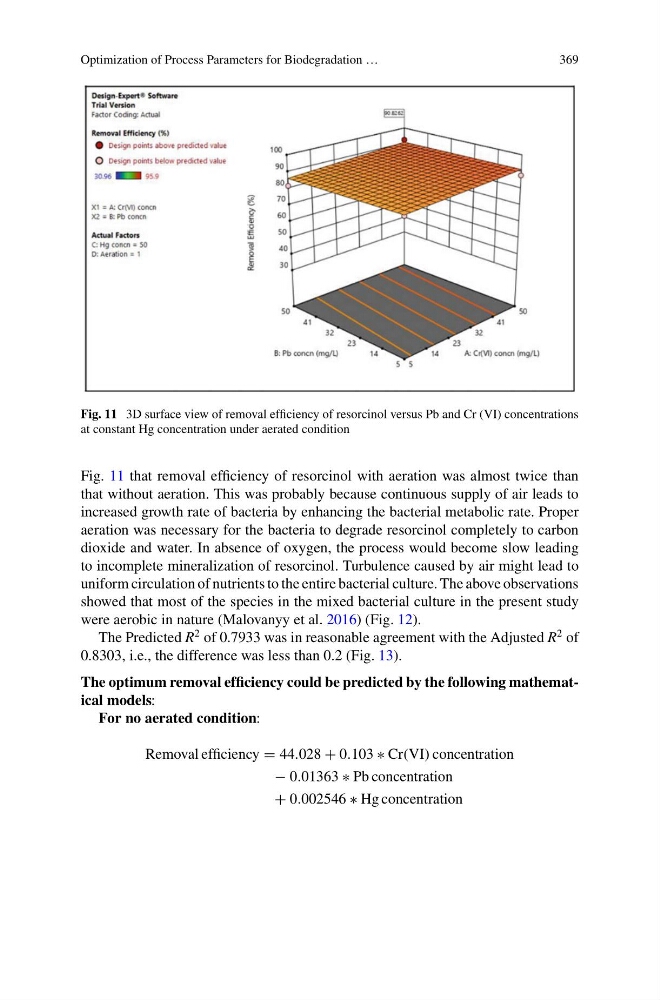
Fig. 11 3D surface view of removal efficiency of resorcinol versus Pb and Cr (VI) concentrations
at constant Hg concentration under aerated condition
Fig. 11 that removal efficiency of resorcinol with aeration was almost twice than
that without aeration. This was probably because continuous supply of air leads to
increased growth rate of bacteria by enhancing the bacterial metabolic rate. Proper
aeration was necessary for the bacteria to degrade resorcinol completely to carbon
dioxide and water. In absence of oxygen, the process would become slow leading
to incomplete mineralization of resorcinol. Turbulence caused by air might lead to
uniform circulation of nutrients to the entire bacterial culture. The above observations
showed that most of the species in the mixed bacterial culture in the present study
were aerobic in nature (Malovanyy et al. 2016) (Fig. 12).
The Predicted R
2 of 0.7933 was in reasonable agreement with the Adjusted R
2 of
0.8303, i.e., the difference was less than 0.2 (Fig. 13).
The optimum removal efficiency could be predicted by the following mathematical models:
For no aerated condition:
Removal efficiency = 44.028 + 0.103 ∗ Cr(VI) concentration
− 0.01363 ∗ Pb concentration
+ 0.002546 ∗ Hg concentration
369
Fig. 11 3D surface view of removal efficiency of resorcinol versus Pb and Cr (VI) concentrations
at constant Hg concentration under aerated condition
Fig. 11 that removal efficiency of resorcinol with aeration was almost twice than
that without aeration. This was probably because continuous supply of air leads to
increased growth rate of bacteria by enhancing the bacterial metabolic rate. Proper
aeration was necessary for the bacteria to degrade resorcinol completely to carbon
dioxide and water. In absence of oxygen, the process would become slow leading
to incomplete mineralization of resorcinol. Turbulence caused by air might lead to
uniform circulation of nutrients to the entire bacterial culture. The above observations
showed that most of the species in the mixed bacterial culture in the present study
were aerobic in nature (Malovanyy et al. 2016) (Fig. 12).
The Predicted R
2 of 0.7933 was in reasonable agreement with the Adjusted R
2 of
0.8303, i.e., the difference was less than 0.2 (Fig. 13).
The optimum removal efficiency could be predicted by the following mathematical models:
For no aerated condition:
Removal efficiency = 44.028 + 0.103 ∗ Cr(VI) concentration
− 0.01363 ∗ Pb concentration
+ 0.002546 ∗ Hg concentration