

352
P. Talukder
2.4.2 DPPH Radical Scavenging Assay
The DPPH radical scavenging assay was done according to Brand-Williams et al.
(1995), with few modifications (Talukder et al. 2016).
2.5 Gene Expression Analysis by Reverse Transcription PCR
and Real-Time PCR
Thermal cycler condition for reverse transcription PCR was reverse transcription at
50 °C for 30 min, Initial denaturation step at 95 °C for 15 min followed by 40 cycles
of denaturation at 94 °C for 1 min, primer annealing at 53 °C for 1 min, elongation
at 72 °C for 1 min and 30 s, and the final extension was done at 72 °C for 10 min.
The reaction condition for real-time PCR was: an initial hold at 95 °C for 10 min,
40 cycles of denaturation at 95 °C for 30 s, annealing, and extension at 60 °C for
1 min. β-actin served as endogenous control. Three biological replicates were used
for each reaction. Real-time PCR 2
−CT was performed according to the method
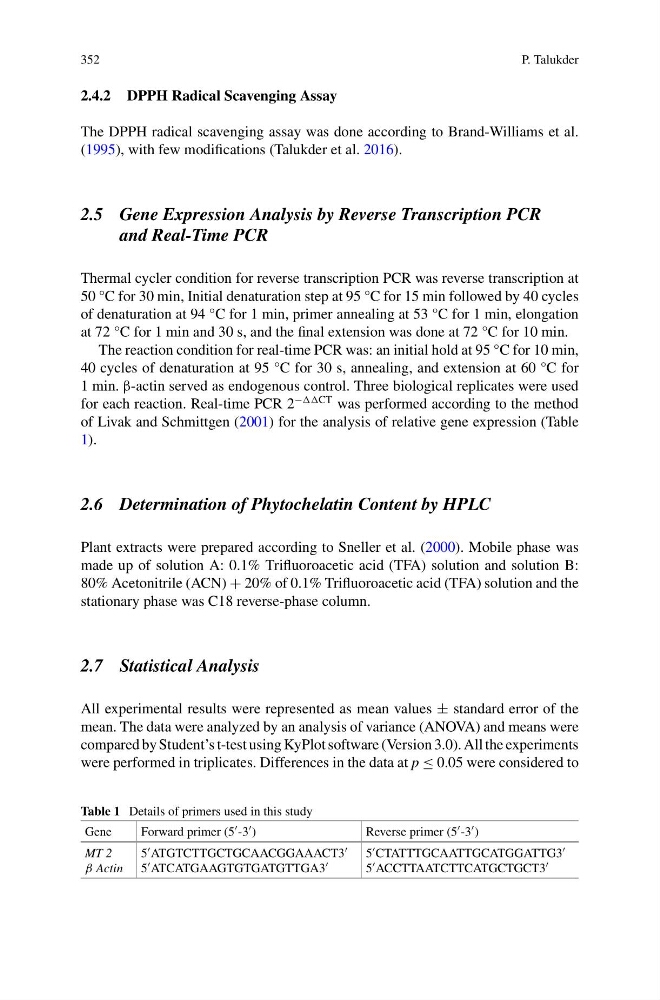
of Livak and Schmittgen (2001) for the analysis of relative gene expression (Table
1).
2.6 Determination of Phytochelatin Content by HPLC
Plant extracts were prepared according to Sneller et al. (2000). Mobile phase was
made up of solution A: 0.1% Trifluoroacetic acid (TFA) solution and solution B:
80% Acetonitrile (ACN) + 20% of 0.1% Trifluoroacetic acid (TFA) solution and the
stationary phase was C18 reverse-phase column.
2.7 Statistical Analysis
All experimental results were represented as mean values ± standard error of the
mean. The data were analyzed by an analysis of variance (ANOVA) and means were
compared by Student’s t-test using KyPlot software (Version 3.0). All the experiments
were performed in triplicates. Differences in the data at p ≤ 0.05 were considered to
Table 1 Details of primers used in this study
Gene
Forward primer (5 -3 )
Reverse primer (5 -3 )
MT 2
β Actin
5 ATGTCTTGCTGCAACGGAAACT3
5 ATCATGAAGTGTGATGTTGA3
5 CTATTTGCAATTGCATGGATTG3
5 ACCTTAATCTTCATGCTGCT3
P. Talukder
2.4.2 DPPH Radical Scavenging Assay
The DPPH radical scavenging assay was done according to Brand-Williams et al.
(1995), with few modifications (Talukder et al. 2016).
2.5 Gene Expression Analysis by Reverse Transcription PCR
and Real-Time PCR
Thermal cycler condition for reverse transcription PCR was reverse transcription at
50 °C for 30 min, Initial denaturation step at 95 °C for 15 min followed by 40 cycles
of denaturation at 94 °C for 1 min, primer annealing at 53 °C for 1 min, elongation
at 72 °C for 1 min and 30 s, and the final extension was done at 72 °C for 10 min.
The reaction condition for real-time PCR was: an initial hold at 95 °C for 10 min,
40 cycles of denaturation at 95 °C for 30 s, annealing, and extension at 60 °C for
1 min. β-actin served as endogenous control. Three biological replicates were used
for each reaction. Real-time PCR 2
−CT was performed according to the method
of Livak and Schmittgen (2001) for the analysis of relative gene expression (Table
1).
2.6 Determination of Phytochelatin Content by HPLC
Plant extracts were prepared according to Sneller et al. (2000). Mobile phase was
made up of solution A: 0.1% Trifluoroacetic acid (TFA) solution and solution B:
80% Acetonitrile (ACN) + 20% of 0.1% Trifluoroacetic acid (TFA) solution and the
stationary phase was C18 reverse-phase column.
2.7 Statistical Analysis
All experimental results were represented as mean values ± standard error of the
mean. The data were analyzed by an analysis of variance (ANOVA) and means were
compared by Student’s t-test using KyPlot software (Version 3.0). All the experiments
were performed in triplicates. Differences in the data at p ≤ 0.05 were considered to
Table 1 Details of primers used in this study
Gene
Forward primer (5 -3 )
Reverse primer (5 -3 )
MT 2
β Actin
5 ATGTCTTGCTGCAACGGAAACT3
5 ATCATGAAGTGTGATGTTGA3
5 CTATTTGCAATTGCATGGATTG3
5 ACCTTAATCTTCATGCTGCT3