

340
B. Chakraborty et al.
Keywords Suspended growth batch reactor · Bakery and confectionery
wastewater · COD removal · NH 4
+ –N removal · Kinetic constants
1 Introduction
Large commercial bakery and confectionery producing products including cakes,
pies, cookies, biscuits, brownies, rolls, and a variety of other desserts. These plants
generate wastewater with loads of contaminants too high, made unsuitable for municipal discharge without pretreatment. Bakeries use large volumes of butter, flour, shortening, eggs, fillings of various types that produce the high level of BOD, suspended
solids and fats, oils, and grease in the wastewater. For purposes of wastewater characterization, the bakery industry may be divided into two groups: dry baking such as
bread, bun, and roll baking and production of cakes, pies, doughnuts, cookies, and
sweet rolls. In dry baking, production equipment such as mixing vats and baking
pans are typically cleaned dry and floors are swept prior to wash down. Wastewater is produced from general cleanup operations and is of low strength. Its major
contaminants are flour and some grease. The second type of baking operation such as
cake production generates wastes of much higher strength containing grease, sugar,
flour, filling ingredients, and detergents. Most of the production equipment, such
as baking pans and trays, mixing vats, mixers, milk, and other liquid containers,
are water cleaned. Pans and trays are washed with hot detergents and greased after
each baking. The spent liquid from pan washers constitutes one of the most important sources of wastewater. Confectionery industry also generates high amounts of
wastewater, which contains high concentrations of readily biodegradable organic
materials characterized by high COD and BOD values (Beal and Raman 2000). The
average wastewater qualities of bakery and confectionery production units found by
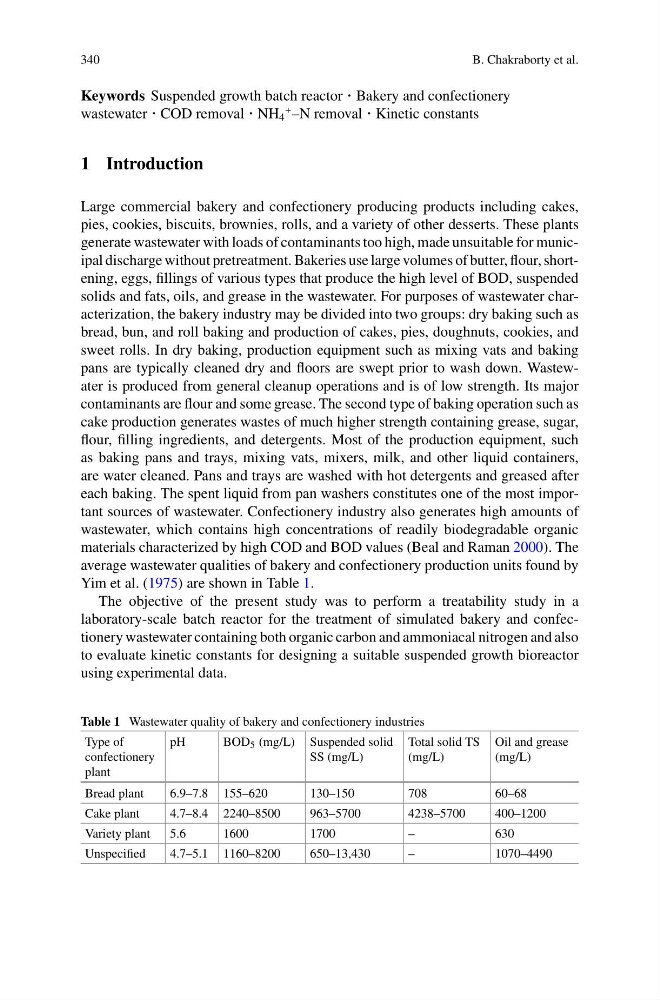
Yim et al. (1975) are shown in Table 1.
The objective of the present study was to perform a treatability study in a
laboratory-scale batch reactor for the treatment of simulated bakery and confectionery wastewater containing both organic carbon and ammoniacal nitrogen and also
to evaluate kinetic constants for designing a suitable suspended growth bioreactor
using experimental data.
Table 1 Wastewater quality of bakery and confectionery industries
Type of
confectionery
plant
pH
BOD 5 (mg/L) Suspended solid
SS (mg/L)
Total solid TS
(mg/L)
Oil and grease
(mg/L)
Bread plant
6.9–7.8 155–620
130–150
708
60–68
Cake plant
4.7–8.4 2240–8500
963–5700
4238–5700
400–1200
Variety plant
5.6
1600
1700
–
630
Unspecified
4.7–5.1 1160–8200
650–13,430
–
1070–4490
B. Chakraborty et al.
Keywords Suspended growth batch reactor · Bakery and confectionery
wastewater · COD removal · NH 4
+ –N removal · Kinetic constants
1 Introduction
Large commercial bakery and confectionery producing products including cakes,
pies, cookies, biscuits, brownies, rolls, and a variety of other desserts. These plants
generate wastewater with loads of contaminants too high, made unsuitable for municipal discharge without pretreatment. Bakeries use large volumes of butter, flour, shortening, eggs, fillings of various types that produce the high level of BOD, suspended
solids and fats, oils, and grease in the wastewater. For purposes of wastewater characterization, the bakery industry may be divided into two groups: dry baking such as
bread, bun, and roll baking and production of cakes, pies, doughnuts, cookies, and
sweet rolls. In dry baking, production equipment such as mixing vats and baking
pans are typically cleaned dry and floors are swept prior to wash down. Wastewater is produced from general cleanup operations and is of low strength. Its major
contaminants are flour and some grease. The second type of baking operation such as
cake production generates wastes of much higher strength containing grease, sugar,
flour, filling ingredients, and detergents. Most of the production equipment, such
as baking pans and trays, mixing vats, mixers, milk, and other liquid containers,
are water cleaned. Pans and trays are washed with hot detergents and greased after
each baking. The spent liquid from pan washers constitutes one of the most important sources of wastewater. Confectionery industry also generates high amounts of
wastewater, which contains high concentrations of readily biodegradable organic
materials characterized by high COD and BOD values (Beal and Raman 2000). The
average wastewater qualities of bakery and confectionery production units found by
Yim et al. (1975) are shown in Table 1.
The objective of the present study was to perform a treatability study in a
laboratory-scale batch reactor for the treatment of simulated bakery and confectionery wastewater containing both organic carbon and ammoniacal nitrogen and also
to evaluate kinetic constants for designing a suitable suspended growth bioreactor
using experimental data.
Table 1 Wastewater quality of bakery and confectionery industries
Type of
confectionery
plant
pH
BOD 5 (mg/L) Suspended solid
SS (mg/L)
Total solid TS
(mg/L)
Oil and grease
(mg/L)
Bread plant
6.9–7.8 155–620
130–150
708
60–68
Cake plant
4.7–8.4 2240–8500
963–5700
4238–5700
400–1200
Variety plant
5.6
1600
1700
–
630
Unspecified
4.7–5.1 1160–8200
650–13,430
–
1070–4490