

336
K. Biswas and M. Rahaman
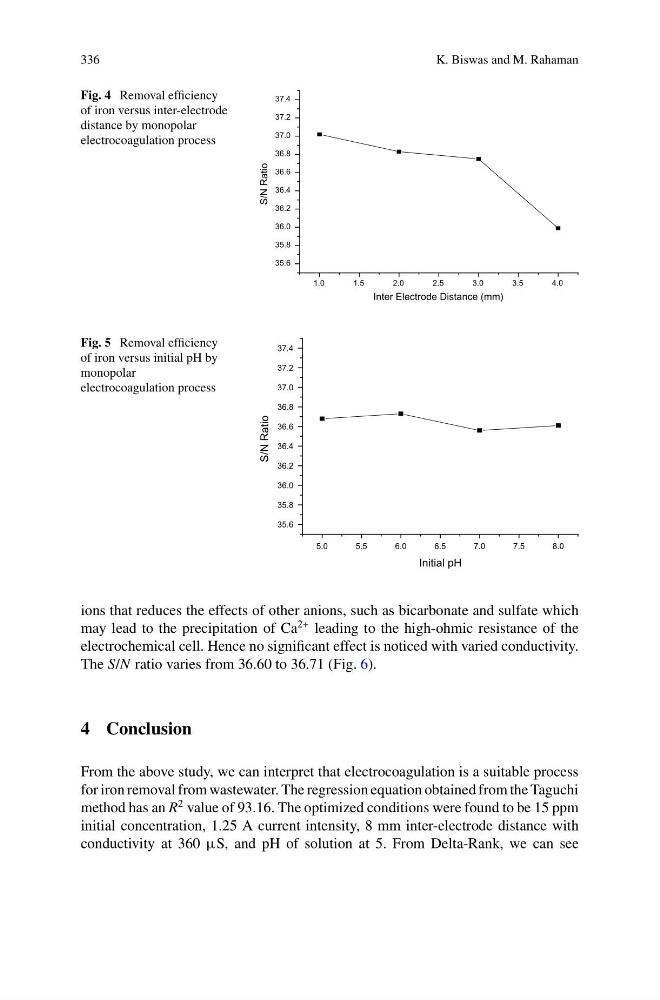
Fig. 4 Removal efficiency
of iron versus inter-electrode
distance by monopolar
electrocoagulation process
1.0
1.5
2.0
2.5
3.0
3.5
4.0
35.6
35.8
36.0
36.2
36.4
36.6
36.8
37.0
37.2
37.4
S/N Ratio
Inter Electrode Distance (mm)
Fig. 5 Removal efficiency
of iron versus initial pH by
monopolar
electrocoagulation process
5.0
5.5
6.0
6.5
7.0
7.5
8.0
35.6
35.8
36.0
36.2
36.4
36.6
36.8
37.0
37.2
37.4
S/N Ratio
Initial pH
ions that reduces the effects of other anions, such as bicarbonate and sulfate which
may lead to the precipitation of Ca
2+ leading to the high-ohmic resistance of the
electrochemical cell. Hence no significant effect is noticed with varied conductivity.
The S/N ratio varies from 36.60 to 36.71 (Fig. 6).
4 Conclusion
From the above study, we can interpret that electrocoagulation is a suitable process
for iron removal from wastewater. The regression equation obtained from the Taguchi
method has an R
2 value of 93.16. The optimized conditions were found to be 15 ppm
initial concentration, 1.25 A current intensity, 8 mm inter-electrode distance with
conductivity at 360 µS, and pH of solution at 5. From Delta-Rank, we can see
K. Biswas and M. Rahaman
Fig. 4 Removal efficiency
of iron versus inter-electrode
distance by monopolar
electrocoagulation process
1.0
1.5
2.0
2.5
3.0
3.5
4.0
35.6
35.8
36.0
36.2
36.4
36.6
36.8
37.0
37.2
37.4
S/N Ratio
Inter Electrode Distance (mm)
Fig. 5 Removal efficiency
of iron versus initial pH by
monopolar
electrocoagulation process
5.0
5.5
6.0
6.5
7.0
7.5
8.0
35.6
35.8
36.0
36.2
36.4
36.6
36.8
37.0
37.2
37.4
S/N Ratio
Initial pH
ions that reduces the effects of other anions, such as bicarbonate and sulfate which
may lead to the precipitation of Ca
2+ leading to the high-ohmic resistance of the
electrochemical cell. Hence no significant effect is noticed with varied conductivity.
The S/N ratio varies from 36.60 to 36.71 (Fig. 6).
4 Conclusion
From the above study, we can interpret that electrocoagulation is a suitable process
for iron removal from wastewater. The regression equation obtained from the Taguchi
method has an R
2 value of 93.16. The optimized conditions were found to be 15 ppm
initial concentration, 1.25 A current intensity, 8 mm inter-electrode distance with
conductivity at 360 µS, and pH of solution at 5. From Delta-Rank, we can see