

334
K. Biswas and M. Rahaman
environment. The rate of generation of aluminum hydroxide complexes is not sufficient to remove high Fe(II) concentration (>15 mg/L) within 40 min of operation.
Therefore, longer residence time is required for electrocoagulation process of high
Fe(II) concentration.
3.2.2 Effect of Current Intensity
The increase in current intensity increases the removal efficiency of iron. The amount
of coagulants formed in electrocoagulation process depends greatly on the current
passed and the time. Choice of electrode material is also an important factor affecting
the cell voltage (different oxidation potential for different electrode materials) and
the separation attained. In our work, aluminum was carefully chosen as the electrode material because of its cheapness, ready availability, nonharmfulness and it
requires comparatively less oxidation potential. Here a sorption coagulation mechanism follows resulting in the creation of loose aggregates. As time progresses, further
aluminum cation accumulation results in amorphous aluminum hydroxide precipitation that stimulates pollutant aggregation through a sweep coagulation followed by
precipitation mechanism. During the final stages, coagulated aggregates act together
with bubbles and float to the surface or settle to the bottom of the reactor. The size of
the H 2 bubbles formed and the coagulant production rate is adjusted by varying the
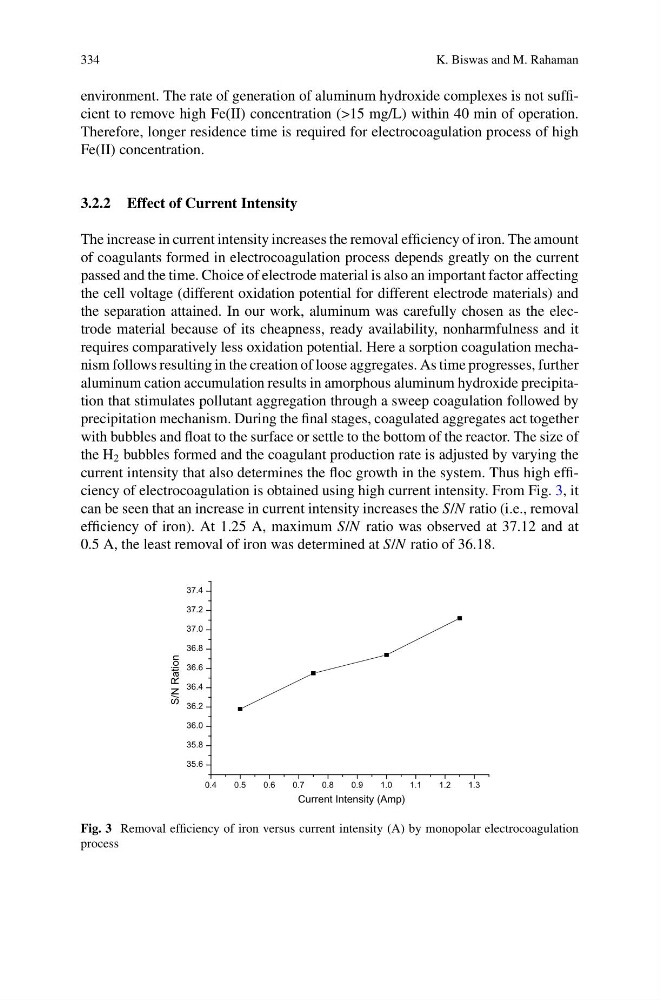
current intensity that also determines the floc growth in the system. Thus high efficiency of electrocoagulation is obtained using high current intensity. From Fig. 3, it
can be seen that an increase in current intensity increases the S/N ratio (i.e., removal
efficiency of iron). At 1.25 A, maximum S/N ratio was observed at 37.12 and at
0.5 A, the least removal of iron was determined at S/N ratio of 36.18.
0.4
0.5
0.6
0.7
0.8
0.9
1.0
1.1
1.2
1.3
35.6
35.8
36.0
36.2
36.4
36.6
36.8
37.0
37.2
37.4
S/N Ration
Current Intensity (Amp)
Fig. 3 Removal efficiency of iron versus current intensity (A) by monopolar electrocoagulation
process
K. Biswas and M. Rahaman
environment. The rate of generation of aluminum hydroxide complexes is not sufficient to remove high Fe(II) concentration (>15 mg/L) within 40 min of operation.
Therefore, longer residence time is required for electrocoagulation process of high
Fe(II) concentration.
3.2.2 Effect of Current Intensity
The increase in current intensity increases the removal efficiency of iron. The amount
of coagulants formed in electrocoagulation process depends greatly on the current
passed and the time. Choice of electrode material is also an important factor affecting
the cell voltage (different oxidation potential for different electrode materials) and
the separation attained. In our work, aluminum was carefully chosen as the electrode material because of its cheapness, ready availability, nonharmfulness and it
requires comparatively less oxidation potential. Here a sorption coagulation mechanism follows resulting in the creation of loose aggregates. As time progresses, further
aluminum cation accumulation results in amorphous aluminum hydroxide precipitation that stimulates pollutant aggregation through a sweep coagulation followed by
precipitation mechanism. During the final stages, coagulated aggregates act together
with bubbles and float to the surface or settle to the bottom of the reactor. The size of
the H 2 bubbles formed and the coagulant production rate is adjusted by varying the
current intensity that also determines the floc growth in the system. Thus high efficiency of electrocoagulation is obtained using high current intensity. From Fig. 3, it
can be seen that an increase in current intensity increases the S/N ratio (i.e., removal
efficiency of iron). At 1.25 A, maximum S/N ratio was observed at 37.12 and at
0.5 A, the least removal of iron was determined at S/N ratio of 36.18.
0.4
0.5
0.6
0.7
0.8
0.9
1.0
1.1
1.2
1.3
35.6
35.8
36.0
36.2
36.4
36.6
36.8
37.0
37.2
37.4
S/N Ration
Current Intensity (Amp)
Fig. 3 Removal efficiency of iron versus current intensity (A) by monopolar electrocoagulation
process