

Cost-Effective and Eco-Friendly Method for Decolorization of Malachite Green …
281
3.2 Application of RSM and ANOVA in Column Study
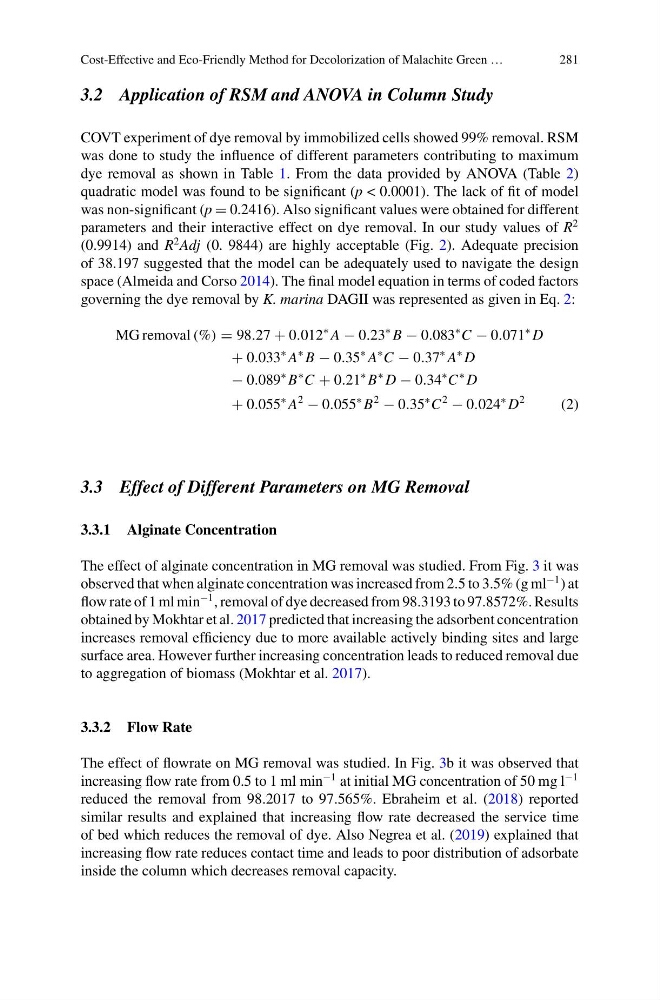
COVT experiment of dye removal by immobilized cells showed 99% removal. RSM
was done to study the influence of different parameters contributing to maximum
dye removal as shown in Table 1. From the data provided by ANOVA (Table 2)
quadratic model was found to be significant (p < 0.0001). The lack of fit of model
was non-significant (p = 0.2416). Also significant values were obtained for different
parameters and their interactive effect on dye removal. In our study values of R
2
(0.9914) and R
2 Adj (0. 9844) are highly acceptable (Fig. 2). Adequate precision
of 38.197 suggested that the model can be adequately used to navigate the design
space (Almeida and Corso 2014). The final model equation in terms of coded factors
governing the dye removal by K. marina DAGII was represented as given in Eq. 2:
MG removal (%) = 98.27 + 0.012
∗ A − 0.23
∗ B − 0.083
∗ C − 0.071
∗ D
+ 0.033
∗ A
∗ B − 0.35
∗ A
∗ C − 0.37
∗ A
∗ D
− 0.089
∗ B
∗ C + 0.21
∗ B
∗ D − 0.34
∗ C
∗ D
+ 0.055
∗ A
2
− 0.055
∗ B
2
− 0.35
∗ C
2
− 0.024
∗ D
2
(2)
3.3 Effect of Different Parameters on MG Removal
3.3.1 Alginate Concentration
The effect of alginate concentration in MG removal was studied. From Fig. 3 it was
observed that when alginate concentration was increased from 2.5 to 3.5% (g ml
−1 ) at
flow rate of 1 ml min
−1 , removal of dye decreased from 98.3193 to 97.8572%. Results
obtained by Mokhtar et al. 2017 predicted that increasing the adsorbent concentration
increases removal efficiency due to more available actively binding sites and large
surface area. However further increasing concentration leads to reduced removal due
to aggregation of biomass (Mokhtar et al. 2017).
3.3.2 Flow Rate
The effect of flowrate on MG removal was studied. In Fig. 3b it was observed that
increasing flow rate from 0.5 to 1 ml min
−1 at initial MG concentration of 50 mg l
−1
reduced the removal from 98.2017 to 97.565%. Ebraheim et al. (2018) reported
similar results and explained that increasing flow rate decreased the service time
of bed which reduces the removal of dye. Also Negrea et al. (2019) explained that
increasing flow rate reduces contact time and leads to poor distribution of adsorbate
inside the column which decreases removal capacity.
281
3.2 Application of RSM and ANOVA in Column Study
COVT experiment of dye removal by immobilized cells showed 99% removal. RSM
was done to study the influence of different parameters contributing to maximum
dye removal as shown in Table 1. From the data provided by ANOVA (Table 2)
quadratic model was found to be significant (p < 0.0001). The lack of fit of model
was non-significant (p = 0.2416). Also significant values were obtained for different
parameters and their interactive effect on dye removal. In our study values of R
2
(0.9914) and R
2 Adj (0. 9844) are highly acceptable (Fig. 2). Adequate precision
of 38.197 suggested that the model can be adequately used to navigate the design
space (Almeida and Corso 2014). The final model equation in terms of coded factors
governing the dye removal by K. marina DAGII was represented as given in Eq. 2:
MG removal (%) = 98.27 + 0.012
∗ A − 0.23
∗ B − 0.083
∗ C − 0.071
∗ D
+ 0.033
∗ A
∗ B − 0.35
∗ A
∗ C − 0.37
∗ A
∗ D
− 0.089
∗ B
∗ C + 0.21
∗ B
∗ D − 0.34
∗ C
∗ D
+ 0.055
∗ A
2
− 0.055
∗ B
2
− 0.35
∗ C
2
− 0.024
∗ D
2
(2)
3.3 Effect of Different Parameters on MG Removal
3.3.1 Alginate Concentration
The effect of alginate concentration in MG removal was studied. From Fig. 3 it was
observed that when alginate concentration was increased from 2.5 to 3.5% (g ml
−1 ) at
flow rate of 1 ml min
−1 , removal of dye decreased from 98.3193 to 97.8572%. Results
obtained by Mokhtar et al. 2017 predicted that increasing the adsorbent concentration
increases removal efficiency due to more available actively binding sites and large
surface area. However further increasing concentration leads to reduced removal due
to aggregation of biomass (Mokhtar et al. 2017).
3.3.2 Flow Rate
The effect of flowrate on MG removal was studied. In Fig. 3b it was observed that
increasing flow rate from 0.5 to 1 ml min
−1 at initial MG concentration of 50 mg l
−1
reduced the removal from 98.2017 to 97.565%. Ebraheim et al. (2018) reported
similar results and explained that increasing flow rate decreased the service time
of bed which reduces the removal of dye. Also Negrea et al. (2019) explained that
increasing flow rate reduces contact time and leads to poor distribution of adsorbate
inside the column which decreases removal capacity.