

Optimization of Energy-Proficient Infrared Radiated Rapid Hydrolysis …
259
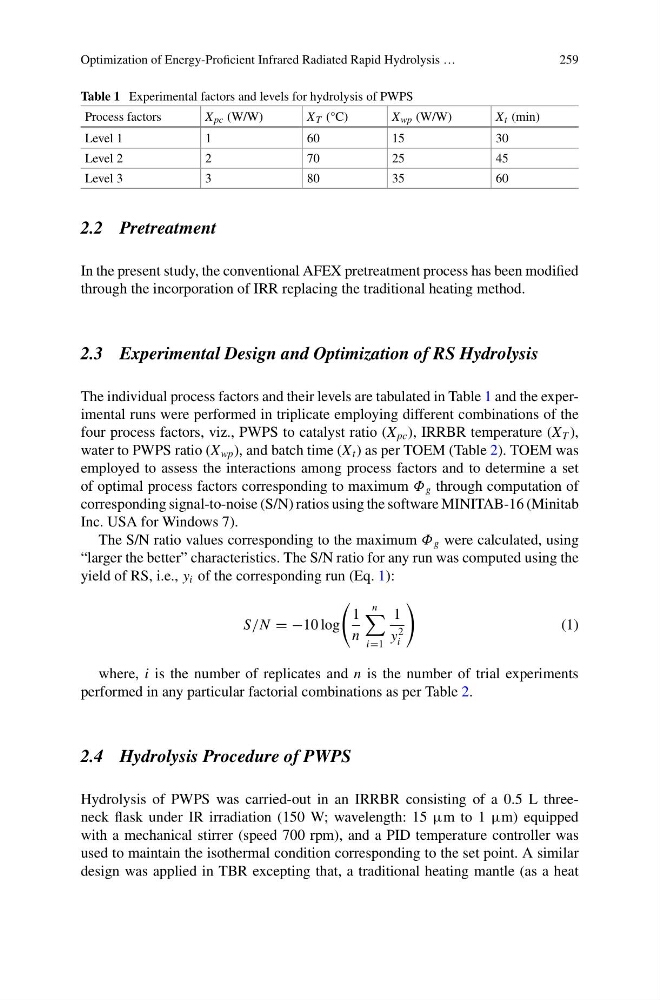
Table 1 Experimental factors and levels for hydrolysis of PWPS
Process factors
X pc (W/W)
X T (°C)
X wp (W/W)
X t (min)
Level 1
1
60
15
30
Level 2
2
70
25
45
Level 3
3
80
35
60
2.2 Pretreatment
In the present study, the conventional AFEX pretreatment process has been modified
through the incorporation of IRR replacing the traditional heating method.
2.3 Experimental Design and Optimization of RS Hydrolysis
The individual process factors and their levels are tabulated in Table 1 and the experimental runs were performed in triplicate employing different combinations of the
four process factors, viz., PWPS to catalyst ratio (X pc ), IRRBR temperature (X T ),
water to PWPS ratio (X wp ), and batch time (X t ) as per TOEM (Table 2). TOEM was
employed to assess the interactions among process factors and to determine a set
of optimal process factors corresponding to maximum Φ g through computation of
corresponding signal-to-noise (S/N) ratios using the software MINITAB-16 (Minitab
Inc. USA for Windows 7).
The S/N ratio values corresponding to the maximum Φ g were calculated, using
“larger the better” characteristics. The S/N ratio for any run was computed using the
yield of RS, i.e., y i of the corresponding run (Eq. 1):
S/N = −10 log
1
n
n
i=1
1
y
2
i
(1)
where, i is the number of replicates and n is the number of trial experiments
performed in any particular factorial combinations as per Table 2.
2.4 Hydrolysis Procedure of PWPS
Hydrolysis of PWPS was carried-out in an IRRBR consisting of a 0.5 L threeneck flask under IR irradiation (150 W; wavelength: 15 µm to 1 µm) equipped
with a mechanical stirrer (speed 700 rpm), and a PID temperature controller was
used to maintain the isothermal condition corresponding to the set point. A similar
design was applied in TBR excepting that, a traditional heating mantle (as a heat
259
Table 1 Experimental factors and levels for hydrolysis of PWPS
Process factors
X pc (W/W)
X T (°C)
X wp (W/W)
X t (min)
Level 1
1
60
15
30
Level 2
2
70
25
45
Level 3
3
80
35
60
2.2 Pretreatment
In the present study, the conventional AFEX pretreatment process has been modified
through the incorporation of IRR replacing the traditional heating method.
2.3 Experimental Design and Optimization of RS Hydrolysis
The individual process factors and their levels are tabulated in Table 1 and the experimental runs were performed in triplicate employing different combinations of the
four process factors, viz., PWPS to catalyst ratio (X pc ), IRRBR temperature (X T ),
water to PWPS ratio (X wp ), and batch time (X t ) as per TOEM (Table 2). TOEM was
employed to assess the interactions among process factors and to determine a set
of optimal process factors corresponding to maximum Φ g through computation of
corresponding signal-to-noise (S/N) ratios using the software MINITAB-16 (Minitab
Inc. USA for Windows 7).
The S/N ratio values corresponding to the maximum Φ g were calculated, using
“larger the better” characteristics. The S/N ratio for any run was computed using the
yield of RS, i.e., y i of the corresponding run (Eq. 1):
S/N = −10 log
1
n
n
i=1
1
y
2
i
(1)
where, i is the number of replicates and n is the number of trial experiments
performed in any particular factorial combinations as per Table 2.
2.4 Hydrolysis Procedure of PWPS
Hydrolysis of PWPS was carried-out in an IRRBR consisting of a 0.5 L threeneck flask under IR irradiation (150 W; wavelength: 15 µm to 1 µm) equipped
with a mechanical stirrer (speed 700 rpm), and a PID temperature controller was
used to maintain the isothermal condition corresponding to the set point. A similar
design was applied in TBR excepting that, a traditional heating mantle (as a heat