

186
G. Saha et al.
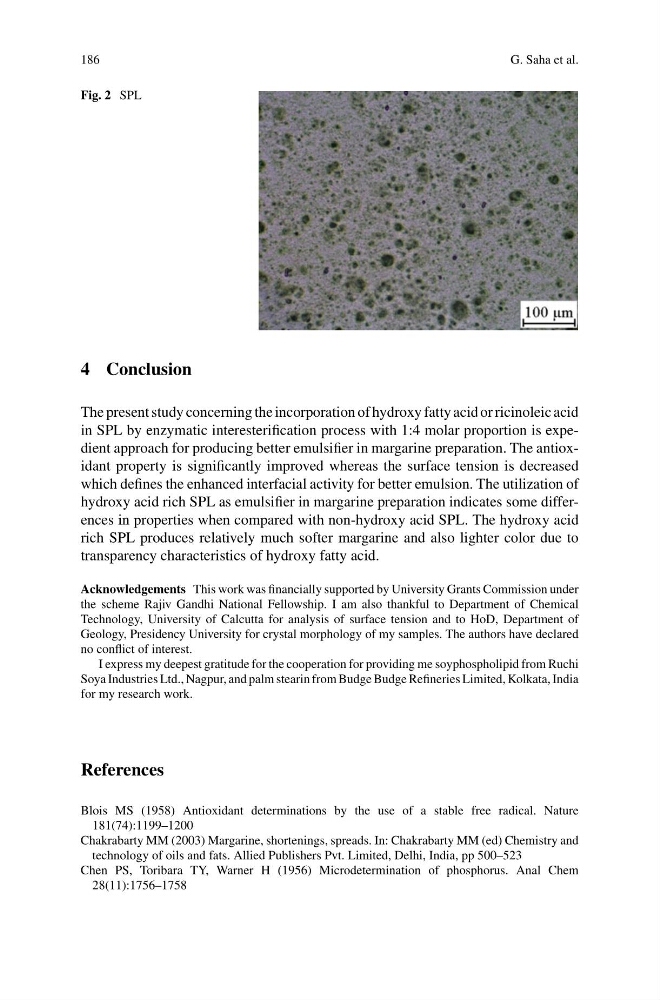
Fig. 2 SPL
4 Conclusion
The present study concerning the incorporation of hydroxy fatty acid or ricinoleic acid
in SPL by enzymatic interesterification process with 1:4 molar proportion is expedient approach for producing better emulsifier in margarine preparation. The antioxidant property is significantly improved whereas the surface tension is decreased
which defines the enhanced interfacial activity for better emulsion. The utilization of
hydroxy acid rich SPL as emulsifier in margarine preparation indicates some differences in properties when compared with non-hydroxy acid SPL. The hydroxy acid
rich SPL produces relatively much softer margarine and also lighter color due to
transparency characteristics of hydroxy fatty acid.
Acknowledgements This work was financially supported by University Grants Commission under
the scheme Rajiv Gandhi National Fellowship. I am also thankful to Department of Chemical
Technology, University of Calcutta for analysis of surface tension and to HoD, Department of
Geology, Presidency University for crystal morphology of my samples. The authors have declared
no conflict of interest.
I express my deepest gratitude for the cooperation for providing me soyphospholipid from Ruchi
Soya Industries Ltd., Nagpur, and palm stearin from Budge Budge Refineries Limited, Kolkata, India
for my research work.
References
Blois MS (1958) Antioxidant determinations by the use of a stable free radical. Nature
181(74):1199–1200
Chakrabarty MM (2003) Margarine, shortenings, spreads. In: Chakrabarty MM (ed) Chemistry and
technology of oils and fats. Allied Publishers Pvt. Limited, Delhi, India, pp 500–523
Chen PS, Toribara TY, Warner H (1956) Microdetermination of phosphorus. Anal Chem
28(11):1756–1758
G. Saha et al.
Fig. 2 SPL
4 Conclusion
The present study concerning the incorporation of hydroxy fatty acid or ricinoleic acid
in SPL by enzymatic interesterification process with 1:4 molar proportion is expedient approach for producing better emulsifier in margarine preparation. The antioxidant property is significantly improved whereas the surface tension is decreased
which defines the enhanced interfacial activity for better emulsion. The utilization of
hydroxy acid rich SPL as emulsifier in margarine preparation indicates some differences in properties when compared with non-hydroxy acid SPL. The hydroxy acid
rich SPL produces relatively much softer margarine and also lighter color due to
transparency characteristics of hydroxy fatty acid.
Acknowledgements This work was financially supported by University Grants Commission under
the scheme Rajiv Gandhi National Fellowship. I am also thankful to Department of Chemical
Technology, University of Calcutta for analysis of surface tension and to HoD, Department of
Geology, Presidency University for crystal morphology of my samples. The authors have declared
no conflict of interest.
I express my deepest gratitude for the cooperation for providing me soyphospholipid from Ruchi
Soya Industries Ltd., Nagpur, and palm stearin from Budge Budge Refineries Limited, Kolkata, India
for my research work.
References
Blois MS (1958) Antioxidant determinations by the use of a stable free radical. Nature
181(74):1199–1200
Chakrabarty MM (2003) Margarine, shortenings, spreads. In: Chakrabarty MM (ed) Chemistry and
technology of oils and fats. Allied Publishers Pvt. Limited, Delhi, India, pp 500–523
Chen PS, Toribara TY, Warner H (1956) Microdetermination of phosphorus. Anal Chem
28(11):1756–1758