

Characterization, Purification and Immobilization …
163
while lyophilized aqueous extract yielded 15,000 ± 350 U/100 g of powder. It was
observed that invertase activity in the plant stem pieces (stored at 0–4 °C) rapidly
decreased to 50 ± 2% of its original activity after 1 week of storage but the aqueous
extract (from fresh stem) stored at 0–4 °C retained 83 ± 2% of its activity till 90 days.
Lyophilized plant stem pieces, powdered and stored at 0–4 °C or at room temperature
was found to be an excellent source of stable enzyme, retaining 90–95% of its activity
till 10 months of the study. Lyophilized (to dryness) aqueous extract stored at 0–4 °C
retained 95 ± 2% of its original activity.
3.2 Purification
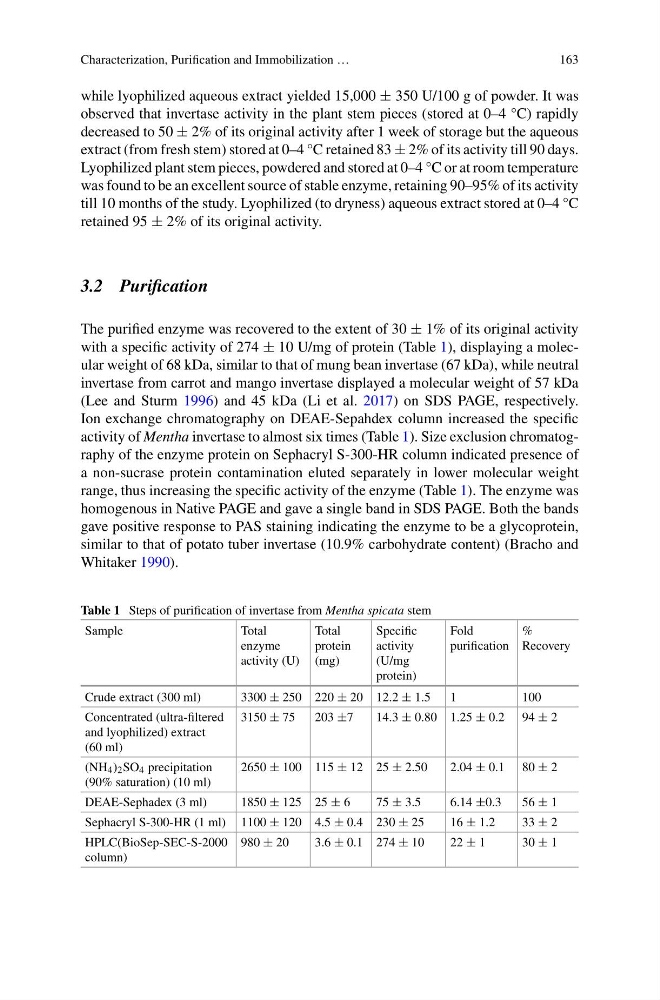
The purified enzyme was recovered to the extent of 30 ± 1% of its original activity
with a specific activity of 274 ± 10 U/mg of protein (Table 1), displaying a molecular weight of 68 kDa, similar to that of mung bean invertase (67 kDa), while neutral
invertase from carrot and mango invertase displayed a molecular weight of 57 kDa
(Lee and Sturm 1996) and 45 kDa (Li et al. 2017) on SDS PAGE, respectively.
Ion exchange chromatography on DEAE-Sepahdex column increased the specific
activity of Mentha invertase to almost six times (Table 1). Size exclusion chromatography of the enzyme protein on Sephacryl S-300-HR column indicated presence of
a non-sucrase protein contamination eluted separately in lower molecular weight
range, thus increasing the specific activity of the enzyme (Table 1). The enzyme was
homogenous in Native PAGE and gave a single band in SDS PAGE. Both the bands
gave positive response to PAS staining indicating the enzyme to be a glycoprotein,
similar to that of potato tuber invertase (10.9% carbohydrate content) (Bracho and
Whitaker 1990).
Table 1 Steps of purification of invertase from Mentha spicata stem
Sample
Total
enzyme
activity (U)
Total
protein
(mg)
Specific
activity
(U/mg
protein)
Fold
purification
%
Recovery
Crude extract (300 ml)
3300 ± 250 220 ± 20 12.2 ± 1.5
1
100
Concentrated (ultra-filtered
and lyophilized) extract
(60 ml)
3150 ± 75
203 ±7
14.3 ± 0.80 1.25 ± 0.2 94 ± 2
(NH 4 ) 2 SO 4 precipitation
(90% saturation) (10 ml)
2650 ± 100 115 ± 12 25 ± 2.50
2.04 ± 0.1 80 ± 2
DEAE-Sephadex (3 ml)
1850 ± 125 25 ± 6
75 ± 3.5
6.14 ±0.3
56 ± 1
Sephacryl S-300-HR (1 ml) 1100 ± 120 4.5 ± 0.4 230 ± 25
16 ± 1.2
33 ± 2
HPLC(BioSep-SEC-S-2000
column)
980 ± 20
3.6 ± 0.1 274 ± 10
22 ± 1
30 ± 1
163
while lyophilized aqueous extract yielded 15,000 ± 350 U/100 g of powder. It was
observed that invertase activity in the plant stem pieces (stored at 0–4 °C) rapidly
decreased to 50 ± 2% of its original activity after 1 week of storage but the aqueous
extract (from fresh stem) stored at 0–4 °C retained 83 ± 2% of its activity till 90 days.
Lyophilized plant stem pieces, powdered and stored at 0–4 °C or at room temperature
was found to be an excellent source of stable enzyme, retaining 90–95% of its activity
till 10 months of the study. Lyophilized (to dryness) aqueous extract stored at 0–4 °C
retained 95 ± 2% of its original activity.
3.2 Purification
The purified enzyme was recovered to the extent of 30 ± 1% of its original activity
with a specific activity of 274 ± 10 U/mg of protein (Table 1), displaying a molecular weight of 68 kDa, similar to that of mung bean invertase (67 kDa), while neutral
invertase from carrot and mango invertase displayed a molecular weight of 57 kDa
(Lee and Sturm 1996) and 45 kDa (Li et al. 2017) on SDS PAGE, respectively.
Ion exchange chromatography on DEAE-Sepahdex column increased the specific
activity of Mentha invertase to almost six times (Table 1). Size exclusion chromatography of the enzyme protein on Sephacryl S-300-HR column indicated presence of
a non-sucrase protein contamination eluted separately in lower molecular weight
range, thus increasing the specific activity of the enzyme (Table 1). The enzyme was
homogenous in Native PAGE and gave a single band in SDS PAGE. Both the bands
gave positive response to PAS staining indicating the enzyme to be a glycoprotein,
similar to that of potato tuber invertase (10.9% carbohydrate content) (Bracho and
Whitaker 1990).
Table 1 Steps of purification of invertase from Mentha spicata stem
Sample
Total
enzyme
activity (U)
Total
protein
(mg)
Specific
activity
(U/mg
protein)
Fold
purification
%
Recovery
Crude extract (300 ml)
3300 ± 250 220 ± 20 12.2 ± 1.5
1
100
Concentrated (ultra-filtered
and lyophilized) extract
(60 ml)
3150 ± 75
203 ±7
14.3 ± 0.80 1.25 ± 0.2 94 ± 2
(NH 4 ) 2 SO 4 precipitation
(90% saturation) (10 ml)
2650 ± 100 115 ± 12 25 ± 2.50
2.04 ± 0.1 80 ± 2
DEAE-Sephadex (3 ml)
1850 ± 125 25 ± 6
75 ± 3.5
6.14 ±0.3
56 ± 1
Sephacryl S-300-HR (1 ml) 1100 ± 120 4.5 ± 0.4 230 ± 25
16 ± 1.2
33 ± 2
HPLC(BioSep-SEC-S-2000
column)
980 ± 20
3.6 ± 0.1 274 ± 10
22 ± 1
30 ± 1