

104
D. Chaudhuri and P. Bhattacharjee
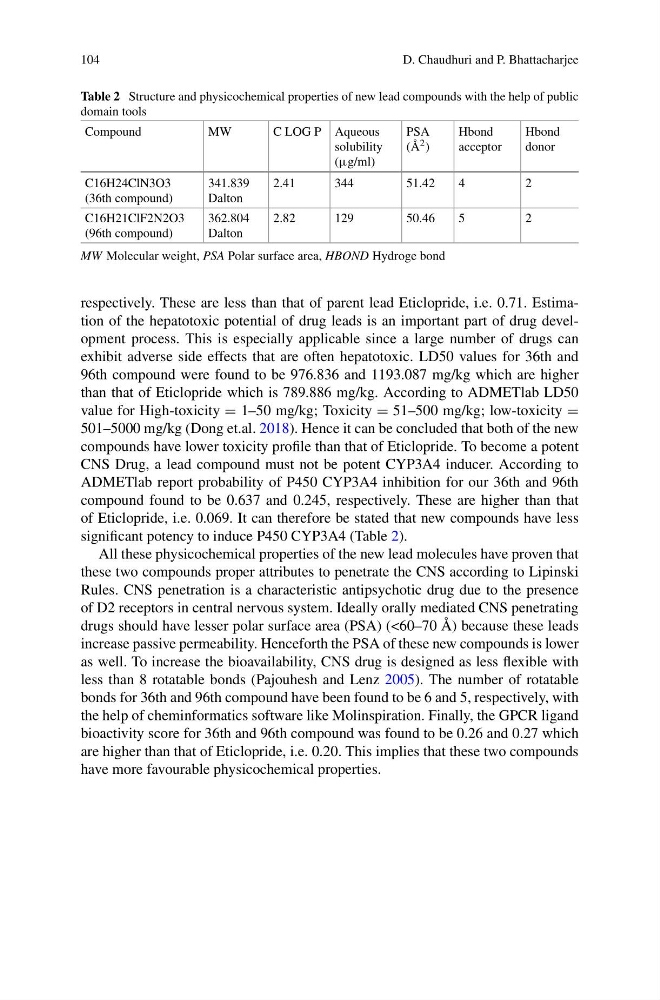
Table 2 Structure and physicochemical properties of new lead compounds with the help of public
domain tools
Compound
MW
C LOG P Aqueous
solubility
(µg/ml)
PSA
(Å 2 )
Hbond
acceptor
Hbond
donor
C16H24ClN3O3
(36th compound)
341.839
Dalton
2.41
344
51.42
4
2
C16H21ClF2N2O3
(96th compound)
362.804
Dalton
2.82
129
50.46
5
2
MW Molecular weight, PSA Polar surface area, HBOND Hydroge bond
respectively. These are less than that of parent lead Eticlopride, i.e. 0.71. Estimation of the hepatotoxic potential of drug leads is an important part of drug development process. This is especially applicable since a large number of drugs can
exhibit adverse side effects that are often hepatotoxic. LD50 values for 36th and
96th compound were found to be 976.836 and 1193.087 mg/kg which are higher
than that of Eticlopride which is 789.886 mg/kg. According to ADMETlab LD50
value for High-toxicity = 1–50 mg/kg; Toxicity = 51–500 mg/kg; low-toxicity =
501–5000 mg/kg (Dong et.al. 2018). Hence it can be concluded that both of the new
compounds have lower toxicity profile than that of Eticlopride. To become a potent
CNS Drug, a lead compound must not be potent CYP3A4 inducer. According to
ADMETlab report probability of P450 CYP3A4 inhibition for our 36th and 96th
compound found to be 0.637 and 0.245, respectively. These are higher than that
of Eticlopride, i.e. 0.069. It can therefore be stated that new compounds have less
significant potency to induce P450 CYP3A4 (Table 2).
All these physicochemical properties of the new lead molecules have proven that
these two compounds proper attributes to penetrate the CNS according to Lipinski
Rules. CNS penetration is a characteristic antipsychotic drug due to the presence
of D2 receptors in central nervous system. Ideally orally mediated CNS penetrating
drugs should have lesser polar surface area (PSA) (<60–70 Å) because these leads
increase passive permeability. Henceforth the PSA of these new compounds is lower
as well. To increase the bioavailability, CNS drug is designed as less flexible with
less than 8 rotatable bonds (Pajouhesh and Lenz 2005). The number of rotatable
bonds for 36th and 96th compound have been found to be 6 and 5, respectively, with
the help of cheminformatics software like Molinspiration. Finally, the GPCR ligand
bioactivity score for 36th and 96th compound was found to be 0.26 and 0.27 which
are higher than that of Eticlopride, i.e. 0.20. This implies that these two compounds
have more favourable physicochemical properties.
D. Chaudhuri and P. Bhattacharjee
Table 2 Structure and physicochemical properties of new lead compounds with the help of public
domain tools
Compound
MW
C LOG P Aqueous
solubility
(µg/ml)
PSA
(Å 2 )
Hbond
acceptor
Hbond
donor
C16H24ClN3O3
(36th compound)
341.839
Dalton
2.41
344
51.42
4
2
C16H21ClF2N2O3
(96th compound)
362.804
Dalton
2.82
129
50.46
5
2
MW Molecular weight, PSA Polar surface area, HBOND Hydroge bond
respectively. These are less than that of parent lead Eticlopride, i.e. 0.71. Estimation of the hepatotoxic potential of drug leads is an important part of drug development process. This is especially applicable since a large number of drugs can
exhibit adverse side effects that are often hepatotoxic. LD50 values for 36th and
96th compound were found to be 976.836 and 1193.087 mg/kg which are higher
than that of Eticlopride which is 789.886 mg/kg. According to ADMETlab LD50
value for High-toxicity = 1–50 mg/kg; Toxicity = 51–500 mg/kg; low-toxicity =
501–5000 mg/kg (Dong et.al. 2018). Hence it can be concluded that both of the new
compounds have lower toxicity profile than that of Eticlopride. To become a potent
CNS Drug, a lead compound must not be potent CYP3A4 inducer. According to
ADMETlab report probability of P450 CYP3A4 inhibition for our 36th and 96th
compound found to be 0.637 and 0.245, respectively. These are higher than that
of Eticlopride, i.e. 0.069. It can therefore be stated that new compounds have less
significant potency to induce P450 CYP3A4 (Table 2).
All these physicochemical properties of the new lead molecules have proven that
these two compounds proper attributes to penetrate the CNS according to Lipinski
Rules. CNS penetration is a characteristic antipsychotic drug due to the presence
of D2 receptors in central nervous system. Ideally orally mediated CNS penetrating
drugs should have lesser polar surface area (PSA) (<60–70 Å) because these leads
increase passive permeability. Henceforth the PSA of these new compounds is lower
as well. To increase the bioavailability, CNS drug is designed as less flexible with
less than 8 rotatable bonds (Pajouhesh and Lenz 2005). The number of rotatable
bonds for 36th and 96th compound have been found to be 6 and 5, respectively, with
the help of cheminformatics software like Molinspiration. Finally, the GPCR ligand
bioactivity score for 36th and 96th compound was found to be 0.26 and 0.27 which
are higher than that of Eticlopride, i.e. 0.20. This implies that these two compounds
have more favourable physicochemical properties.