

Production and Characterization of Functional Lipid …
99
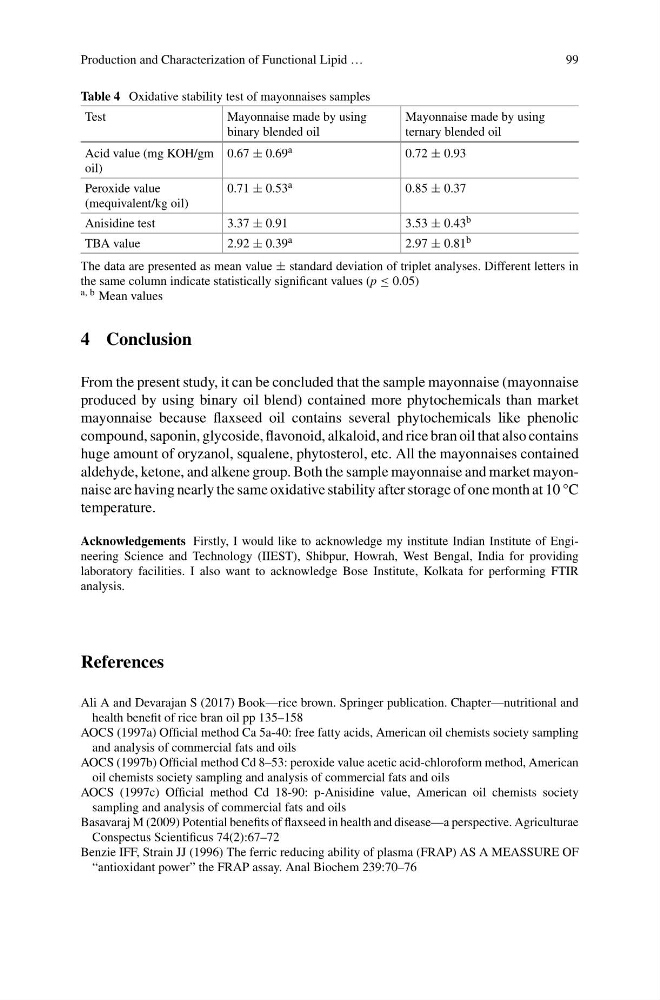
Table 4 Oxidative stability test of mayonnaises samples
Test
Mayonnaise made by using
binary blended oil
Mayonnaise made by using
ternary blended oil
Acid value (mg KOH/gm
oil)
0.67 ± 0.69 a
0.72 ± 0.93
Peroxide value
(mequivalent/kg oil)
0.71 ± 0.53 a
0.85 ± 0.37
Anisidine test
3.37 ± 0.91
3.53 ± 0.43 b
TBA value
2.92 ± 0.39 a
2.97 ± 0.81 b
The data are presented as mean value ± standard deviation of triplet analyses. Different letters in
the same column indicate statistically significant values (p ≤ 0.05)
a, b Mean values
4 Conclusion
From the present study, it can be concluded that the sample mayonnaise (mayonnaise
produced by using binary oil blend) contained more phytochemicals than market
mayonnaise because flaxseed oil contains several phytochemicals like phenolic
compound, saponin, glycoside, flavonoid, alkaloid, and rice bran oil that also contains
huge amount of oryzanol, squalene, phytosterol, etc. All the mayonnaises contained
aldehyde, ketone, and alkene group. Both the sample mayonnaise and market mayonnaise are having nearly the same oxidative stability after storage of one month at 10 °C
temperature.
Acknowledgements Firstly, I would like to acknowledge my institute Indian Institute of Engineering Science and Technology (IIEST), Shibpur, Howrah, West Bengal, India for providing
laboratory facilities. I also want to acknowledge Bose Institute, Kolkata for performing FTIR
analysis.
References
Ali A and Devarajan S (2017) Book—rice brown. Springer publication. Chapter—nutritional and
health benefit of rice bran oil pp 135–158
AOCS (1997a) Official method Ca 5a-40: free fatty acids, American oil chemists society sampling
and analysis of commercial fats and oils
AOCS (1997b) Official method Cd 8–53: peroxide value acetic acid-chloroform method, American
oil chemists society sampling and analysis of commercial fats and oils
AOCS (1997c) Official method Cd 18-90: p-Anisidine value, American oil chemists society
sampling and analysis of commercial fats and oils
Basavaraj M (2009) Potential benefits of flaxseed in health and disease—a perspective. Agriculturae
Conspectus Scientificus 74(2):67–72
Benzie IFF, Strain JJ (1996) The ferric reducing ability of plasma (FRAP) AS A MEASSURE OF
“antioxidant power” the FRAP assay. Anal Biochem 239:70–76
99
Table 4 Oxidative stability test of mayonnaises samples
Test
Mayonnaise made by using
binary blended oil
Mayonnaise made by using
ternary blended oil
Acid value (mg KOH/gm
oil)
0.67 ± 0.69 a
0.72 ± 0.93
Peroxide value
(mequivalent/kg oil)
0.71 ± 0.53 a
0.85 ± 0.37
Anisidine test
3.37 ± 0.91
3.53 ± 0.43 b
TBA value
2.92 ± 0.39 a
2.97 ± 0.81 b
The data are presented as mean value ± standard deviation of triplet analyses. Different letters in
the same column indicate statistically significant values (p ≤ 0.05)
a, b Mean values
4 Conclusion
From the present study, it can be concluded that the sample mayonnaise (mayonnaise
produced by using binary oil blend) contained more phytochemicals than market
mayonnaise because flaxseed oil contains several phytochemicals like phenolic
compound, saponin, glycoside, flavonoid, alkaloid, and rice bran oil that also contains
huge amount of oryzanol, squalene, phytosterol, etc. All the mayonnaises contained
aldehyde, ketone, and alkene group. Both the sample mayonnaise and market mayonnaise are having nearly the same oxidative stability after storage of one month at 10 °C
temperature.
Acknowledgements Firstly, I would like to acknowledge my institute Indian Institute of Engineering Science and Technology (IIEST), Shibpur, Howrah, West Bengal, India for providing
laboratory facilities. I also want to acknowledge Bose Institute, Kolkata for performing FTIR
analysis.
References
Ali A and Devarajan S (2017) Book—rice brown. Springer publication. Chapter—nutritional and
health benefit of rice bran oil pp 135–158
AOCS (1997a) Official method Ca 5a-40: free fatty acids, American oil chemists society sampling
and analysis of commercial fats and oils
AOCS (1997b) Official method Cd 8–53: peroxide value acetic acid-chloroform method, American
oil chemists society sampling and analysis of commercial fats and oils
AOCS (1997c) Official method Cd 18-90: p-Anisidine value, American oil chemists society
sampling and analysis of commercial fats and oils
Basavaraj M (2009) Potential benefits of flaxseed in health and disease—a perspective. Agriculturae
Conspectus Scientificus 74(2):67–72
Benzie IFF, Strain JJ (1996) The ferric reducing ability of plasma (FRAP) AS A MEASSURE OF
“antioxidant power” the FRAP assay. Anal Biochem 239:70–76