

96
S. Ghosh et al.
Table 2 Antioxidant activity of sample mayonnaise prepared and market mayonnaise
Test
Mayonnaise made by using binary blended oil
Market mayonnaise
DPPH (%)
76% ± 0.37
69% ± 0.57
FRAP (µmol/ml)
10 ± 0.56
8 ± 0.43
ABTS (%)
40% ± 0.37
33% ± 0.67
Correlation is significant at the p ≤ 0.05 level
residue and makeup the filtrate to 100 ml with 1-butanol. 50–200 mg sample was
taken in a volumetric flask (25 ml), dissolved in small amount of 1-butanol and
made up to volume with the same solvent. 5 ml sample solution was mixed with
5 ml reagent solution, and the solution was placed into a thermostat bath at 95 °C
temperature. After 120 min the solution was removed from thermostat and cooled
under running water and absorbance was measured at 530 nm.
2.6 Statistical Analysis
Results were expressed as mean value ± standard deviation of three replications.
Statistical differences were analyzed using one way ANOVA followed by post hoc
Tukey HSD (Honestly Significant Difference) at level p ≤ 0.05.
3 Results and Discussion
3.1 Antioxidant Activity
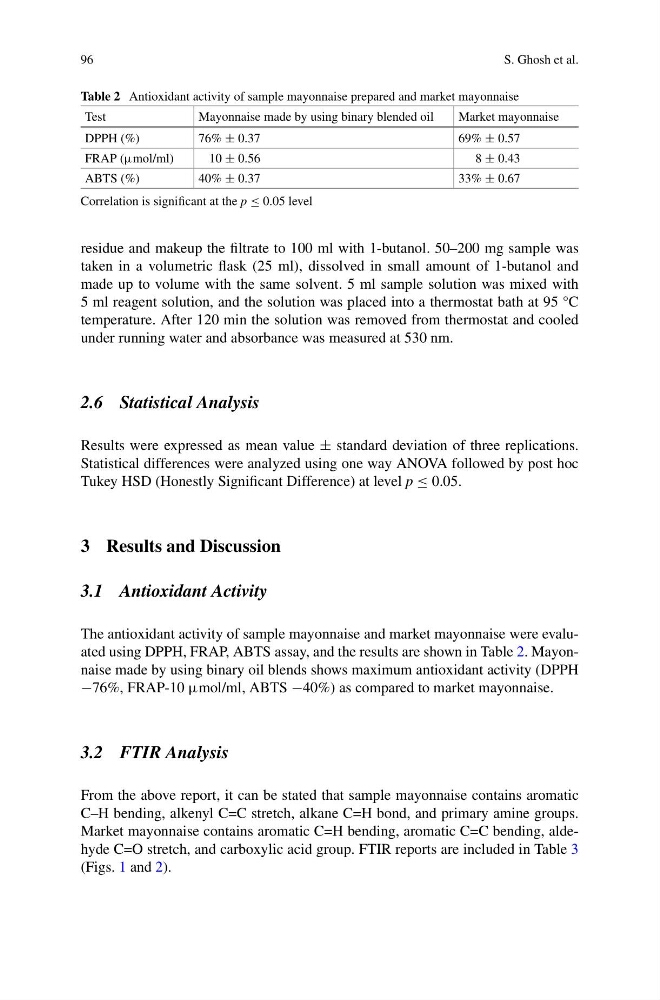
The antioxidant activity of sample mayonnaise and market mayonnaise were evaluated using DPPH, FRAP, ABTS assay, and the results are shown in Table 2. Mayonnaise made by using binary oil blends shows maximum antioxidant activity (DPPH
−76%, FRAP-10 µmol/ml, ABTS −40%) as compared to market mayonnaise.
3.2 FTIR Analysis
From the above report, it can be stated that sample mayonnaise contains aromatic
C–H bending, alkenyl C=C stretch, alkane C=H bond, and primary amine groups.
Market mayonnaise contains aromatic C=H bending, aromatic C=C bending, aldehyde C=O stretch, and carboxylic acid group. FTIR reports are included in Table 3
(Figs. 1 and 2).
S. Ghosh et al.
Table 2 Antioxidant activity of sample mayonnaise prepared and market mayonnaise
Test
Mayonnaise made by using binary blended oil
Market mayonnaise
DPPH (%)
76% ± 0.37
69% ± 0.57
FRAP (µmol/ml)
10 ± 0.56
8 ± 0.43
ABTS (%)
40% ± 0.37
33% ± 0.67
Correlation is significant at the p ≤ 0.05 level
residue and makeup the filtrate to 100 ml with 1-butanol. 50–200 mg sample was
taken in a volumetric flask (25 ml), dissolved in small amount of 1-butanol and
made up to volume with the same solvent. 5 ml sample solution was mixed with
5 ml reagent solution, and the solution was placed into a thermostat bath at 95 °C
temperature. After 120 min the solution was removed from thermostat and cooled
under running water and absorbance was measured at 530 nm.
2.6 Statistical Analysis
Results were expressed as mean value ± standard deviation of three replications.
Statistical differences were analyzed using one way ANOVA followed by post hoc
Tukey HSD (Honestly Significant Difference) at level p ≤ 0.05.
3 Results and Discussion
3.1 Antioxidant Activity
The antioxidant activity of sample mayonnaise and market mayonnaise were evaluated using DPPH, FRAP, ABTS assay, and the results are shown in Table 2. Mayonnaise made by using binary oil blends shows maximum antioxidant activity (DPPH
−76%, FRAP-10 µmol/ml, ABTS −40%) as compared to market mayonnaise.
3.2 FTIR Analysis
From the above report, it can be stated that sample mayonnaise contains aromatic
C–H bending, alkenyl C=C stretch, alkane C=H bond, and primary amine groups.
Market mayonnaise contains aromatic C=H bending, aromatic C=C bending, aldehyde C=O stretch, and carboxylic acid group. FTIR reports are included in Table 3
(Figs. 1 and 2).