

12
are abundant. Especially in the months when the temperature is high, they are dense
at 0–10 m depths (Kumlu 2001).
Parapenaeus longirostris (Lucas, 1846)
Parapenaeus longirostris is a deep-water shrimp species that lives in the depths of
20 m up to 700 m and can live in all areas of the Mediterranean Sea. It also shows a
wide distribution from Portugal to Angola coast in the east of the Atlantic Ocean,
and from USA to France in the west of the Atlantic Ocean. Maximum size is
reported as 16 cm in males and 19 cm in females. It lives in deep waters (Chan
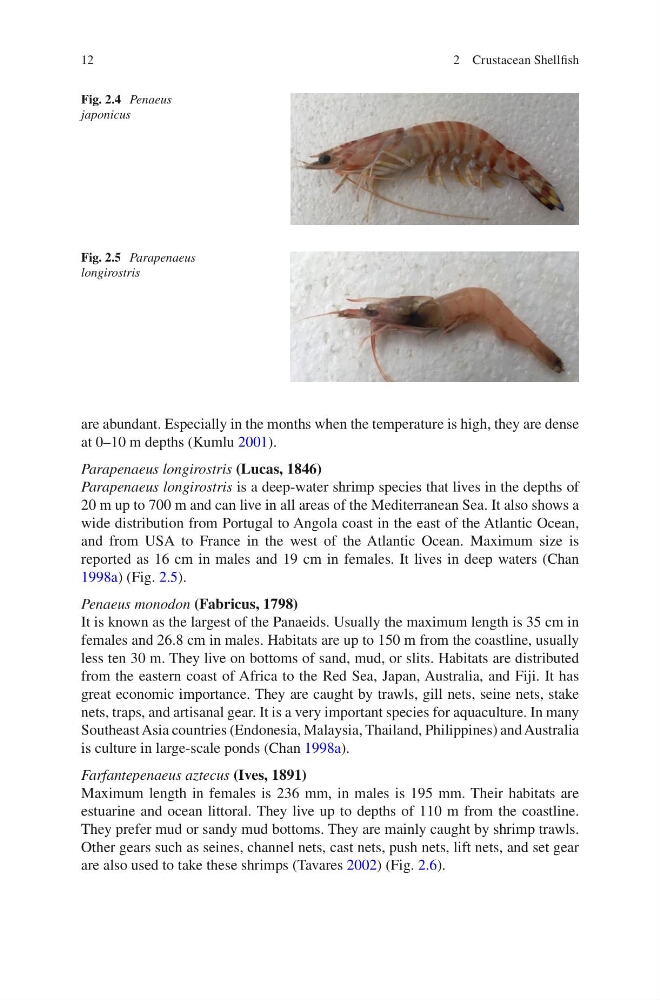
1998a) (Fig. 2.5).
Penaeus monodon (Fabricus, 1798)
It is known as the largest of the Panaeids. Usually the maximum length is 35 cm in
females and 26.8 cm in males. Habitats are up to 150 m from the coastline, usually
less ten 30 m. They live on bottoms of sand, mud, or slits. Habitats are distributed
from the eastern coast of Africa to the Red Sea, Japan, Australia, and Fiji. It has
great economic importance. They are caught by trawls, gill nets, seine nets, stake
nets, traps, and artisanal gear. It is a very important species for aquaculture. In many
Southeast Asia countries (Endonesia, Malaysia, Thailand, Philippines) and Australia
is culture in large-scale ponds (Chan 1998a).
Farfantepenaeus aztecus (Ives, 1891)
Maximum length in females is 236 mm, in males is 195 mm. Their habitats are
estuarine and ocean littoral. They live up to depths of 110 m from the coastline.
They prefer mud or sandy mud bottoms. They are mainly caught by shrimp trawls.
Other gears such as seines, channel nets, cast nets, push nets, lift nets, and set gear
are also used to take these shrimps (Tavares 2002) (Fig. 2.6).
Fig. 2.4 Penaeus
japonicus
Fig. 2.5 Parapenaeus
longirostris
2 Crustacean Shellfish
are abundant. Especially in the months when the temperature is high, they are dense
at 0–10 m depths (Kumlu 2001).
Parapenaeus longirostris (Lucas, 1846)
Parapenaeus longirostris is a deep-water shrimp species that lives in the depths of
20 m up to 700 m and can live in all areas of the Mediterranean Sea. It also shows a
wide distribution from Portugal to Angola coast in the east of the Atlantic Ocean,
and from USA to France in the west of the Atlantic Ocean. Maximum size is
reported as 16 cm in males and 19 cm in females. It lives in deep waters (Chan
1998a) (Fig. 2.5).
Penaeus monodon (Fabricus, 1798)
It is known as the largest of the Panaeids. Usually the maximum length is 35 cm in
females and 26.8 cm in males. Habitats are up to 150 m from the coastline, usually
less ten 30 m. They live on bottoms of sand, mud, or slits. Habitats are distributed
from the eastern coast of Africa to the Red Sea, Japan, Australia, and Fiji. It has
great economic importance. They are caught by trawls, gill nets, seine nets, stake
nets, traps, and artisanal gear. It is a very important species for aquaculture. In many
Southeast Asia countries (Endonesia, Malaysia, Thailand, Philippines) and Australia
is culture in large-scale ponds (Chan 1998a).
Farfantepenaeus aztecus (Ives, 1891)
Maximum length in females is 236 mm, in males is 195 mm. Their habitats are
estuarine and ocean littoral. They live up to depths of 110 m from the coastline.
They prefer mud or sandy mud bottoms. They are mainly caught by shrimp trawls.
Other gears such as seines, channel nets, cast nets, push nets, lift nets, and set gear
are also used to take these shrimps (Tavares 2002) (Fig. 2.6).
Fig. 2.4 Penaeus
japonicus
Fig. 2.5 Parapenaeus
longirostris
2 Crustacean Shellfish