

The Effect of Titanium Carbide and Spark Plasma Sintering …
69
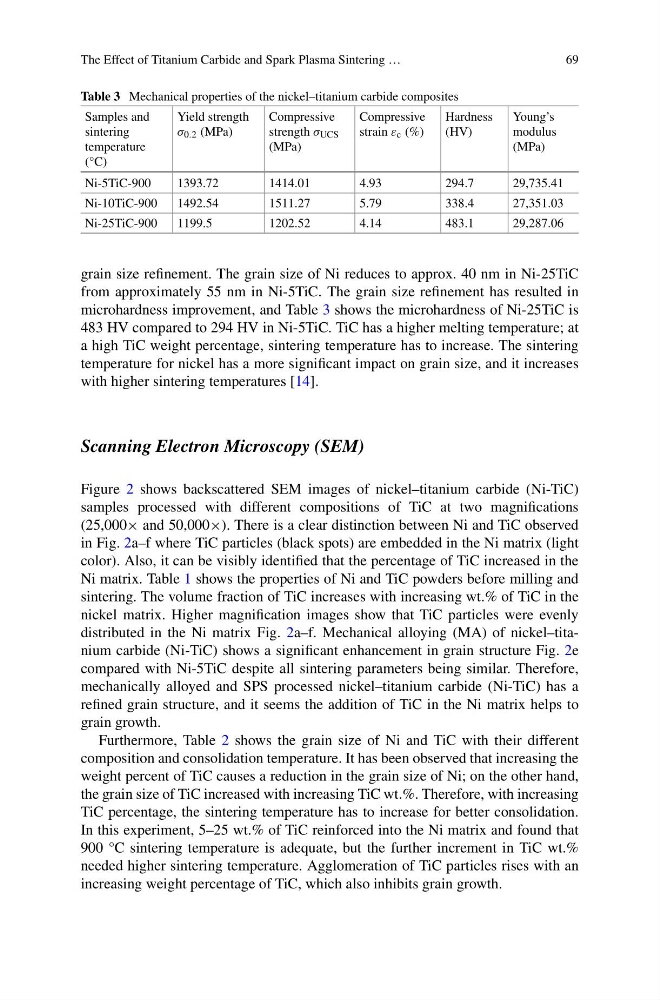
Table 3 Mechanical properties of the nickel–titanium carbide composites
Samples and
sintering
temperature
(°C)
Yield strength
σ 0.2 (MPa)
Compressive
strength σ UCS
(MPa)
Compressive
strain ε c (%)
Hardness
(HV)
Young’s
modulus
(MPa)
Ni-5TiC-900
1393.72
1414.01
4.93
294.7
29,735.41
Ni-10TiC-900
1492.54
1511.27
5.79
338.4
27,351.03
Ni-25TiC-900
1199.5
1202.52
4.14
483.1
29,287.06
grain size refinement. The grain size of Ni reduces to approx. 40 nm in Ni-25TiC
from approximately 55 nm in Ni-5TiC. The grain size refinement has resulted in
microhardness improvement, and Table 3 shows the microhardness of Ni-25TiC is
483 HV compared to 294 HV in Ni-5TiC. TiC has a higher melting temperature; at
a high TiC weight percentage, sintering temperature has to increase. The sintering
temperature for nickel has a more significant impact on grain size, and it increases
with higher sintering temperatures [14].
Scanning Electron Microscopy (SEM)
Figure 2 shows backscattered SEM images of nickel–titanium carbide (Ni-TiC)
samples processed with different compositions of TiC at two magnifications
(25,000× and 50,000×). There is a clear distinction between Ni and TiC observed
in Fig. 2a–f where TiC particles (black spots) are embedded in the Ni matrix (light
color). Also, it can be visibly identified that the percentage of TiC increased in the
Ni matrix. Table 1 shows the properties of Ni and TiC powders before milling and
sintering. The volume fraction of TiC increases with increasing wt.% of TiC in the
nickel matrix. Higher magnification images show that TiC particles were evenly
distributed in the Ni matrix Fig. 2a–f. Mechanical alloying (MA) of nickel–titanium carbide (Ni-TiC) shows a significant enhancement in grain structure Fig. 2e
compared with Ni-5TiC despite all sintering parameters being similar. Therefore,
mechanically alloyed and SPS processed nickel–titanium carbide (Ni-TiC) has a
refined grain structure, and it seems the addition of TiC in the Ni matrix helps to
grain growth.
Furthermore, Table 2 shows the grain size of Ni and TiC with their different
composition and consolidation temperature. It has been observed that increasing the
weight percent of TiC causes a reduction in the grain size of Ni; on the other hand,
the grain size of TiC increased with increasing TiC wt.%. Therefore, with increasing
TiC percentage, the sintering temperature has to increase for better consolidation.
In this experiment, 5–25 wt.% of TiC reinforced into the Ni matrix and found that
900 °C sintering temperature is adequate, but the further increment in TiC wt.%
needed higher sintering temperature. Agglomeration of TiC particles rises with an
increasing weight percentage of TiC, which also inhibits grain growth.
69
Table 3 Mechanical properties of the nickel–titanium carbide composites
Samples and
sintering
temperature
(°C)
Yield strength
σ 0.2 (MPa)
Compressive
strength σ UCS
(MPa)
Compressive
strain ε c (%)
Hardness
(HV)
Young’s
modulus
(MPa)
Ni-5TiC-900
1393.72
1414.01
4.93
294.7
29,735.41
Ni-10TiC-900
1492.54
1511.27
5.79
338.4
27,351.03
Ni-25TiC-900
1199.5
1202.52
4.14
483.1
29,287.06
grain size refinement. The grain size of Ni reduces to approx. 40 nm in Ni-25TiC
from approximately 55 nm in Ni-5TiC. The grain size refinement has resulted in
microhardness improvement, and Table 3 shows the microhardness of Ni-25TiC is
483 HV compared to 294 HV in Ni-5TiC. TiC has a higher melting temperature; at
a high TiC weight percentage, sintering temperature has to increase. The sintering
temperature for nickel has a more significant impact on grain size, and it increases
with higher sintering temperatures [14].
Scanning Electron Microscopy (SEM)
Figure 2 shows backscattered SEM images of nickel–titanium carbide (Ni-TiC)
samples processed with different compositions of TiC at two magnifications
(25,000× and 50,000×). There is a clear distinction between Ni and TiC observed
in Fig. 2a–f where TiC particles (black spots) are embedded in the Ni matrix (light
color). Also, it can be visibly identified that the percentage of TiC increased in the
Ni matrix. Table 1 shows the properties of Ni and TiC powders before milling and
sintering. The volume fraction of TiC increases with increasing wt.% of TiC in the
nickel matrix. Higher magnification images show that TiC particles were evenly
distributed in the Ni matrix Fig. 2a–f. Mechanical alloying (MA) of nickel–titanium carbide (Ni-TiC) shows a significant enhancement in grain structure Fig. 2e
compared with Ni-5TiC despite all sintering parameters being similar. Therefore,
mechanically alloyed and SPS processed nickel–titanium carbide (Ni-TiC) has a
refined grain structure, and it seems the addition of TiC in the Ni matrix helps to
grain growth.
Furthermore, Table 2 shows the grain size of Ni and TiC with their different
composition and consolidation temperature. It has been observed that increasing the
weight percent of TiC causes a reduction in the grain size of Ni; on the other hand,
the grain size of TiC increased with increasing TiC wt.%. Therefore, with increasing
TiC percentage, the sintering temperature has to increase for better consolidation.
In this experiment, 5–25 wt.% of TiC reinforced into the Ni matrix and found that
900 °C sintering temperature is adequate, but the further increment in TiC wt.%
needed higher sintering temperature. Agglomeration of TiC particles rises with an
increasing weight percentage of TiC, which also inhibits grain growth.