

Role of Microstructure on the Potential of MAX and MAB Phases …
27
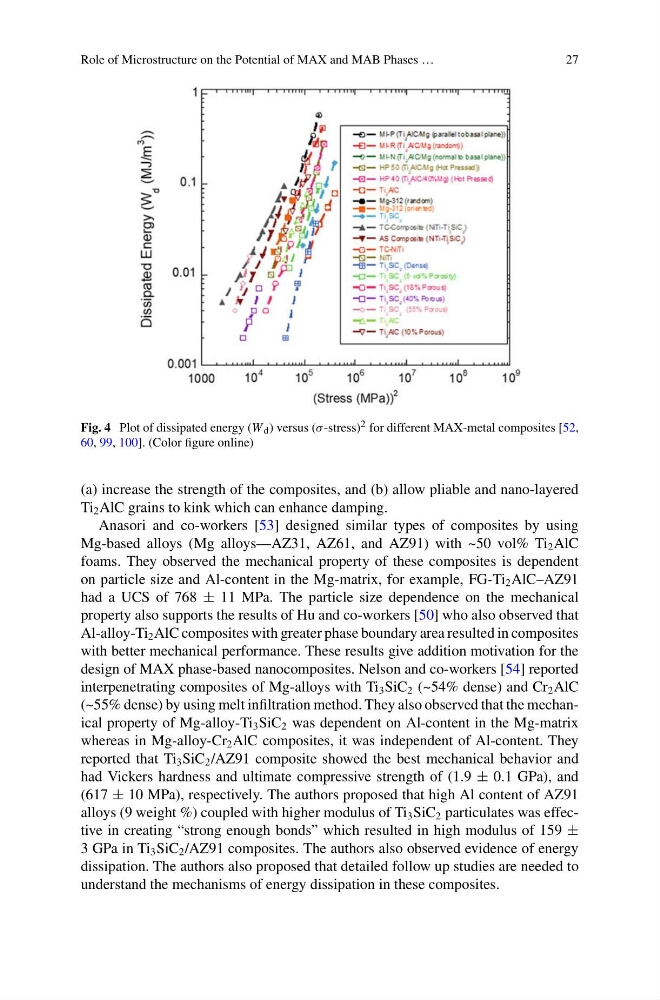
Fig. 4 Plot of dissipated energy (W d ) versus (σ-stress) 2 for different MAX-metal composites [52,
60, 99, 100]. (Color figure online)
(a) increase the strength of the composites, and (b) allow pliable and nano-layered
Ti 2 AlC grains to kink which can enhance damping.
Anasori and co-workers [53] designed similar types of composites by using
Mg-based alloys (Mg alloys—AZ31, AZ61, and AZ91) with ~50 vol% Ti 2 AlC
foams. They observed the mechanical property of these composites is dependent
on particle size and Al-content in the Mg-matrix, for example, FG-Ti 2 AlC–AZ91
had a UCS of 768 ± 11 MPa. The particle size dependence on the mechanical
property also supports the results of Hu and co-workers [50] who also observed that
Al-alloy-Ti 2 AlC composites with greater phase boundary area resulted in composites
with better mechanical performance. These results give addition motivation for the
design of MAX phase-based nanocomposites. Nelson and co-workers [54] reported
interpenetrating composites of Mg-alloys with Ti 3 SiC 2 (~54% dense) and Cr 2 AlC
(~55% dense) by using melt infiltration method. They also observed that the mechanical property of Mg-alloy-Ti 3 SiC 2 was dependent on Al-content in the Mg-matrix
whereas in Mg-alloy-Cr 2 AlC composites, it was independent of Al-content. They
reported that Ti 3 SiC 2 /AZ91 composite showed the best mechanical behavior and
had Vickers hardness and ultimate compressive strength of (1.9 ± 0.1 GPa), and
(617 ± 10 MPa), respectively. The authors proposed that high Al content of AZ91
alloys (9 weight %) coupled with higher modulus of Ti 3 SiC 2 particulates was effective in creating “strong enough bonds” which resulted in high modulus of 159 ±
3 GPa in Ti 3 SiC 2 /AZ91 composites. The authors also observed evidence of energy
dissipation. The authors also proposed that detailed follow up studies are needed to
understand the mechanisms of energy dissipation in these composites.
27
Fig. 4 Plot of dissipated energy (W d ) versus (σ-stress) 2 for different MAX-metal composites [52,
60, 99, 100]. (Color figure online)
(a) increase the strength of the composites, and (b) allow pliable and nano-layered
Ti 2 AlC grains to kink which can enhance damping.
Anasori and co-workers [53] designed similar types of composites by using
Mg-based alloys (Mg alloys—AZ31, AZ61, and AZ91) with ~50 vol% Ti 2 AlC
foams. They observed the mechanical property of these composites is dependent
on particle size and Al-content in the Mg-matrix, for example, FG-Ti 2 AlC–AZ91
had a UCS of 768 ± 11 MPa. The particle size dependence on the mechanical
property also supports the results of Hu and co-workers [50] who also observed that
Al-alloy-Ti 2 AlC composites with greater phase boundary area resulted in composites
with better mechanical performance. These results give addition motivation for the
design of MAX phase-based nanocomposites. Nelson and co-workers [54] reported
interpenetrating composites of Mg-alloys with Ti 3 SiC 2 (~54% dense) and Cr 2 AlC
(~55% dense) by using melt infiltration method. They also observed that the mechanical property of Mg-alloy-Ti 3 SiC 2 was dependent on Al-content in the Mg-matrix
whereas in Mg-alloy-Cr 2 AlC composites, it was independent of Al-content. They
reported that Ti 3 SiC 2 /AZ91 composite showed the best mechanical behavior and
had Vickers hardness and ultimate compressive strength of (1.9 ± 0.1 GPa), and
(617 ± 10 MPa), respectively. The authors proposed that high Al content of AZ91
alloys (9 weight %) coupled with higher modulus of Ti 3 SiC 2 particulates was effective in creating “strong enough bonds” which resulted in high modulus of 159 ±
3 GPa in Ti 3 SiC 2 /AZ91 composites. The authors also observed evidence of energy
dissipation. The authors also proposed that detailed follow up studies are needed to
understand the mechanisms of energy dissipation in these composites.