

Iron Oxide–Gold Composite Nanoparticles and Nano-Gap Junctions …
271
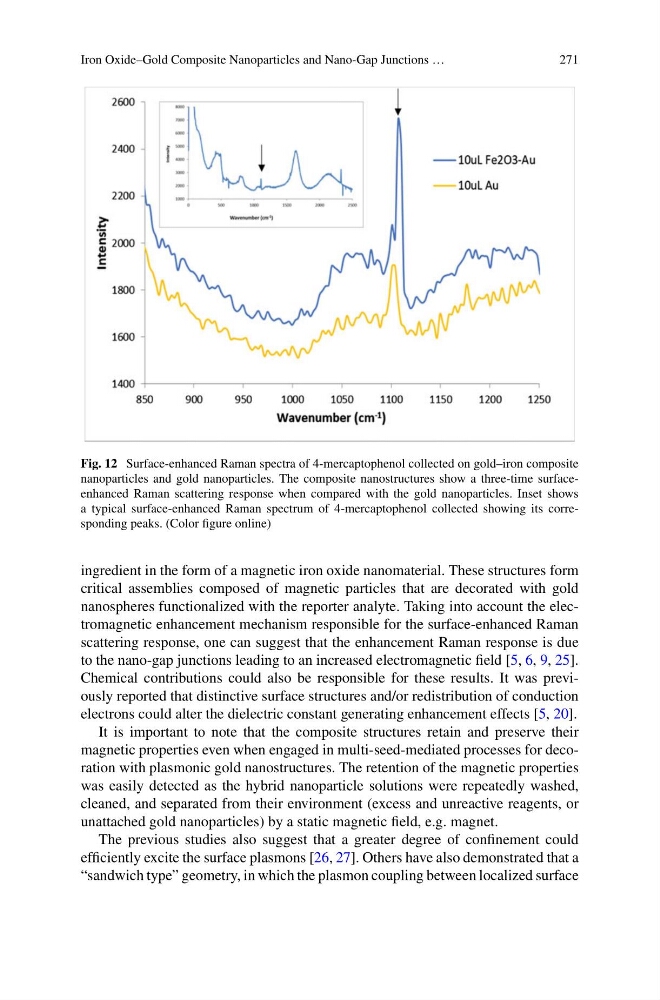
Fig. 12 Surface-enhanced Raman spectra of 4-mercaptophenol collected on gold–iron composite
nanoparticles and gold nanoparticles. The composite nanostructures show a three-time surfaceenhanced Raman scattering response when compared with the gold nanoparticles. Inset shows
a typical surface-enhanced Raman spectrum of 4-mercaptophenol collected showing its corresponding peaks. (Color figure online)
ingredient in the form of a magnetic iron oxide nanomaterial. These structures form
critical assemblies composed of magnetic particles that are decorated with gold
nanospheres functionalized with the reporter analyte. Taking into account the electromagnetic enhancement mechanism responsible for the surface-enhanced Raman
scattering response, one can suggest that the enhancement Raman response is due
to the nano-gap junctions leading to an increased electromagnetic field [5, 6, 9, 25].
Chemical contributions could also be responsible for these results. It was previously reported that distinctive surface structures and/or redistribution of conduction
electrons could alter the dielectric constant generating enhancement effects [5, 20].
It is important to note that the composite structures retain and preserve their
magnetic properties even when engaged in multi-seed-mediated processes for decoration with plasmonic gold nanostructures. The retention of the magnetic properties
was easily detected as the hybrid nanoparticle solutions were repeatedly washed,
cleaned, and separated from their environment (excess and unreactive reagents, or
unattached gold nanoparticles) by a static magnetic field, e.g. magnet.
The previous studies also suggest that a greater degree of confinement could
efficiently excite the surface plasmons [26, 27]. Others have also demonstrated that a
“sandwich type” geometry, in which the plasmon coupling between localized surface
271
Fig. 12 Surface-enhanced Raman spectra of 4-mercaptophenol collected on gold–iron composite
nanoparticles and gold nanoparticles. The composite nanostructures show a three-time surfaceenhanced Raman scattering response when compared with the gold nanoparticles. Inset shows
a typical surface-enhanced Raman spectrum of 4-mercaptophenol collected showing its corresponding peaks. (Color figure online)
ingredient in the form of a magnetic iron oxide nanomaterial. These structures form
critical assemblies composed of magnetic particles that are decorated with gold
nanospheres functionalized with the reporter analyte. Taking into account the electromagnetic enhancement mechanism responsible for the surface-enhanced Raman
scattering response, one can suggest that the enhancement Raman response is due
to the nano-gap junctions leading to an increased electromagnetic field [5, 6, 9, 25].
Chemical contributions could also be responsible for these results. It was previously reported that distinctive surface structures and/or redistribution of conduction
electrons could alter the dielectric constant generating enhancement effects [5, 20].
It is important to note that the composite structures retain and preserve their
magnetic properties even when engaged in multi-seed-mediated processes for decoration with plasmonic gold nanostructures. The retention of the magnetic properties
was easily detected as the hybrid nanoparticle solutions were repeatedly washed,
cleaned, and separated from their environment (excess and unreactive reagents, or
unattached gold nanoparticles) by a static magnetic field, e.g. magnet.
The previous studies also suggest that a greater degree of confinement could
efficiently excite the surface plasmons [26, 27]. Others have also demonstrated that a
“sandwich type” geometry, in which the plasmon coupling between localized surface